Chapter 8 : The county's nuisance investigation closed in December, and I have the letter in a file in my kitchen in a manila folder next to Adaeze's tax records. It says, in two paragraphs of dense legal prose, that the code enforcement division fou
Story: She Shamed Me for a Junkyard Yard — My Doorbell Cam Caught Who Really Dumped It
What the county found at Brenda Whitfield's own house, I know only secondhand, because Norma Whitaker does not tell me everything and because I did not go to look.
What I know is that on the twenty-first of November, an inspector cited a residential lot at 1217 Willow Bend Court for an unpermitted accessory structure, and that the structure was a detached garage that had been built eight years earlier without the required setback variance. I know that the citation was issued because the county, in the course of reviewing the file, pulled every recorded plat on the loop and found that Brenda's garage sits four feet into the utility easement, which had been noted by the surveyor in 2016 in a document that the county still has a copy of.
I know that when the county asked the HOA for its records for the last three years, the board provided them, and that among those records was a board minute from 2020 in which the board voted to grant an exception for "the president's garage."
I know that the board, when it met in November, voted five to one to accept Brenda's resignation as president.
And I know that on the second Tuesday in December, at the next regular board meeting, the room was quieter than usual, and the cookie tray was full at the end of the night, and there was a folding chair pulled out for anybody who wanted it, and nobody in that room looked at me like I was anything other than a person who lived on the street.
That was what we all got.
Not a lawsuit. Not a headline. Not an apology — Brenda has never apologized, and I stopped expecting one in November. What we got was the chance to start over in a room where the ledger was accurate and the minutes were read out loud and nobody on the board got to be the neighborhood by themselves.
I took the truck off the tarp in March.
By then, the grass had grown back over the dead patch under the junk pile. I'd overseeded it in the fall and it came in thin and patchy at first and by March it had filled in and I couldn't find the spot anymore unless I knelt down and looked for the exact shape of the shadow, which I never did, because there's no reason to look for the place something used to be if the grass has already covered it.
I pulled the tarp off on a Saturday morning and folded it up and put it in the attic. Then I unhooked the battery tender and sat in the cab and turned the key, and the old Ford started on the second crank the way it always had. Adaeze had rebuilt that engine to be patient. She used to say the truck started like a good neighbor: slow on purpose, because it was thinking about you.
I let it idle for a while and then backed it out of the side yard and drove it around the loop, past Brenda's house, past the Halloran house that was still empty, and down to the cul-de-sac at the end where the retention pond opens up and the herons sit on the deadfall in the morning, and I parked it there and sat with the engine off for a while.
That's where I was when Norma Whitaker called me, at 9:40 in the morning, to tell me that the county had reassessed the Halloran property and that the developer from the county seat had walked away from the purchase in January, and that a family with two kids and a labrador had put an offer in on it, and that she'd watched the mother walk the lot with a coffee cup and a smile.
"Frank," she said. "You still out driving?"
"Yes," I said.
"You going to come back for the meeting tonight?"
"I might."
"Bring the truck. I want to see it."
"I'll bring the truck."
I sat at the cul-de-sac for a while and watched a heron work the shallow water at the pond's edge. My wife had picked this street in 2004 because of that pond. She'd stood on the empty lot with the sales agent and said, "Frank, look at the birds. Nobody's going to sell a lot with birds on it to a builder." Twenty years later, she was almost right.
On the drive back I passed the Halloran house and saw a child's bike leaning against the fence, and I passed Brenda's house and saw a moving truck's worth of boxes stacked on the front porch, and I did not slow down at either.
I parked the truck in the side yard where it belonged, under the oak, in the dappled morning shade, and I went inside and put on the flannel shirt I'd worn on the day of the October meeting and I sat down at the kitchen table and had a cup of tea, and then I did the only thing I can honestly call a plan: I got out the yellow legal pad, turned to a fresh page, and wrote, at the top, in pen:
Board meeting — second Tuesday.
And below that:
Ask about the minutes. Read the ledger aloud. Bring the truck.
Then I got in the truck and drove to the clubhouse.
The lot was half full when I pulled in. I parked the Ford in the back corner, under the security light, where I could see it from the door. The paint is still river-at-dusk green. The plate is still the original 1965 plate, because in this state you can keep the vintage plate, and Adaeze had gone down to the DMV five separate times to make sure of it.
Kevin Boudreaux held the door open for me.
Norma Whitaker was in the second row, aisle seat, cane across her knees.
Marcus Pell stood at the back, arms folded, phone in his pocket.
Ruth Alvarez was at the board table, with the ledger.
And the room, this time, had twenty-four folding chairs set out, and a cookie tray at the end of the table, and a whiteboard that said, in simple marker letters, AGENDA — and under it, in the vice president's handwriting, Item 4: Review of the 2024 violation records, Okafor property. Correction of minutes.
I sat down.
Somebody had saved a chair for me in the front row, and I took it. I set my jacket on the back of the chair. I put my phone face-up on the table in front of me, the way I always do now — because a phone is a thing that tells the truth or hides it, and I've decided which one mine is for.
Keith called the meeting to order at 7:04 p.m.
I sat in the front row with Adaeze's wedding band on my thumb and I looked around at the neighbors in the folding chairs, and I waited to hear what the room had to say.
Advertisement
All 8 chapters
- 1Brenda Whitfield's palm came down flat on the printed photograph, and the sound cracked through the clubhouse like a gavel. The photo was eight by ten, glossy, and brutal: my front lawn at seven in the morning, two weeks ago. Cut branches
- 2"Frank," he said. "Hey. Frank."
- 3The next morning, at 7:40, I took the SD card out of the camera, put the files on a thumb drive, put the thumb drive in a Ziploc bag, and put the Ziploc bag in the pocket of my jacket next to my wallet. I considered what else I might need
- 4She was in her late thirties, thin, quick, in a gray suit that made her look like she'd been in court all morning, which she had. She listened to me for eleven minutes without interrupting, and when I finished she said, "Give me the thumb
- 5"I heard what you told Brenda at the end of the meeting." Ruth is fifty-two and works as a legal assistant at a firm downtown and has been treasurer of the HOA for four years, and she is not a bad person, which is the whole problem with t
- 6The room had changed since the last meeting. That was the first thing I noticed. Same clubhouse, same U-shaped tables, same cookie tray, same harsh light. But the folding chairs were fuller — twenty-three, by my count, more than the last
- 7I met Alice Pham at the code enforcement office at 8:30 with the thumb drive and a printed copy of Ruth's scanned ledger pages and a two-page typed statement I had written the night before in the kitchen, and a code officer named Reggie P
- 8The county's nuisance investigation closed in December, and I have the letter in a file in my kitchen in a manila folder next to Adaeze's tax records. It says, in two paragraphs of dense legal prose, that the code enforcement division fou
You may also like

My Uncle Slapped Me at the Country Club and Called Me a Thief — But I Was Already Holding the Chit He Signed
My uncle's palm cracked across my cheek at the country-club lunch table and he shouted that I had stolen a member number that never…
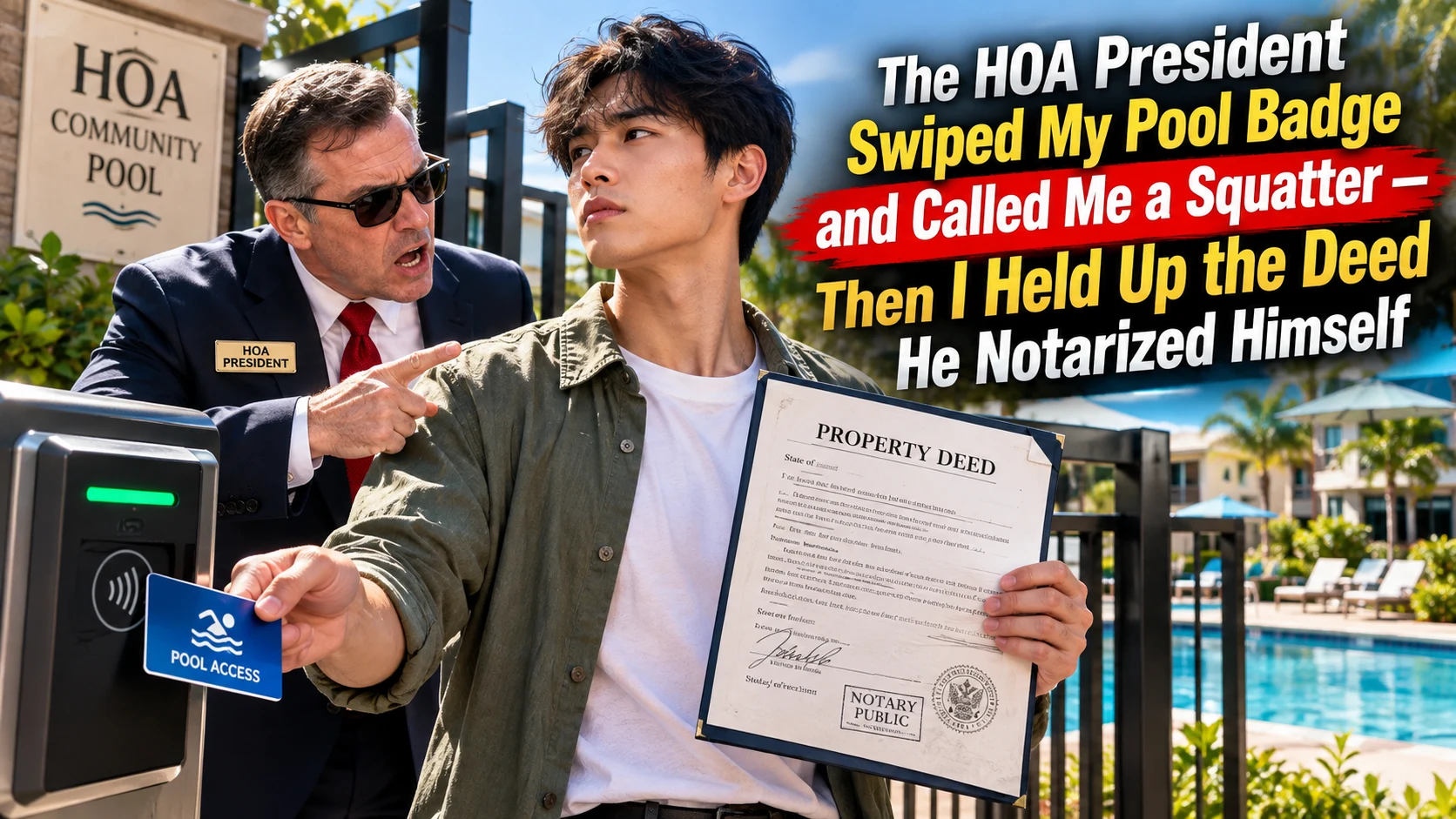
The HOA President Swiped My Pool Badge and Called Me a Squatter — Then I Held Up the Deed He Notarized Himself
Dale Brandt ripped my pool badge out of my hand in front of forty neighbors and told me squatters don't get to swim. My…
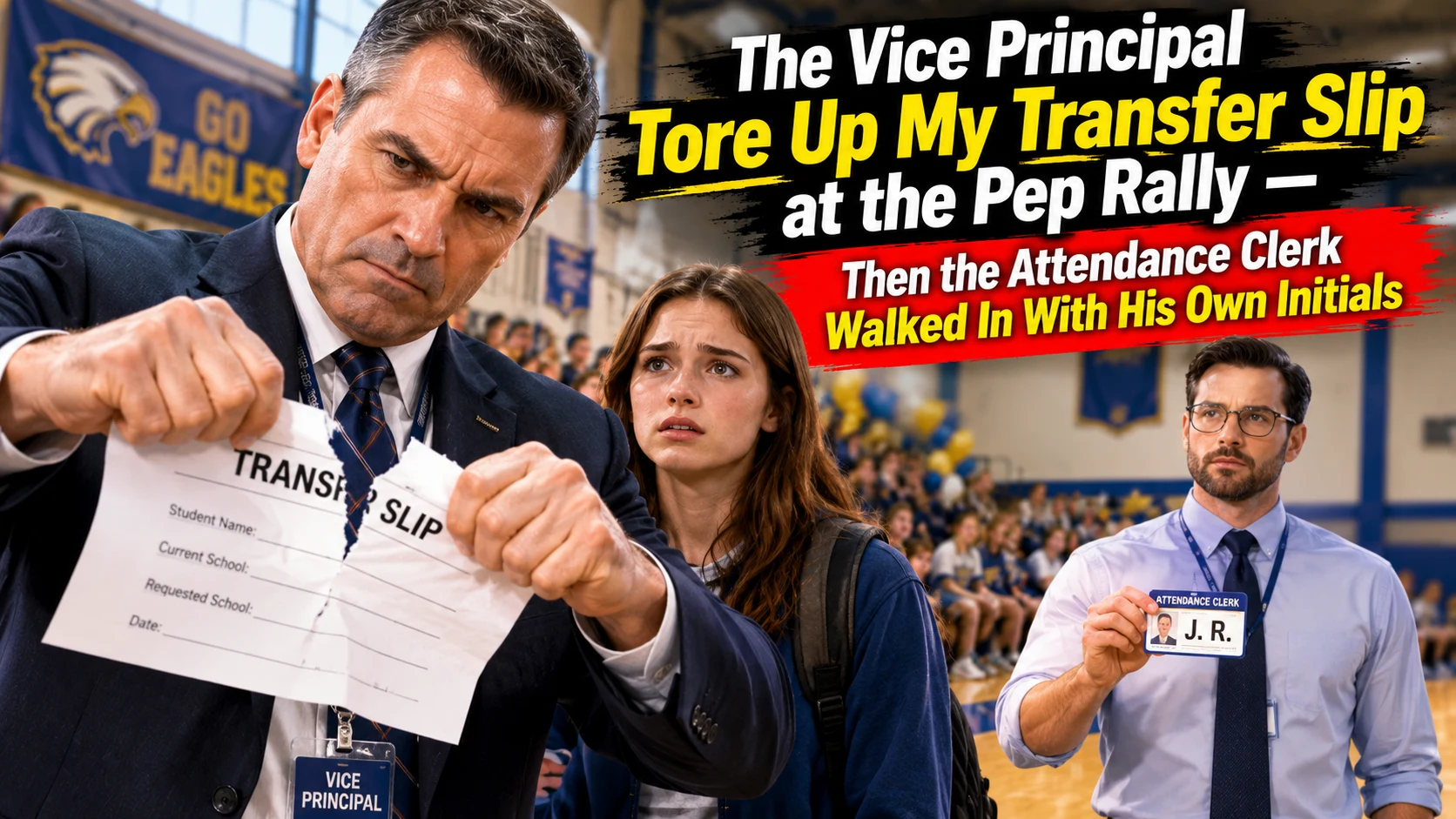
The Vice Principal Tore Up My Transfer Slip at the Pep Rally — Then the Attendance Clerk Walked In With His Own Initials
Coleman Pruitt tore my transfer slip in half at the pep rally, held the pieces above my head, and told eleven hundred people I…
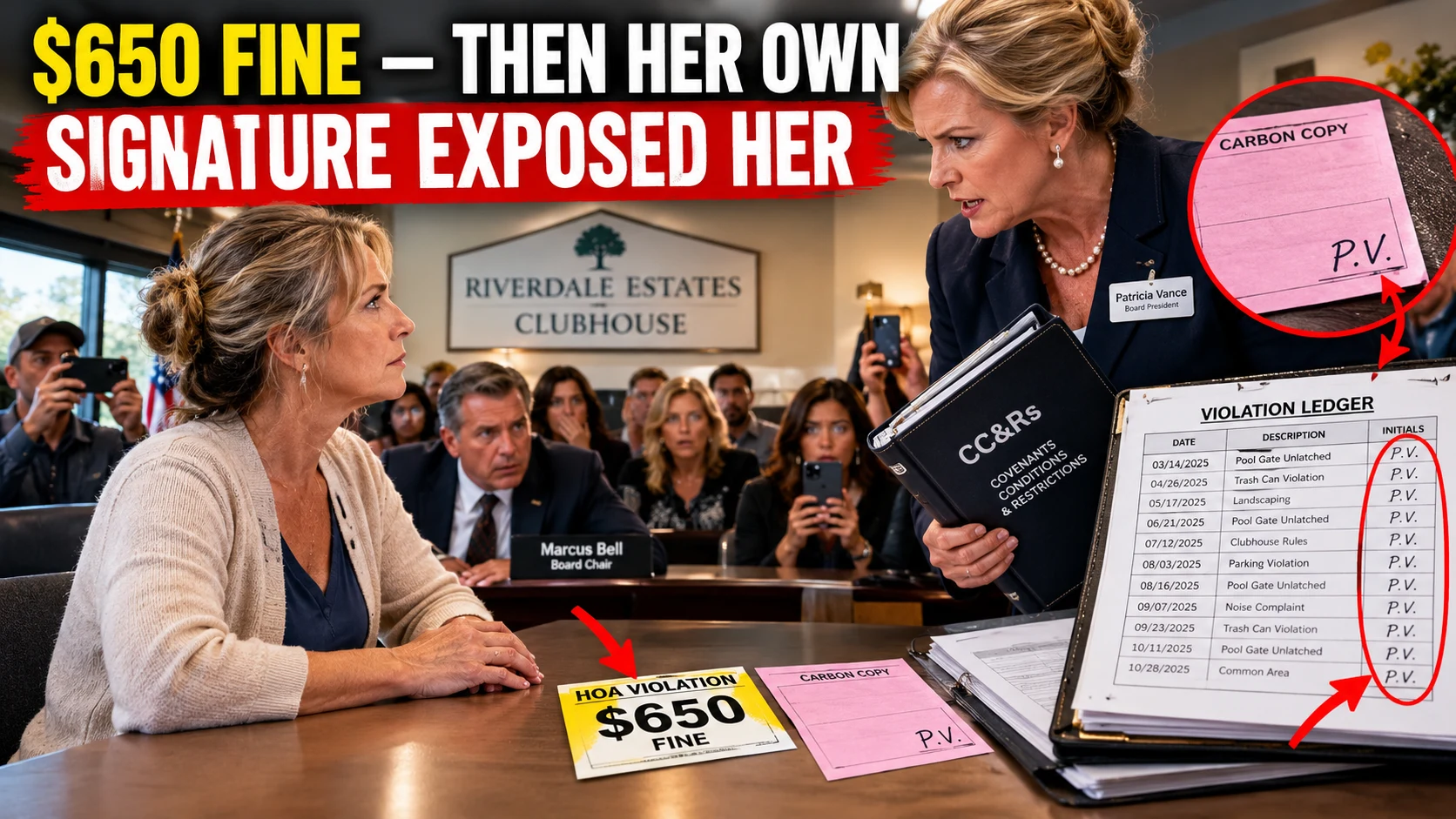
The HOA President Fined Me $650 for a Pool Gate I Never Touched — Then I Held Up the Pink Carbon Copy With Her Own Initials on It
"You left the pool gate unlatched again," Patricia Vance said, sliding the $650 violation sticker across the folding table, "and this time the board…
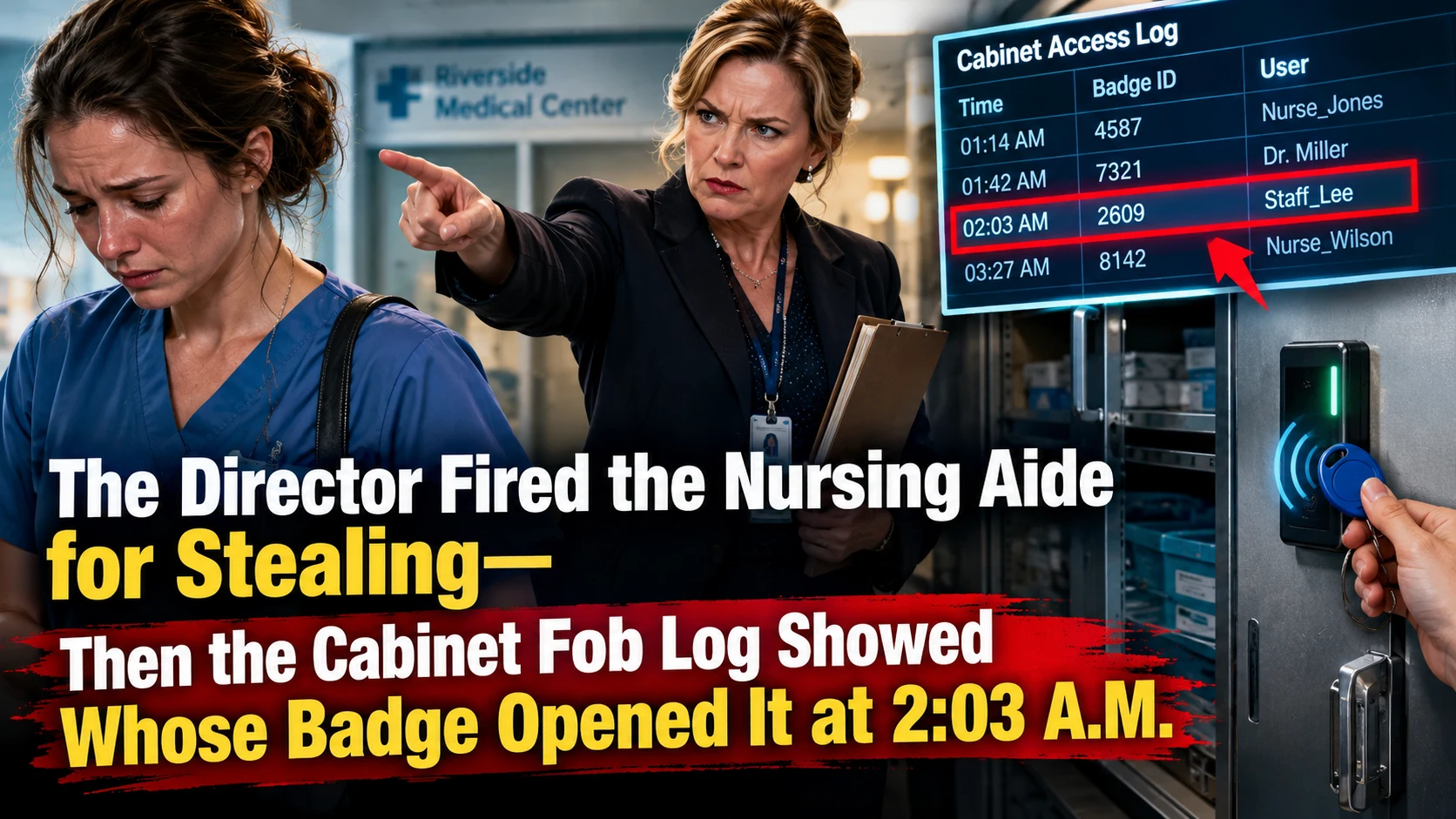
The Director Fired the Nursing Aide for Stealing—Then the Cabinet Fob Log Showed Whose Badge Opened It at 2:03 A.M.
The director's palm cracked down on the medication-room counter while the pill tray was still in my hands. "You took from the cart at…
The HOA President Fined Me $650 for a Pool Gate — Then the Log Showed Her Own Fob at 2 A.M.
The violation sticker landed on the folding table in front of me dated April 12 — the night I was three states away at…