Chapter 1 : Brenda Whitfield's palm came down flat on the printed photograph, and the sound cracked through the clubhouse like a gavel. The photo was eight by ten, glossy, and brutal: my front lawn at seven in the morning, two weeks ago. Cut branches
Story: She Shamed Me for a Junkyard Yard — My Doorbell Cam Caught Who Really Dumped It
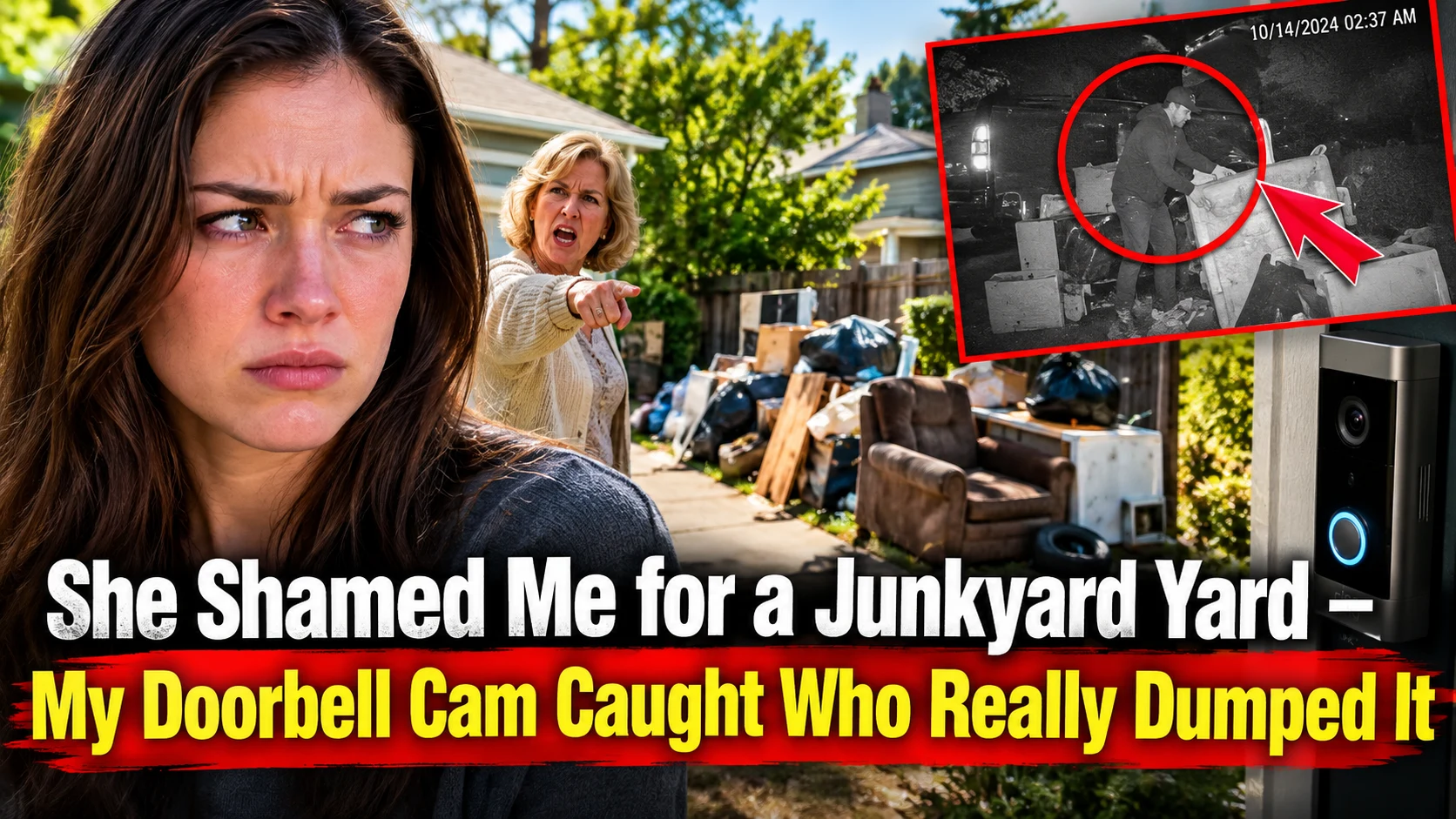
"Your junkyard is why my property value dropped, Frank!" Brenda slammed the violation photo down on the table, and the whole clubhouse leaned in to watch me lose. Fifteen neighbors in folding chairs. Two board members at her sides. And me — the quiet widower…
Fifteen neighbors in folding chairs leaned forward as one body. Two board members sat at Brenda's left and right, hands folded like altar boys. The whiteboard behind her read AGENDA in blue marker, and under it, in her handwriting, Item 4: Nuisance property — Okafor.
I didn't move.
Brenda was sixty-one, tall, wide through the shoulders, wearing a cream blazer in a room where everyone else wore fleece and sneakers. Her hair was frosted blonde and held so stiff it didn't shift when she turned her head. She'd been HOA president for nine years. She ran the meetings like a woman who had never once been interrupted in her life.
"Three written warnings," she said, lifting the photo so the whole room could see it. "Two abatement notices. One certified letter. And Frank here —" she gestured at me with the photo, like I was a stain on it — "has done exactly nothing. Not one thing. For two weeks."
Somebody in the back row made a small sound. Agreement, or the beginning of a laugh. I heard a chair creak. I heard a phone camera click, once, discreet, like a fork on a plate.
My lawn. Mine.
The dead branches had appeared on a Tuesday. I'd come out at seven for the paper and stopped at the bottom of the steps with my hand still on the rail, looking at a pile of cut limbs and a fender and something that might once have been a washer drum, dropped across the grass like a dog had dragged the whole neighborhood into my yard.
I'd picked up the phone that morning to call the city. Then I'd put it down. My wife, Adaeze, had spent thirty-one years teaching me not to make a scene. Two months after her funeral, I was still learning how to live inside that lesson.
So I'd stood in my own yard, in the cold, looking at wood that didn't belong to me.
"We've been patient," Brenda said. "Everyone here has been patient. But patience has a cost. I've had two families looking at the Halloran house ask me, in person, why the neighborhood looks like a salvage yard. Two families. So we're done being patient."
She turned the photo toward me and held it like a summons.
"The fine is two hundred dollars a day, starting tonight. And if that truck isn't moved off your property by Friday at six p.m., I'm calling A-1 Towing and having it hauled out of there myself."
The room made a noise. Not loud. Just a low, collective understanding, the sound of a crowd agreeing on what a person is.
My truck was a 1965 Ford F-100. Adaeze had bought it at a garage sale in 1998 as a shell with no engine, and it had taken her eleven years of Saturdays to restore it. She'd rebuilt the carburetor on our kitchen table. She'd picked the paint herself — a deep green she called "river at dusk" — and she'd painted the tailgate in the driveway with a mask on, in the summer of 2010, sweating through her T-shirt while I held the shop light.
When she died in March, the truck was the last thing she'd touched. I'd washed it by hand twice since then. I'd started it every Sunday, let it run for ten minutes in the driveway, and shut it off. That was the whole of my religion now.
"If you don't clear it by Friday," Brenda said again, softer this time, as if softening made it kind, "I'm towing that truck."
I looked at her.
I said nothing.
That was the part that made them lean in. That was the part the room fed on — the quiet man with the messy yard, sitting there like a man caught, hands flat on the folding table, no defense, no argument, no lawyer's phone call, nothing.
Carol Hoyt, the board secretary, kept her eyes on her minutes. Ruth Alvarez, the treasurer, had a red pen capped over the fine ledger, waiting. Keith Boudreaux, the vice president, sat with his arms crossed and nodded along like a man watching a movie he'd already seen.
"Board vote," Brenda said. "All in favor of the fine and the abatement order, raise your hand."
Three hands went up. Hers, Keith's, and a hesitant, terrible fourth from Ruth, whose hand shook slightly and then was still.
The silence that followed was the loudest thing in the room.
I sat inside it. I remembered Adaeze, in the kitchen, in January, when she could still stand at the stove — how she'd said, out of nowhere, "Frank, if anything ever happens, you don't have to be polite to people who lie about you. You just have to be ready."
I hadn't asked her what she meant by ready. I'd been busy putting her tea down.
Her tea.
The board moved on to Item 5: pool gate key fobs. I sat through it. Somebody's sprinkler complaint. The fall festival budget. The guy behind me — I knew the crease of his jacket, it was Marcus Pell, two streets over — tapped his phone against his knee the whole time, screen dark.
At 7:48, Brenda closed the meeting the way she always did: "Thank you all for coming. Let's keep this neighborhood something we're proud of." She said it looking directly at me.
People stood. Chairs scraped. The cookie tray emptied.
Norma Whitaker — seventy-eight, walked with a cane, one of the two people on the street who still called me every week — stopped at the end of my table and put her hand on my forearm. She didn't say anything. She just squeezed, once, and walked out.
Then the room was mostly empty, and I was still sitting, hands flat, and Brenda was stacking her ledger and her binder, and I heard myself say, out loud, for the first time in two months, a sentence I hadn't planned.
"There's something on my porch camera."
Brenda's hands stopped.
She didn't look up right away. That was the thing. She finished stacking the binder, squared it against the table, picked up her red pen, capped it, and put it in the pocket of her blazer. Only then did she lift her eyes to me, and I saw it — half a second of something that wasn't confident, that wasn't the president of anything.
"Your porch camera," she repeated. Flat.
"Adaeze made me put it in," I said. "After the package thefts. Two years ago." I stood up. I was taller than her when I stood. "I forgot about it until tonight."
I didn't have the clip yet. I want that to be clear, because a lot of people have told the story since, and they always tell it like I came in with the phone loaded and ready, like I was waiting for her. I wasn't. The truth is simpler and stranger.
I remembered the porch light.
Two weeks ago, on the Tuesday, I'd woken up at 2:03 in the morning because the porch light — the one on a motion sensor that Adaeze had wired herself — snapped on and threw a long yellow stripe across the bedroom ceiling. I'd lain there for a while listening. I'd heard a truck engine, low, and then the hydraulic whine and the thud of something heavy hitting the grass, and then the light went off.
I'd gone back to sleep. I was grieving. I was tired. I'd assumed I dreamed it.
I hadn't thought about the camera until the photo was on the table in front of me.
Brenda looked at me for a long time, and then she said, in a voice that was almost gentle, "Frank, if you're about to threaten me, you should think about how this room has already voted."
"I'm not threatening you," I said. "I'm telling you the camera has the clip."
I didn't say anything else. I picked up my jacket and I walked out of the clubhouse into the mild October dark.
Behind me, I heard her heels on the linoleum, all the way to the door, and then stopping — the sound of a woman deciding not to follow.
Advertisement
All 8 chapters
- 1Brenda Whitfield's palm came down flat on the printed photograph, and the sound cracked through the clubhouse like a gavel. The photo was eight by ten, glossy, and brutal: my front lawn at seven in the morning, two weeks ago. Cut branches
- 2"Frank," he said. "Hey. Frank."
- 3The next morning, at 7:40, I took the SD card out of the camera, put the files on a thumb drive, put the thumb drive in a Ziploc bag, and put the Ziploc bag in the pocket of my jacket next to my wallet. I considered what else I might need
- 4She was in her late thirties, thin, quick, in a gray suit that made her look like she'd been in court all morning, which she had. She listened to me for eleven minutes without interrupting, and when I finished she said, "Give me the thumb
- 5"I heard what you told Brenda at the end of the meeting." Ruth is fifty-two and works as a legal assistant at a firm downtown and has been treasurer of the HOA for four years, and she is not a bad person, which is the whole problem with t
- 6The room had changed since the last meeting. That was the first thing I noticed. Same clubhouse, same U-shaped tables, same cookie tray, same harsh light. But the folding chairs were fuller — twenty-three, by my count, more than the last
- 7I met Alice Pham at the code enforcement office at 8:30 with the thumb drive and a printed copy of Ruth's scanned ledger pages and a two-page typed statement I had written the night before in the kitchen, and a code officer named Reggie P
- 8The county's nuisance investigation closed in December, and I have the letter in a file in my kitchen in a manila folder next to Adaeze's tax records. It says, in two paragraphs of dense legal prose, that the code enforcement division fou
You may also like

My Uncle Slapped Me at the Country Club and Called Me a Thief — But I Was Already Holding the Chit He Signed
My uncle's palm cracked across my cheek at the country-club lunch table and he shouted that I had stolen a member number that never…
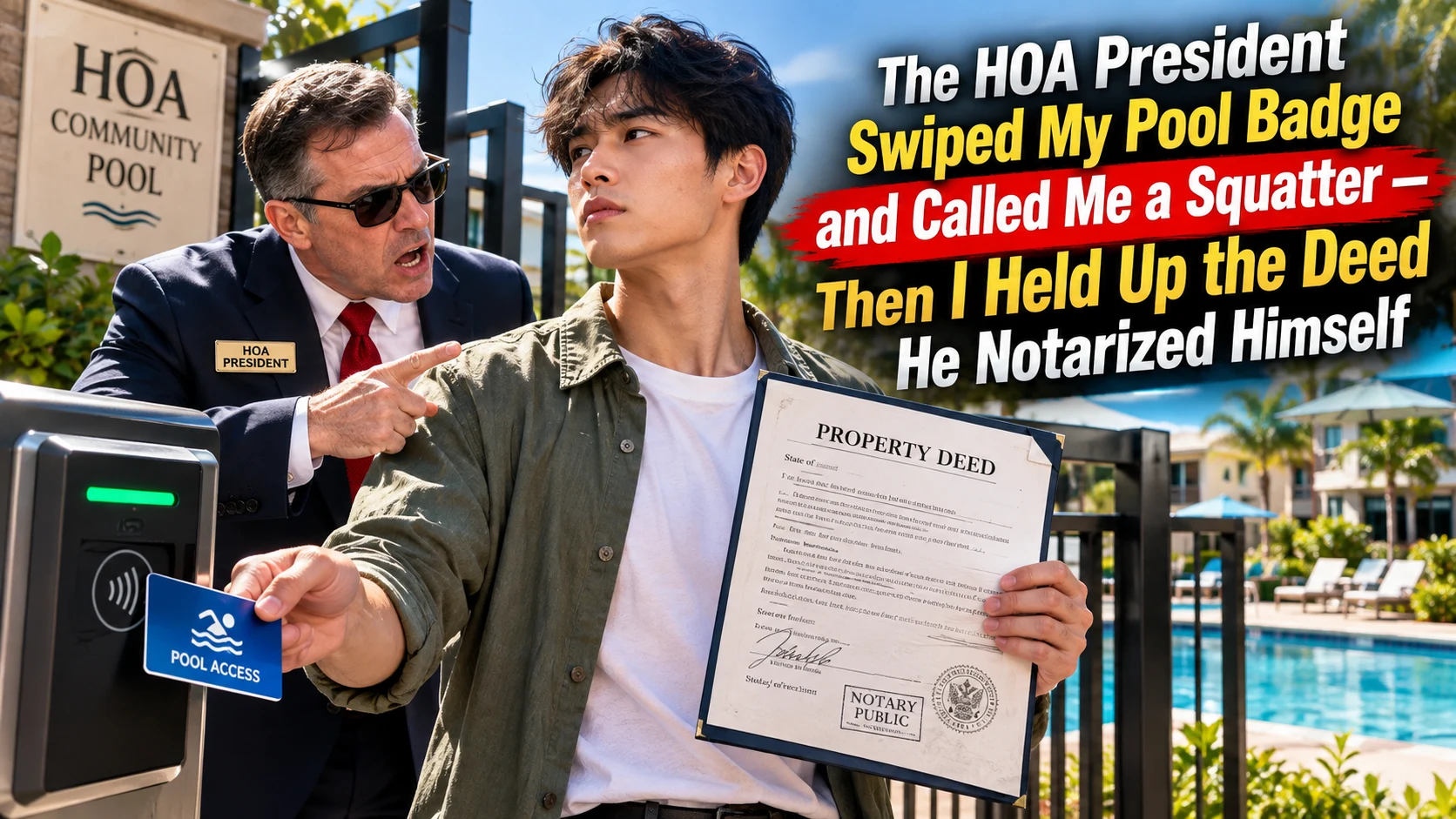
The HOA President Swiped My Pool Badge and Called Me a Squatter — Then I Held Up the Deed He Notarized Himself
Dale Brandt ripped my pool badge out of my hand in front of forty neighbors and told me squatters don't get to swim. My…
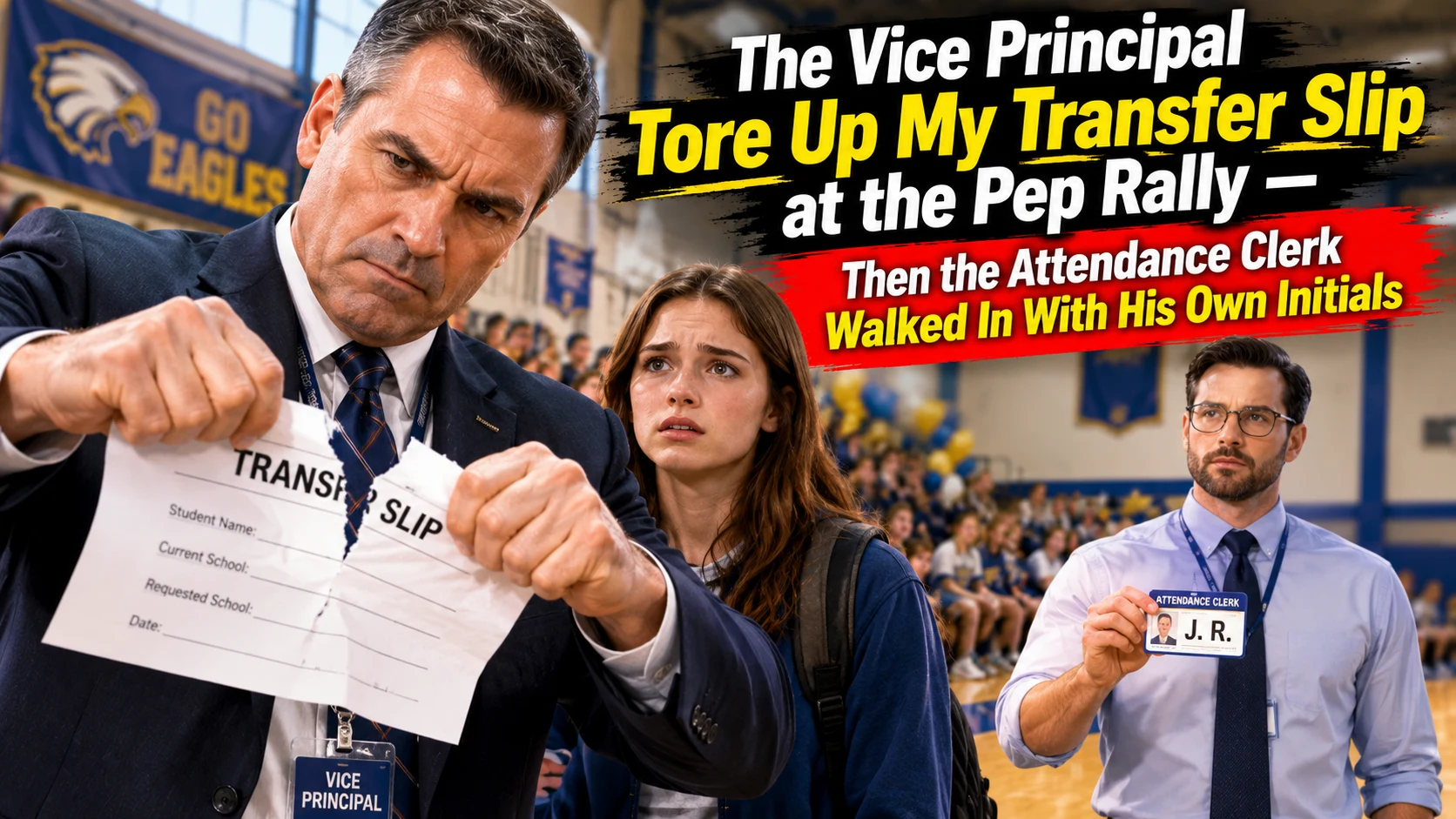
The Vice Principal Tore Up My Transfer Slip at the Pep Rally — Then the Attendance Clerk Walked In With His Own Initials
Coleman Pruitt tore my transfer slip in half at the pep rally, held the pieces above my head, and told eleven hundred people I…
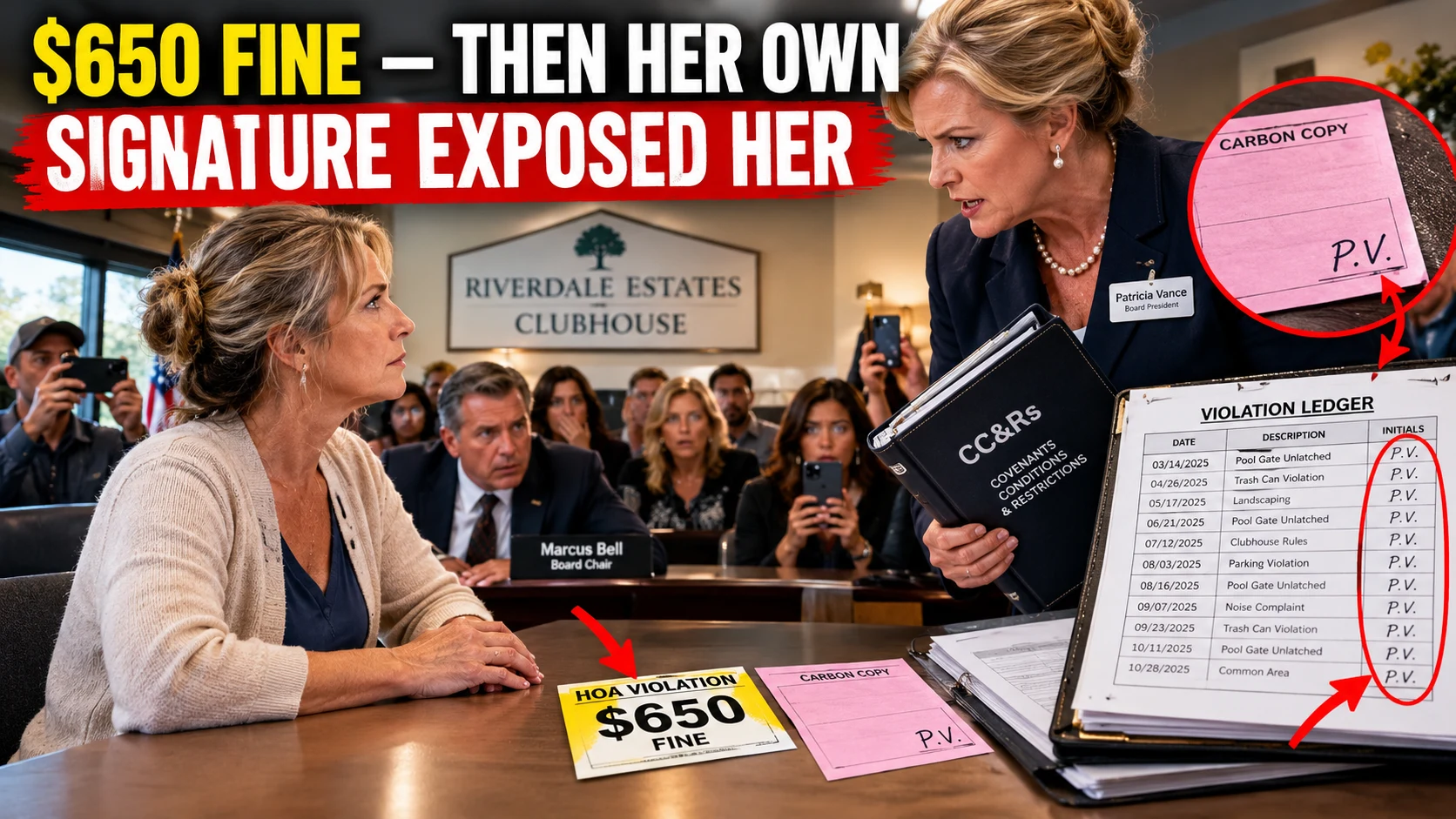
The HOA President Fined Me $650 for a Pool Gate I Never Touched — Then I Held Up the Pink Carbon Copy With Her Own Initials on It
"You left the pool gate unlatched again," Patricia Vance said, sliding the $650 violation sticker across the folding table, "and this time the board…
The Director Fired the Nursing Aide for Stealing—Then the Cabinet Fob Log Showed Whose Badge Opened It at 2:03 A.M.
The director's palm cracked down on the medication-room counter while the pill tray was still in my hands. "You took from the cart at…
The HOA President Fined Me $650 for a Pool Gate — Then the Log Showed Her Own Fob at 2 A.M.
The violation sticker landed on the folding table in front of me dated April 12 — the night I was three states away at…