Chapter 3 : I didn't answer the number I didn't know. I sat in the bleachers with my mother until the gym cleared, which took twenty-two minutes of the loudest, slowest, most disorganized dismissal in the history of Ridgeway High School, because nobo
I found out later that Pruitt had been on the phone with the district for eleven minutes, from the parking lot, sitting in his car, with the resource officer standing outside the driver's side door — which is a thing that happens, apparently, when a vice principal is walked out of a building: he gets to make a call, once, and then somebody stands there. Officer Bream stood outside that car for eleven minutes. I know because a senior in my English class parked two rows over and took a picture that got sent to the group chat and made it out to the whole school in about the time it takes to walk from the gym to the parking lot.
I didn't see the picture until that night, and when I did, it broke the whole day into a different set of rooms. In the photo, Pruitt's face is lit by the phone screen, and the phone is in his hand, angled up, and I could see — this is what got me — that the phone was not the school-issued phone, it was his personal phone, and the number he was calling was a contact saved with the initials of a person I would later find out was the district athletic director, and the call was at 3:07 p.m. on Friday, and it was the first thing he did.
He did not call his wife. He did not call his lawyer. He did not call his boss. He called the athletic director, because if you're going down over a hole in an attendance log, the only thing standing between you and Monday morning at nine is the man whose season depends on the name twelve.
I got home at 5:20 p.m. My mother drove. The car we drive is a 2014 Honda CR-V with a dent in the passenger door and a small sticker in the rear window for the middle school where she subs — because her real hope, the whole time we've lived here, is that people will see the sticker and treat her like a person with a job. She didn't say anything in the car. Her silence is a load-bearing wall. It props up the whole family.
When we parked, she finally said, "Alvarez called the house."
"When?"
"At 4:52 p.m. I saw the number on my phone while we were in the car and I didn't pick up."
"You didn't pick up the principal?"
"I don't pick up numbers I don't know," she said. "They can leave a message if it's important."
This is my mother. She will sit in the third row of a pep rally she was supposed to miss a job interview for and watch her daughter get torn up by a man with a microphone, and then she will not pick up the phone when the principal calls, because her rule is: they can leave a message. Her whole life is a set of rules designed to make sure nobody catches her by surprise. I learned the rules. I keep them. I keep them better than she does, arguably, which is its own thing I'll get to later.
The message was six seconds long. I heard it through the bathroom door while she listened to it on speaker, half accidentally.
"Ms. Brenner, this is Principal Alvarez at the high school. I'd like to speak with you and Kayla together, in my office, Monday morning at seven-thirty, before the audit. Please call or text me back at this number."
That's it. Six seconds. No apology. No mention of the rally. No mention of the transfer slip or the log or the vice principal. Monday morning at seven-thirty, before the audit, in my office.
I stood in the hallway in my socks and stared at my mother through the open bathroom door and I said, "She said Monday at seven-thirty. Before the audit."
"I heard."
"That's ninety minutes before the audit."
"I heard," my mother said again, and she turned off the water at the sink, and she looked at me in the mirror. "What do you want to do?"
I didn't know. There was a version of me that wanted to say yes to the meeting — show up, sit down, let grown adults figure out what happened to them. And there was another version, smaller, quieter, and it had been with me since the landlord phone call in Akron: the one that says, don't walk into a room you didn't build, because the room was built to make you agree.
"What happens if we don't show up?" I said.
"Then we still show up at nine," my mother said. "To the audit."
She turned off the bathroom light and came into the hallway and stopped two feet from me and did the thing she does — she looked at me not like a mother, but like a real person she was trying to read.
"You had a call from a number you don't know," she said. "Twice."
I told her about it. I hadn't planned to. I was going to wait and figure out who it was first, because the truth is I've learned to worry about texts from unknown numbers. But my mother had crossed a line today for me. She'd given something up. She was standing in the hallway in her socks and her middle-school lanyard with her hair falling out of the plastic clip, and she had made a choice in the third row of the pep rally that I did not get to argue with, and I didn't want to be a person who hides her phone.
I handed her the phone.
She looked at the number. She looked at the two messages. She handed it back.
"That's a 614 area code," she said.
"Meaning?"
"Meaning it's a Columbus number," she said. "Meaning it's probably somebody from the district." She said this in the flat way she says things she already knew. "Meaning tomorrow morning, before Monday morning, somebody at the district office wants to talk to you and is doing it on a Saturday to avoid the audit."
"You think it's a lawyer?"
"I think it's somebody who doesn't want the audit to happen," my mother said. "And they think you're the way to stop it."
She looked at the phone in my hand. "Answer it. I'll sit in the room."
I answered it.
A man on the other end said he was calling from the district office, that his name was Mr. Calhoun, that he handles "athletic compliance" for the district, that he had received a call from Vice Principal Pruitt around three-fifteen that afternoon, and that he wanted to speak with me personally to "clear up a misunderstanding" that he was "sure we could resolve privately" and that he wanted to know if I could meet him at a coffee shop on Route 4 tomorrow morning at ten o'clock.
He said the phrase "clear up" four times in three minutes. He said "misunderstanding" three times. He said "as a courtesy" once. He never once said the words "attendance log."
I said, "I'll have to ask my mother."
He said, "Of course, of course." A pause. "And Kayla — I know this has been a hard day for you. I want to be clear that nobody at the district thinks you did anything wrong."
That sentence — nobody thinks you did anything wrong — is the sentence that decided it for me. Because I have been told that sentence before. My mother and I got that sentence from the landlord in Akron, word for word, right after he called about the water bill. It's the sentence people say when they're setting up the sentence after it.
I said, "I'll call you back tomorrow morning."
I hung up. My mother was still standing two feet away. She hadn't left.
"Seven-thirty Monday," she said. "Then ten o'clock tomorrow with the district guy. Then nine o'clock Monday."
"Yes."
"Also somewhere in there," she said, "we need to hear from Mrs. Okafor."
She said it exactly like that — "we need to hear from Mrs. Okafor" — as if it were as obvious as a bus schedule, as if there were only one person in the entire building whose next move mattered, and as if the whole plan came down to waiting on a woman she had never met.
I woke up the next morning to a text from a number I did not know, at 6:41 a.m., that said: "Call me before the coffee shop. It's Okafor. Ignore the 614 number."
Advertisement
All 8 chapters
- 1The silence came first, and that was the wrong order. A pep rally is supposed to be noise — the band ripping through the fight song, the cheerleaders stacked on the baseline, eleven hundred kids screaming for a football team that had won
- 2I'll tell you the one thing I know about school hallways: they have a different sound than they look. A hallway empty looks loud and clean. A hallway occupied sounds like a roll of tape being pulled off the roll in another room. It took m
- 3I didn't answer the number I didn't know. I sat in the bleachers with my mother until the gym cleared, which took twenty-two minutes of the loudest, slowest, most disorganized dismissal in the history of Ridgeway High School, because nobo
- 4The first thing I did Saturday morning was sit on the edge of my bed with the phone in both hands and reread the message about eleven times. Then I got up, walked to the kitchen, and put the phone on the table between me and my mother.
- 5What I want to get right is what happened between Saturday afternoon and Monday morning, because this is the part that people always skip when they tell stories like this. Everything important happens in that dead space. The gym was publi
- 6Monday morning the low overcast had come back, the same flat white sky from Friday, like the week had never moved. My mother drove me. We left the house at 6:55. She was wearing what she wears to work: dark slacks, a soft blue blouse with
- 7Mrs. Okafor's attendance office is a small room behind the front desk with a counter that opens out to the lobby. She was standing at the counter with the folder closed, and when I walked up she didn't say hello. She said, "Did you sign."
- 8Friday night. Homecoming. Ridgeway High vs. Bellbrook, kickoff 7:15, the field-house lights on the way they always are on Friday nights in November, cold yellow glow through the fog. My mother parked in the far lot because the near lot fi
You may also like

My Uncle Slapped Me at the Country Club and Called Me a Thief — But I Was Already Holding the Chit He Signed
My uncle's palm cracked across my cheek at the country-club lunch table and he shouted that I had stolen a member number that never…
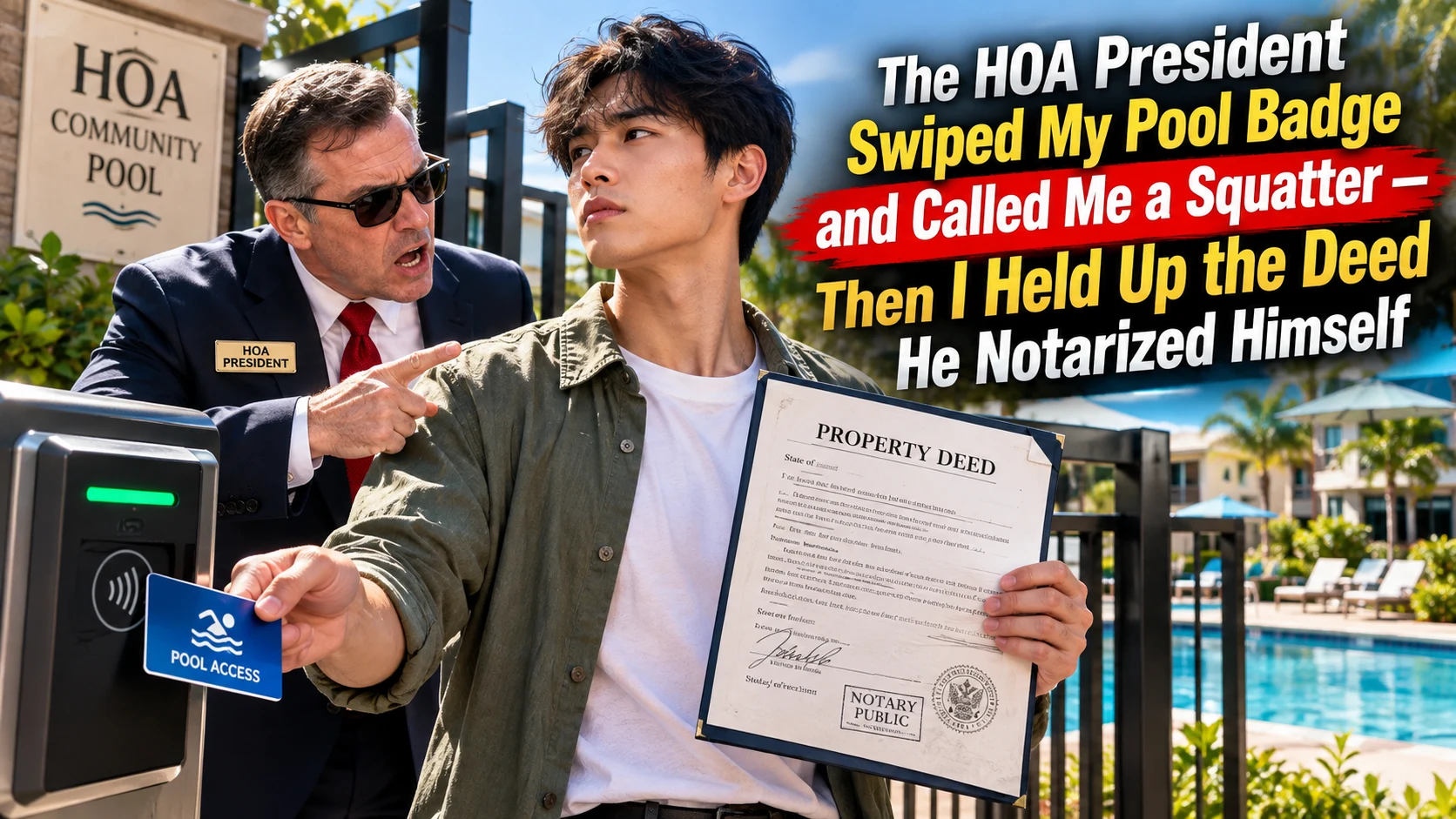
The HOA President Swiped My Pool Badge and Called Me a Squatter — Then I Held Up the Deed He Notarized Himself
Dale Brandt ripped my pool badge out of my hand in front of forty neighbors and told me squatters don't get to swim. My…
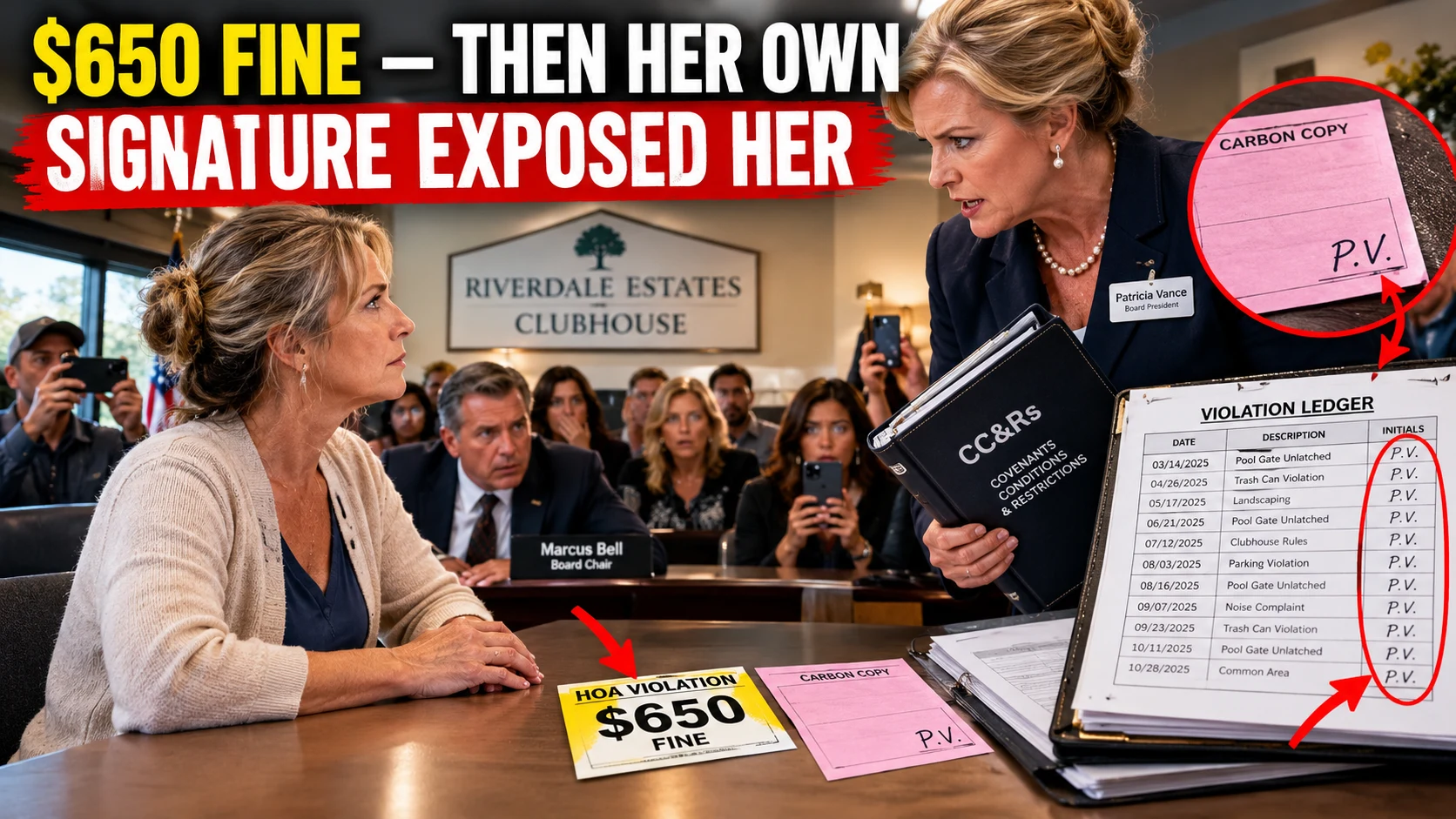
The HOA President Fined Me $650 for a Pool Gate I Never Touched — Then I Held Up the Pink Carbon Copy With Her Own Initials on It
"You left the pool gate unlatched again," Patricia Vance said, sliding the $650 violation sticker across the folding table, "and this time the board…
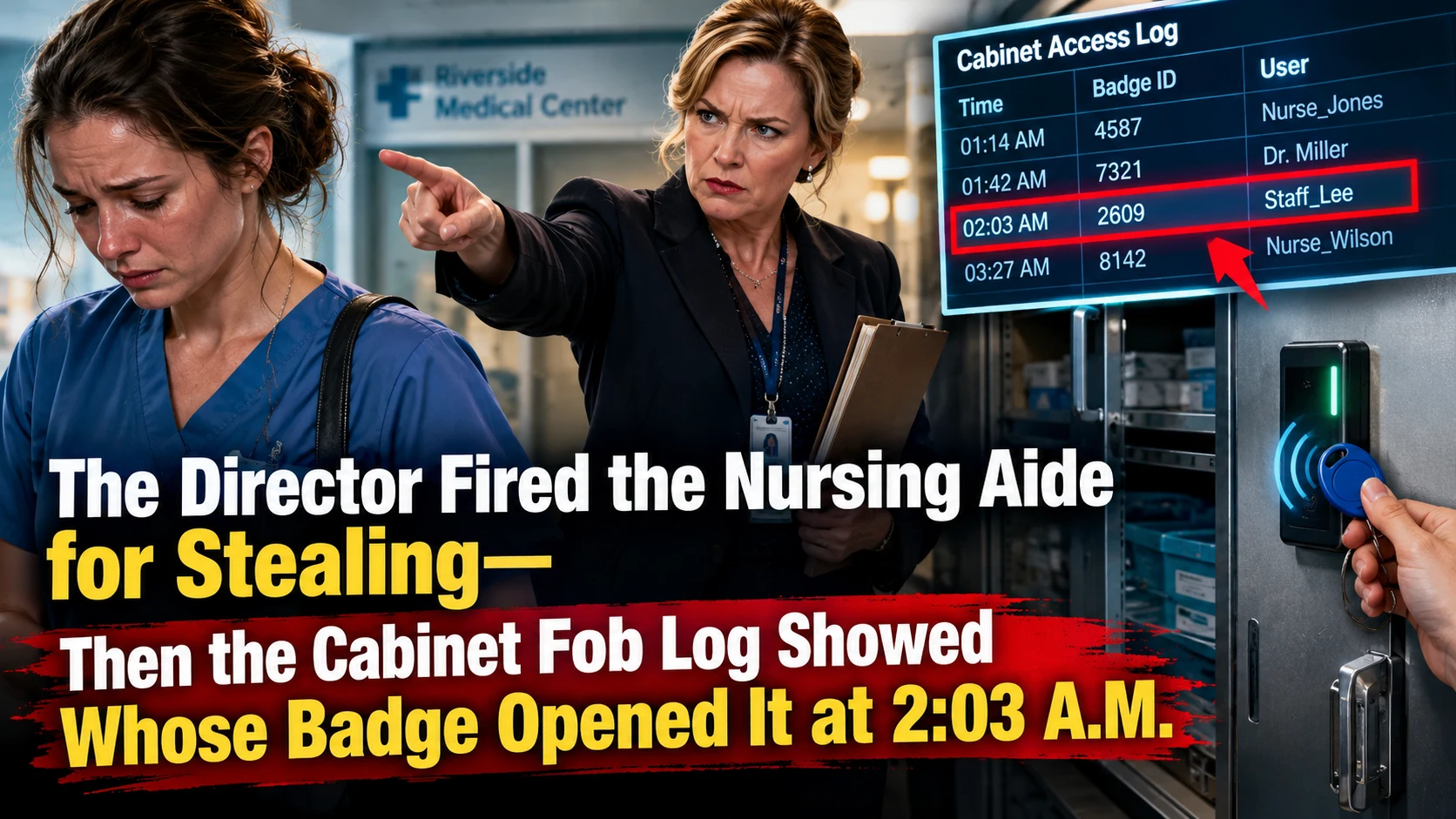
The Director Fired the Nursing Aide for Stealing—Then the Cabinet Fob Log Showed Whose Badge Opened It at 2:03 A.M.
The director's palm cracked down on the medication-room counter while the pill tray was still in my hands. "You took from the cart at…
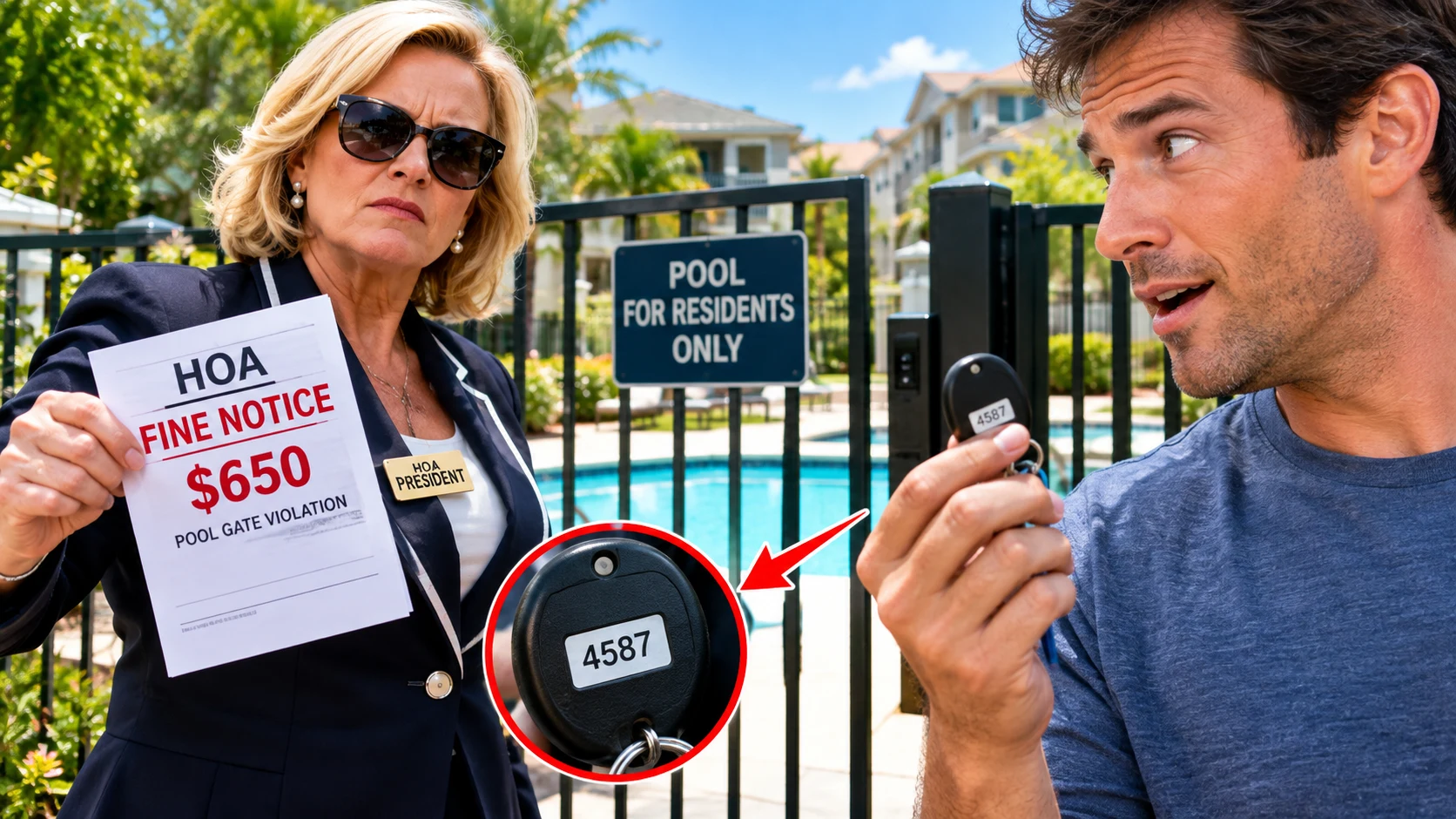
The HOA President Fined Me $650 for a Pool Gate — Then the Log Showed Her Own Fob at 2 A.M.
The violation sticker landed on the folding table in front of me dated April 12 — the night I was three states away at…
She Shamed Me for a Junkyard Yard — My Doorbell Cam Caught Who Really Dumped It
"Your junkyard is why my property value dropped, Frank!" Brenda slammed the violation photo down on the table, and the whole clubhouse leaned in…