Chapter 1 : The silence came first, and that was the wrong order. A pep rally is supposed to be noise — the band ripping through the fight song, the cheerleaders stacked on the baseline, eleven hundred kids screaming for a football team that had won
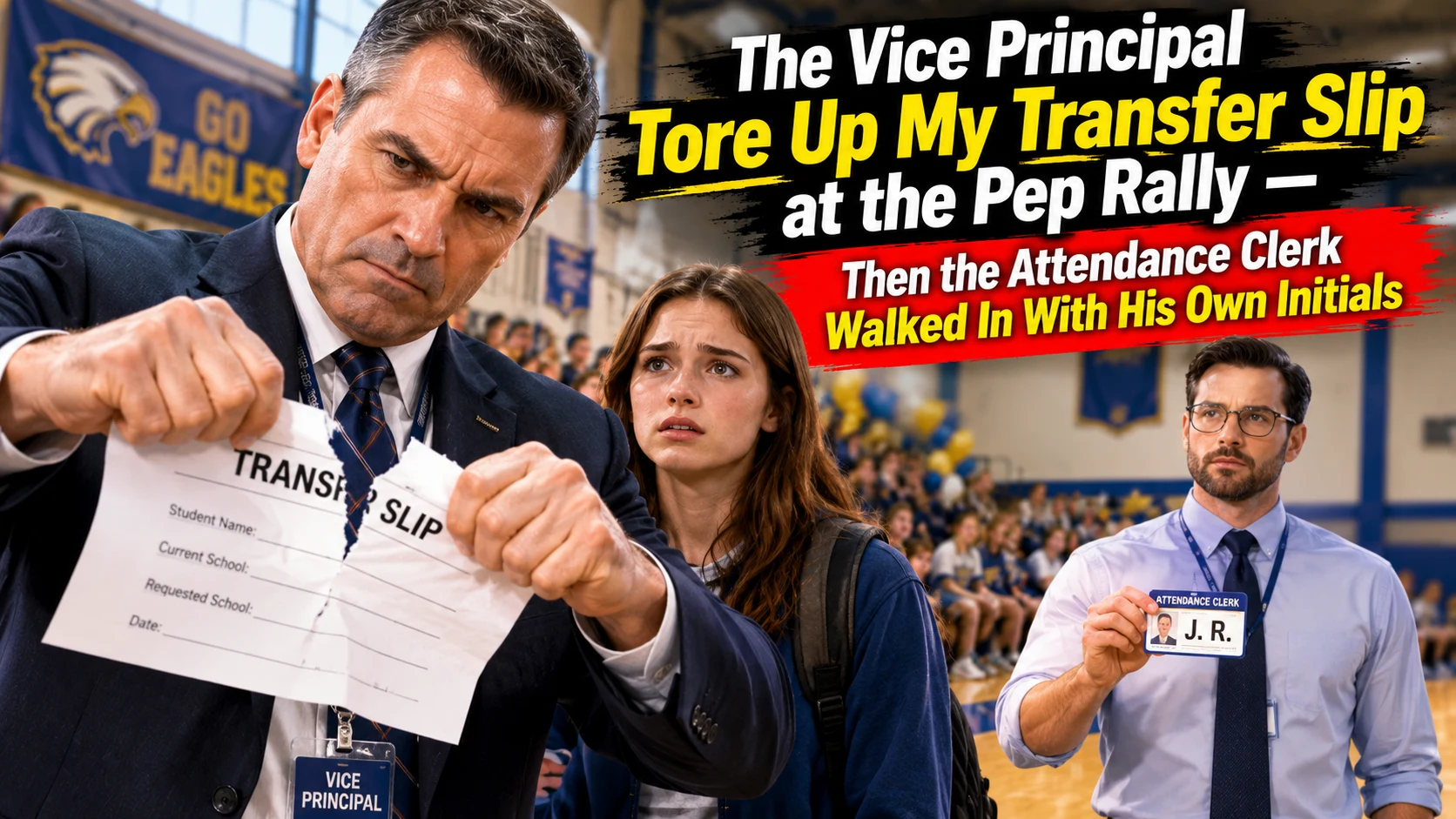
Coleman Pruitt tore my transfer slip in half at the pep rally, held the pieces above my head, and told eleven hundred people I was a liar and a truant — then he saw the attendance clerk walking across the gym floor with the original…
I was on the lowest bleacher with my binder open on my knees. Third week at Ridgeway High. I didn't know yet that the gym has a smell that stays with you — hot rubber, floor wax, a thousand kids' deodorant losing a war. I only knew the microphone had gone quiet and every face in the baseline section had swung toward the floor.
"Kayla Brenner."
Vice Principal Coleman Pruitt said my name into the mic the way a judge reads a charge. He was standing at center court with the whistle on his lanyard and his district ID clipped to his lapel, navy blazer, khaki slacks, reading glasses folded in his breast pocket. Fifty-one years old, fourteen years in this building, and he owned that microphone the way some men own a driveway.
"Come down here."
Nobody moves when a vice principal calls your name at a pep rally. That's the trap. If you don't move, you're defiant. If you do move, you've already agreed you did something. I closed the binder. I stood up. I walked down the bleacher steps with eleven hundred people watching the back of my head, and I could hear the junior section already starting to whisper-buzz, because they knew — everybody knew — that a name called at a rally means a public discipline.
He didn't say it to me first. He said it to the room.
"Third period today," he said, holding the mic low, walking a slow half-circle like he was telling a story. "You were on my attendance list as unexcused. You want to stand there and tell this school you weren't skipping?"
I said, "I had an appointment. The office has the call."
He smiled at the bleachers, not at me. That was the first wrong thing. "The office has the call," he repeated, sing-song, and a laugh popped out of the junior section, and then the whole baseline was laughing, and the laugh kept feeding itself because the microphone was still on.
"Funny thing," he said. "I checked. No call. No note. No email. Nothing."
The laughing had stopped being a sound and become a pressure. My ears went hot. My hands went cold. I want to be honest with you about what was happening in my head, because everybody watching me probably thought I was stunned. I wasn't stunned. I was counting. I was counting the way my mother counts coins at the register when she needs the total to be right the first time.
One-fifteen. Dr. Patel's office. The bracket on my back molar, popped again, because I eat ice like it's a food group. My mother's call to the front office at one-oh-five while I was still in the chair. The secretary's email confirming it at one-oh-nine. The appointment card with the timestamp clipped to the inside of my binder. And third — the thing I didn't even think about until later — the fact that when the registrar processed my transfer three weeks ago, she ran the form in triplicate.
Pruitt was not done. "You're new here, so let me explain how Ridgeway works," he said, and now his voice had that performance in it, the way it gets at assemblies. "You get a clean slate. You don't get to come in and decide which classes you feel like attending."
I said, "Sir, I have the email. It's printed."
He said, "Then it's in your fairy-tale folder somewhere."
And the gym laughed, and he walked toward me, and I stood there holding my own binder like it was the only furniture in the room.
What I knew right then: my appointment was real. My mother had called. The office had logged it. What I did not know yet — I would not know for another four minutes — was why the vice principal of Ridgeway High had decided, that morning, to erase it.
He reached me. He looked down at the open binder on my knees — three-ring, black, the appointment card clipped inside the front cover with a paper clip I'd bent straight with my thumb — and he closed his hand on the top sheet. My transfer slip. The office copy. The one I'd carried since enrollment so I could hand it to anybody who needed it.
He pulled it out.
He held it up over my head, above the microphone cord, so the whole baseline could see; and then he tore it in half, one clean pull, and dropped both pieces at my feet. They landed on the free-throw line, one face-up, one face-down.
"One more referral," he said into the mic, "and your transfer is void. Go sit down."
And then something happened that I have thought about every day since.
The gym noise — the real noise, the noise of a room deciding something — went flat and quiet, and in that quiet you could hear him breathe.
I didn't sit down.
I want to tell you why, because I was sixteen years old and standing in front of a microphone and every instinct in my body was screaming sit. Two reasons. One, I've watched my mother get talked to like that my whole life — on the phone with a landlord in Akron, at a checkout counter, in a school office, one time at a bank — and she never fights back in the room. She waits. She files. And every time she waits and files, they do it again, because they already know she'll wait and file. Two, the flat quiet in the gym after the laugh was the loudest thing I'd ever heard, and it was pointed at Pruitt, not at me. Somebody had stopped laughing before the others. Somebody was uncomfortable already. I couldn't see who, but I could feel it, the way you can feel a rainstorm a couple blocks away.
I looked down at the two pieces of my transfer slip on the floor.
Then I reached back into the inside cover of the binder, where the paper clip had been holding the appointment card, and under the card, slid flat against the cardboard, was the third copy.
Yellow. Registration carbon. Same transfer number in the top right corner. Same registrar's initials. Same date. Because Mrs. Paulsen, the registrar, runs every transfer form through her machine in triplicate — white office copy, pink registrar's copy, yellow student copy — and she handed me the yellow one without looking up, three weeks ago, on a Thursday, with my mother standing next to me holding the manila envelope of records from my old district.
Pruitt didn't know there was a third copy. Nobody ever knows about the third copy.
I pulled it out and held it up over my head, the way he'd held his.
The laugh didn't stop. It changed. Like a wave hitting the beach and pulling back and hitting rock instead.
I didn't say anything. He was three feet away, holding the microphone like a loaded thing, and I just stood there with my arm up, and I let the paper do the talking, because paper doesn't stutter and paper doesn't get hot in the ears.
The microphone clicked off.
Pruitt stared at the yellow slip. And then he did the thing I'll remember for the rest of my life. He didn't grab it. He didn't yell. He looked down at the two pieces of paper on the floor at my feet, and then he looked past me, past the bleachers, at the edges of the gym — at the doors. All of them. Like a man in a room he suddenly wanted out of.
Behind me, in the front row of the baseline bleachers, a folding chair scraped. Coach Hargrove, standing up. Big man, always in a stadium jacket with the crest on it, always with his arms crossed during rallies. He looked at the yellow paper in my hand, and then he looked at Pruitt, and then he sat back down and crossed his arms again.
He didn't say a word. That's how I knew it was worse than I thought. When a head coach stops speaking during a rally, the rally is over for reasons no one is going to explain to you in the gym.
The band started up again — one tentative tuba note, then a drum — because the band director thought the silence needed cover. It didn't help.
Pruitt stepped in close to me and said, low, off-mic: "Where'd you get that."
"Same place you got yours," I said. My voice came out flat. Not brave. Flat. There's a difference and I've never been able to explain it to anybody who hasn't needed it. "The registrar runs three."
He looked at the yellow slip again, and his hand went to his breast pocket and touched the folded reading glasses in there, the way a smoker pats a pocket they don't have any more.
And then he did the last thing I expected. He turned and walked back to center court, put the mic back on the stand, and said, at normal volume, to the room: "Third period attendance is suspended for the day. Go back to your seats."
Nobody went back to their seats. Everybody stayed exactly where they were, and that's when I understood — the rally wasn't the show and I wasn't the show. The show was coming in through the baseline door, and she was already halfway across the floor.
Mrs. Delia Okafor has worked in the front office at Ridgeway for twenty-two years. Plum cardigan over a cream blouse, gray slacks, flat shoes. Pen behind her ear. Walked a little fast for her height. She carries a manila folder the way other people carry a phone — half the day it's under her arm, and she never puts it down, not even to sign for a UPS package. She was carrying it now, and she did not walk to the microphone. She walked straight past Pruitt like he was a kid in a hallway.
She looked down at the two pieces of my transfer slip on the free-throw line. Then she looked up at me, just once, and there was something in her face — not a smile, not pity, something more like a referee confirming a call.
She stopped next to me, on my left, and opened the folder.
She didn't narrate. That's the thing people don't get about Mrs. Okafor. She's spent twenty-two years in a building where everybody narrates, and it's made her allergic to it. She pulled one wide sheet of paper out of the folder — a page the size of a folded newspaper, the daily third-period attendance log, with rows and columns and green pre-printed grid lines and a handwritten margin column on the right, and everything about it looked stupid and boring, and it was, and that's the point.
She held it up flat, at her chest, at the eye line of the first five rows of bleachers behind me.
"This is the third-period log for today," she said. Her voice was not loud. She did not need it to be. "Miss Brenner's row is marked U. Unexcused by phone call at one-oh-five. Confirmed by email at one-oh-nine."
Pruitt said, "Delia—"
She didn't wait for him. "But the office copy of this log is different, so I pulled the original."
She turned the page in her hands, slow, patient, like a woman turning a page in a cookbook to see whether the recipe continues. The whole baseline watched that page turn. I could hear a page turn like a car door slam.
"There's a row I want the school to see," she said.
And she moved her thumb down the margin.
I saw it before anybody else did, because I was standing right under her arm with my own yellow slip still up in my fist.
My row. Kayla Brenner, third period, marked U. In the narrow margin to the right of it, in blue ink, two initials in tall backward-slant handwriting: C.P.
Directly below my row — same day, same period, next student down alphabetically by last name, no gap — was a different name. Nicolas Vega. Twelve on the varsity roster. Our quarterback for the homecoming game on Friday. His row was supposed to say T for tardy. Somebody had crossed out the T with two short pen strokes and written U above it. And in the margin to the right of his row, in the same blue ink, in the same backward-slant handwriting, the same two letters.
C.P.
Mrs. Okafor didn't explain what that meant. She held the log flat and higher, turned it so the bleachers could read it, and said, in exactly the same tone as before, at exactly the same volume:
"Both rows are initialed C.P. — and one of them is not her row."
I've replayed that sentence about a thousand times. The thing that stays with me isn't the sentence. It's that she never raised her voice. Twenty-two years of watching administrators perform, and the one person who actually ended the day didn't raise her voice once. She just brought the paper.
For about two seconds nothing happened. Then the laughing came back — but it came back wrong, it came back on the other side of the gym, and it wasn't a laugh anymore, it was more like the noise water makes when a heavy thing drops into it. Kids in the junior section turned to the kid next to them and asked questions. A girl two rows up from me said, loudly, "Wait, the quarterback?"
Pruitt said, "Give me that."
He reached for the log. Mrs. Okafor pulled it back, closed the folder with the log inside, and held it against her chest with both arms like a woman locking a filing cabinet on a Friday afternoon.
"You can look at it Monday," she said. "The district audit is at nine."
I want to describe what happened to Pruitt's face, because I've seen men get angry in my life and this wasn't anger. It went small. Small like a photograph you're looking at from the wrong end of a pair of binoculars. His mouth was open and his eyes were somewhere past my shoulder and his hand came down from the folder and hung in the air at his side like it had been emptied out.
Into the dead microphone, he said, "There's a process for this—"
Mrs. Okafor said, "There is. It starts Monday morning at nine."
The way she said it turned off the rest of the gym like a light switch. And that would have been enough. That would have been the whole day. But it wasn't, because a chair scraped in the front row of the bleachers, and Coach Hargrove stood up again, and this time he didn't sit down.
He walked down the three steps of the bleacher in front of him, crossed to the baseline edge, and stopped about ten feet from Pruitt. Big man. Grey stubble. Arms not crossed. He looked at Mrs. Okafor, then at the folder in her arms, then at Pruitt, and he said one sentence, quiet, flat, that I don't think anybody outside the first two rows heard, and that I heard because I was five feet away from him and I'm not going to repeat it here except to say it was four words long, and it began with "I asked you."
Then he turned and walked out of the gym through the baseline door.
I don't know who called the resource officer. It wasn't me. I was still standing with my yellow slip above my head, frozen in the pose I'd been holding since Pruitt tore my office copy. Somebody's phone was filming from the third row of the bleachers — I still don't know whose — and when I've tried to piece it together afterwards, that's the moment the sound on the recording changes, like the person holding the phone has turned their body.
Officer Bream works the east end of the building and does hallway duty near the gym on Fridays. He came in through the equipment-room door at the far baseline and walked a long diagonal across the floor, unhurried, keeping his body square, exactly the way they train you. He stopped at Mrs. Okafor, and she handed him the folder without being asked. He opened it, looked at the log for about four seconds — I watched him count the rows with his finger — and closed it.
He walked to Pruitt and said two words. I heard them because by then the entire gym had gotten so quiet that you could hear the marching band's low notes leaking in from the back wall where the bass drum had no reason to stop playing.
"Come on."
Pruitt looked at him. Then he looked at me. I want to be honest: I thought he was going to say something to me. Something cutting. Because that's how men like that — men who are used to owning the microphone — finish things when they're backed into a corner. They pick one last name and say it low so only the name hears it.
He didn't. He looked at me for about two full seconds and then looked away, and it was worse than if he'd said something. Worse than anything he'd said at that microphone. He looked at me like I was the thing that had happened to him. Like a bad flu. Like weather. Not a person whose paper he tore up in front of a school. Not a girl he just accused of lying for four minutes. Just the thing.
He walked out through the baseline door with Officer Bream beside him. Neither of them ran. Officer Bream kept his body half a step behind Pruitt's shoulder, the way I've since learned they are trained to do so the crowd can see who's being escorted and who's doing the escorting.
The door swung shut. The cold overcast light through the high windows caught the back of the doorframe.
And then the gym exploded.
Not into cheers. Not into boos. Into a kind of roar that doesn't know what it is — half surprise, half gossip, half somebody laughing from relief, half somebody crying, all of it bouncing off the cinder block. Somebody started a chant of "Kay-la" from the junior section and it didn't take, thank God, because I would have died on the free-throw line. The band director, seeing his moment, called up the fight song, and the drums swallowed everything else.
Principal Alvarez came down off the bleachers. I'd seen her in the hallways for three weeks. Short woman, thin-rimmed glasses, cardigan over the district polo, always carrying the same game-day roster clipboard on Fridays because she personally walks the roster up to the press box before kickoff, which is a whole thing at Ridgeway that everybody knows about and nobody thinks about. She came down off the bleacher steps and crossed the free-throw line and stopped in front of me.
She looked at the yellow slip in my raised hand and she said, "Put that in your binder."
I put it in my binder.
She looked down at the two white pieces of my transfer slip on the free-throw line. Then she looked at a janitor standing at the baseline door with a push broom.
"Leave those," she said.
Then she held out the game-day roster clipboard. The one with all the numbers on it, home side, visiting side, kickoff time at the top, the whole officiating crew listed at the bottom. It's the actual clipboard the actual announcer in the press box uses during the actual game. I'd seen it a hundred times in three weeks from the bleachers and I never once thought about who carried it.
"Take this up to the press box," she said. "Tell Coach Inman we're pushing kickoff back fifteen minutes." She looked at me and something moved at the corner of her mouth that wasn't a smile and wasn't not a smile. "Walk slow."
And that was it. That was the whole sentence the principal of Ridgeway High School gave me in front of eleven hundred kids.
I walked.
I want to tell you what it's like to walk across the free-throw line of a gym with a clipboard in your hands after the whole building has been screaming your name for five minutes. It's terrible. Every single person in there is looking at you. Not one of them says anything. You just walk. I could hear my own sneakers on the floor. Skipping sounds. Old scuffed white New Balance that I've had since eighth grade. I could feel the yellow slip pressing against the inside of my binder, still, in the inside cover, where it lives.
The cheerleaders were still on the baseline because they hadn't been dismissed yet. When I reached them, they parted. Not dramatically. Just parted — like water at the prow of a boat — without looking at me, standing aside so I could walk between them.
I walked through them.
I got to the baseline door. I put one hand on it.
And I took out my phone.
I don't know why I did it right there, exactly in the doorway, exactly between the noise and the hallway, exactly with the cold air from the basement coming under the door and up my legs. I think I wanted to prove to myself that I was going to be okay before I had to talk to anybody. That's a thing my mother does, and I've picked it up — you take out your phone in the doorway of the thing that just happened, and if there's a message there that isn't bad, you're allowed to keep going.
There were three messages. All from my mother, all sent within about forty seconds of each other.
"I saw everything."
"Are you okay."
"Call me when you're out. I'm in the third row."
I stood in that doorway with one foot in the cold hallway, one foot on the gym floor, the roster clipboard in my left hand and my phone in my right, and I could not decide which one was heavier.
She was in the third row.
The third row of the baseline section is where the parents sit — right behind the band, right behind the drumline, the loudest seats in the building. My mother was supposed to be at a job interview at four o'clock across town, her real interview, the full-time cafeteria position at the middle school that she'd been subbing into for two months because the woman who had it was retiring in January and the district hires from within and if my mother got this job it would mean no more sub days and no more Monday uncertainty about whether she was working, and if she didn't, we could keep going the way we had been going, which was fine, which was survivable, which was not the point.
She should not have been in the third row. She should have been at the district office with her hair clipped back and a printed résumé in her bag.
She was in the third row because she had decided to be in the third row. I didn't know which message to answer first and I didn't answer any of them, and I walked out through the baseline door into the cold cinder-block hallway with the roster clipboard in my left hand and my phone in my right, and the door swung shut on the roar behind me, and for about ten seconds — down there in the basement hallway between the equipment room and the boys' locker room, with nobody watching — I could hear my own breathing.
And then I heard footsteps behind me.
Advertisement
All 8 chapters
- 1The silence came first, and that was the wrong order. A pep rally is supposed to be noise — the band ripping through the fight song, the cheerleaders stacked on the baseline, eleven hundred kids screaming for a football team that had won
- 2I'll tell you the one thing I know about school hallways: they have a different sound than they look. A hallway empty looks loud and clean. A hallway occupied sounds like a roll of tape being pulled off the roll in another room. It took m
- 3I didn't answer the number I didn't know. I sat in the bleachers with my mother until the gym cleared, which took twenty-two minutes of the loudest, slowest, most disorganized dismissal in the history of Ridgeway High School, because nobo
- 4The first thing I did Saturday morning was sit on the edge of my bed with the phone in both hands and reread the message about eleven times. Then I got up, walked to the kitchen, and put the phone on the table between me and my mother.
- 5What I want to get right is what happened between Saturday afternoon and Monday morning, because this is the part that people always skip when they tell stories like this. Everything important happens in that dead space. The gym was publi
- 6Monday morning the low overcast had come back, the same flat white sky from Friday, like the week had never moved. My mother drove me. We left the house at 6:55. She was wearing what she wears to work: dark slacks, a soft blue blouse with
- 7Mrs. Okafor's attendance office is a small room behind the front desk with a counter that opens out to the lobby. She was standing at the counter with the folder closed, and when I walked up she didn't say hello. She said, "Did you sign."
- 8Friday night. Homecoming. Ridgeway High vs. Bellbrook, kickoff 7:15, the field-house lights on the way they always are on Friday nights in November, cold yellow glow through the fog. My mother parked in the far lot because the near lot fi
You may also like

My Uncle Slapped Me at the Country Club and Called Me a Thief — But I Was Already Holding the Chit He Signed
My uncle's palm cracked across my cheek at the country-club lunch table and he shouted that I had stolen a member number that never…
The HOA President Swiped My Pool Badge and Called Me a Squatter — Then I Held Up the Deed He Notarized Himself
Dale Brandt ripped my pool badge out of my hand in front of forty neighbors and told me squatters don't get to swim. My…
The HOA President Fined Me $650 for a Pool Gate I Never Touched — Then I Held Up the Pink Carbon Copy With Her Own Initials on It
"You left the pool gate unlatched again," Patricia Vance said, sliding the $650 violation sticker across the folding table, "and this time the board…
The Director Fired the Nursing Aide for Stealing—Then the Cabinet Fob Log Showed Whose Badge Opened It at 2:03 A.M.
The director's palm cracked down on the medication-room counter while the pill tray was still in my hands. "You took from the cart at…
The HOA President Fined Me $650 for a Pool Gate — Then the Log Showed Her Own Fob at 2 A.M.
The violation sticker landed on the folding table in front of me dated April 12 — the night I was three states away at…

She Shamed Me for a Junkyard Yard — My Doorbell Cam Caught Who Really Dumped It
"Your junkyard is why my property value dropped, Frank!" Brenda slammed the violation photo down on the table, and the whole clubhouse leaned in…