Chapter 7 : On Wednesday morning at 2:11 a.m. my phone rang.
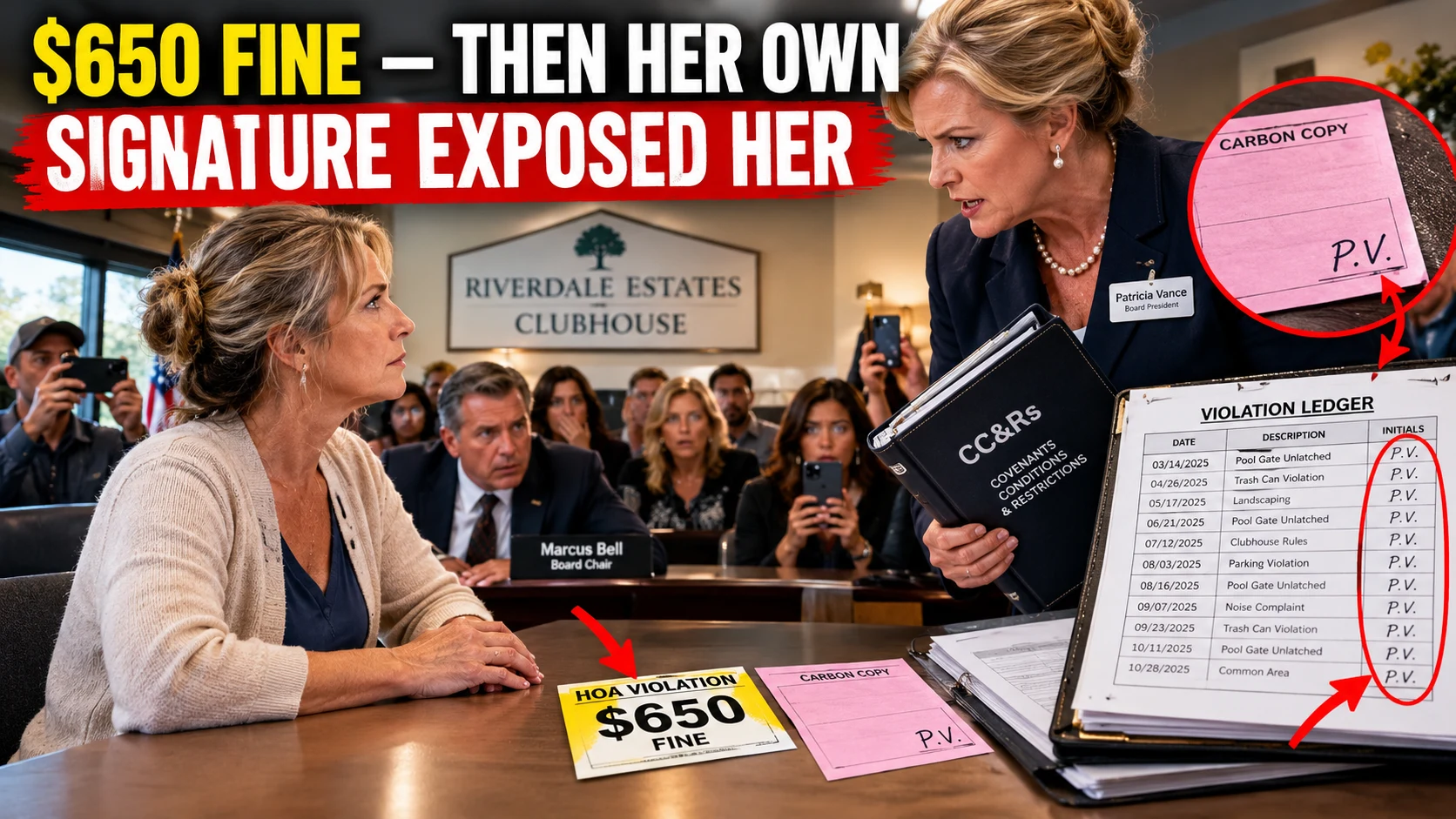
Story: The HOA President Fined Me $650 for a Pool Gate — Then the Log Showed Her Own Fob at 2 A.M.
I want you to understand something about me. I work in medical billing. I have been woken up by a phone call at 2 a.m. exactly twice in my adult life: once when my husband had his accident, and once when the hospital called me about my mother. Both times I picked up the phone before I was fully awake, and both times I knew what the call was before the voice on the other end had said three words.
This was the third time. I picked up before I knew who it was.
"Dana?" It was Karen. She sounded like she had not slept.
"Karen, what's wrong."
"You need to come to my house."
"Why?"
"Because somebody put a note on my door and it says your name."
"Say that again."
"There's a note on my front door. It's taped to the doorframe. It says 'Karen Hall' on the outside and inside it says 'You know what to do.' And it has your name at the bottom."
I sat up in bed. I want to be precise here because this is the part of the story where I have to be careful. I have screenshots of the note. I have photographs. I have the original. I have not made it public. I have shared it with the management company's regional office, with the interim board, and with the county, and I am sharing it with you now because it is part of what happened and because I think the details matter.
The note was handwritten in black Sharpie on standard white printer paper, torn off a sheet. The paper had a fold line down the middle. The handwriting matched, per a handwriting sample later collected from Pat Vance by Deirdre Anson's office, the pattern of cursive on several of the violation stickers in the fine ledger. The note was taped to Karen's front doorframe between 1:32 and 1:39 a.m. according to Karen's doorbell camera, which she had installed the week after the Thursday meeting, because Karen is the kind of person who installs a doorbell camera the week after a stranger shakes her hand at a board meeting.
The note said:
"Karen — You know what to do. Dana has gone too far. Every family has things to lose. You have a sister on Lot Fifty-One. Consider what your sister has to lose."
It was signed with my first name. Not a signature. My first name. "Dana."
The note had been written, per the county's review of the timestamp, roughly nine hours after Pat Vance walked out of the clubhouse. Nine hours. She had gone home, had dinner, had gone to bed, had woken up at midnight, and had driven to Karen Hall's house with a Sharpie and a roll of tape.
That is what it takes. I want you to sit with that. Somebody with an elected office, a leather folio, a gavel, a chain necklace, a husband who travels, and a porch light that has been on every night for a week — that person drove to Karen Hall's house in the middle of the night with a Sharpie.
I got dressed and drove to Karen's house. I was there at 2:41. Karen was standing in the open doorway with her phone in her hand. Her husband Dennis was in the kitchen with a mug of coffee that he had not drunk. Kathryn Ruiz was already there — Karen had called her first. The four of us stood in the doorway and looked at the note taped to the frame and nobody touched it.
"We're going to call the sheriff," Kathryn said.
"No," Karen said. "We're going to call Marcus."
"Karen —"
"Marcus Bell," Karen said, looking at me. "He has the file. He knows the sequence. He knows the handwriting. We're going to call Marcus and Marcus is going to call Deirdre and Deirdre is going to call whoever Deirdre is supposed to call at two in the morning."
I called Marcus. He picked up on the second ring. He was, I have since learned, not asleep either.
"Where are you?" he said.
"Karen's."
"Don't touch the note. Take three photos of the note, one of the doorframe, one of the back of the paper if you can see it without lifting it. Then call the sheriff's non-emergency line and say you have an incident report to file."
"You've done this before."
"I've walked this neighborhood at two in the morning before," Marcus said. "I've seen this exact template on a different door. On Lot 44. Two years ago. Karen was not the first."
Karen heard him because the phone was on speaker. She looked at me and she looked at Kathryn and then she said, in a voice I have never heard her use, "Who else was it?"
"Somebody on Lot Thirty-Two," Marcus said. "Somebody on Lot Eight. Somebody on Lot Twelve. I have a list. That's the file I was going to send to the county if they ever asked."
"It's not a small thing," Karen said.
"It was never a small thing," Marcus said. "It just got small when everybody paid."
He was right about that. He was right about almost everything, and I think this is the part of the story where I have to admit that I was wrong about something small. I had spent nine days preparing a folder to win a hearing. Marcus had spent eight months preparing a folder to prove a pattern. The difference between us was the difference between being right and being done.
By 3:15 there was a deputy at Karen's door. By 4:00 there was a case number. By 5:00 there was a message in my inbox from Deirdre Anson that said, in part, "I have the note. I have forwarded it to the corporate legal team. I have also forwarded it to the county. This is no longer a management matter. This is a legal matter. Please do not do anything else without talking to me or to Marcus first."
By 8:00 that morning, Pat Vance had been contacted by the county sheriff's office. By 9:00, she had been contacted by the corporate legal team. By 10:00, the doorbell camera video of her walking up to Karen's door at 1:33 a.m., in a dark sweatshirt with the hood up, holding a torn sheet of printer paper, had been shared with the county district attorney's office.
I want to be honest about what I felt at 10:00 on that Wednesday morning. I felt relieved. I also felt a little sick. Not for Pat — I cannot be that generous. For Karen. For Kathryn. For Hal. For all of us who had spent a week taking photos of notes we had not wanted to look at closely, because to look closely at a note from a woman like that was to invite the next one.
By 10:30 the note was in the hands of the county and I was back at my kitchen table with a cup of tea and my mother's voice on the phone saying, "Eat something."
Advertisement
All 8 chapters
- 1"—and I have the photos right here, Dana. Right here in this folder. So before you tell this board you're the victim, I want you to look at what your license plate was doing at eleven forty-five on the night of April twelfth."
- 2He talked for eight minutes.
- 3The folder was nine files. I want to tell you what was in it, because if the rest of this story is going to make sense to you, you have to understand what I was holding by Sunday morning.
- 4The woman on the phone was named Tanisha McElroy and she was the permit clerk for the county office, and she was not in the mood for a long conversation.
- 5Deirdre Anson's office was in Phoenix and she was brisk in a way that I respected immediately because it was so unlike the clubhouse.
- 6I have to tell you what happened on Tuesday night, and I have to tell you why I made a decision that has cost me more than anything else in this.
- 7On Wednesday morning at 2:11 a.m. my phone rang.
- 8The final board meeting was on a Thursday, six weeks after the first one. Harriet called it to order at 7:00 p.m. and the gavel came down at 7:01.
You may also like

My Uncle Slapped Me at the Country Club and Called Me a Thief — But I Was Already Holding the Chit He Signed
My uncle's palm cracked across my cheek at the country-club lunch table and he shouted that I had stolen a member number that never…
The HOA President Swiped My Pool Badge and Called Me a Squatter — Then I Held Up the Deed He Notarized Himself
Dale Brandt ripped my pool badge out of my hand in front of forty neighbors and told me squatters don't get to swim. My…

The Vice Principal Tore Up My Transfer Slip at the Pep Rally — Then the Attendance Clerk Walked In With His Own Initials
Coleman Pruitt tore my transfer slip in half at the pep rally, held the pieces above my head, and told eleven hundred people I…
The HOA President Fined Me $650 for a Pool Gate I Never Touched — Then I Held Up the Pink Carbon Copy With Her Own Initials on It
"You left the pool gate unlatched again," Patricia Vance said, sliding the $650 violation sticker across the folding table, "and this time the board…
The Director Fired the Nursing Aide for Stealing—Then the Cabinet Fob Log Showed Whose Badge Opened It at 2:03 A.M.
The director's palm cracked down on the medication-room counter while the pill tray was still in my hands. "You took from the cart at…
She Shamed Me for a Junkyard Yard — My Doorbell Cam Caught Who Really Dumped It
"Your junkyard is why my property value dropped, Frank!" Brenda slammed the violation photo down on the table, and the whole clubhouse leaned in…