Chapter 1 : "—and I have the photos right here, Dana. Right here in this folder. So before you tell this board you're the victim, I want you to look at what your license plate was doing at eleven forty-five on the night of April twelfth."
Story: The HOA President Fined Me $650 for a Pool Gate — Then the Log Showed Her Own Fob at 2 A.M.
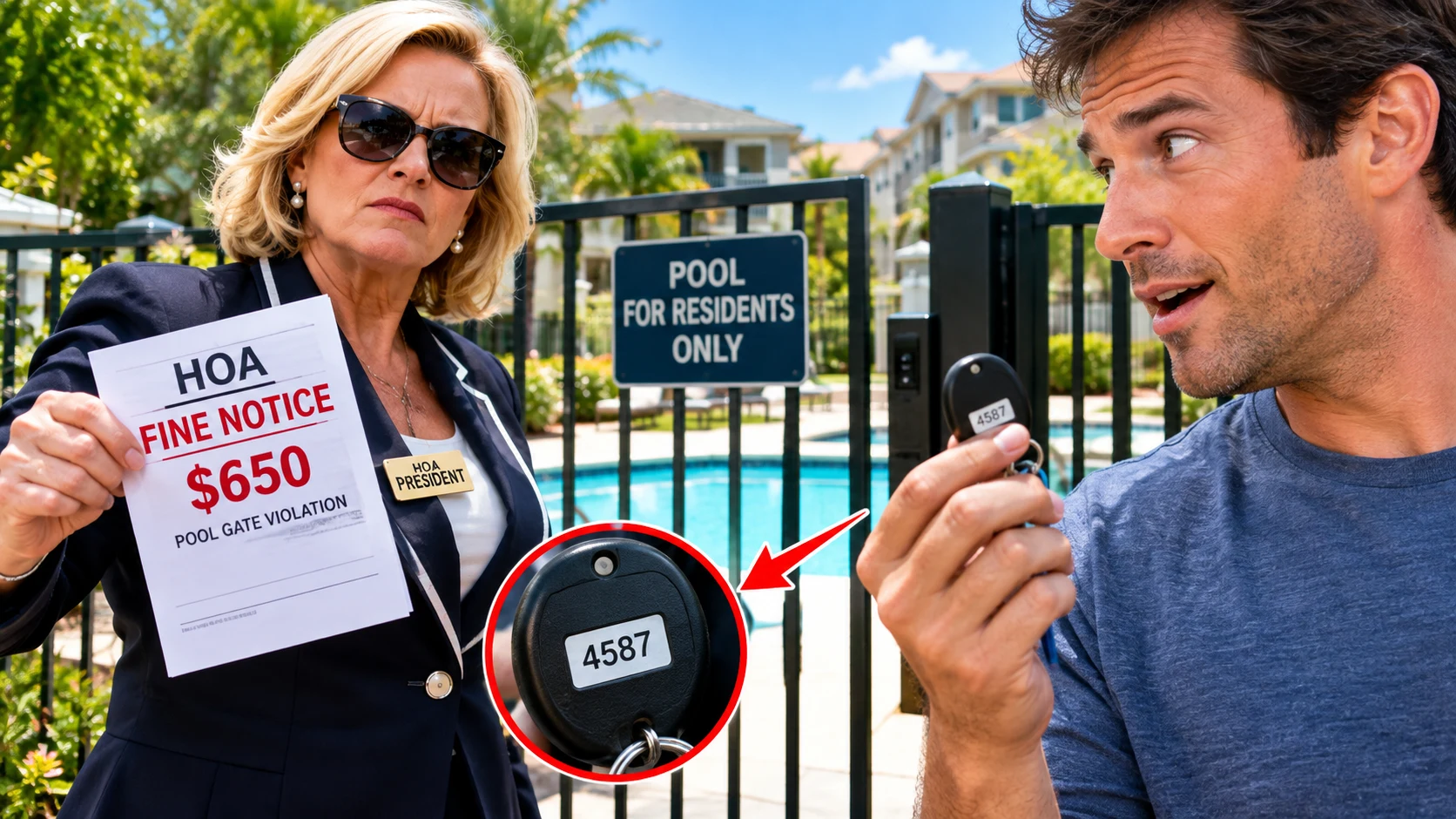
The violation sticker landed on the folding table in front of me dated April 12 — the night I was three states away at my mother's hospital bedside — and the woman who put it there was already smiling. Pat Vance doesn't smile unless the…
Pat Vance's palm came down flat on the manila folder and the crack of it echoed off the clubhouse ceiling like a gavel she didn't need yet.
The room made the sound rooms make. Fifty-odd neighbors in vinyl stack chairs arranged around three gray folding tables pushed into a U, coffee cups, phone screens glowing in laps, the smell of burnt coffee and copy toner and the faint chlorine drift coming off the pool through the window behind the board table. Every chair was taken. People I'd nodded at for eleven years, people whose dogs I'd watched while they were on vacation, people who had stood in my driveway the day after my husband died and told me to call if I needed anything, and never once after that.
I was seated at the end of the left leg of the U. My name tag, printed off a label maker in the management office, said WHITMORE, DANA — LOT 41. It sat on the table in front of me like a defendant's card.
"The violation," Pat said, straightening, smoothing the front of her cream blazer, letting her eyes travel the room on the way to mine, "is a pool gate violation. Gate found open after hours. Debris in the pool area — cups, a towel, a broken float. Fine assessed at six hundred fifty dollars. That's the number in the ledger. That's the number that goes on the lien if it isn't paid in thirty days."
The room murmured. Someone behind me said something I didn't catch and someone else laughed short and covered it with a cough.
Pat opened the folder. She turned it toward me, and even from where I sat I could see the violation sticker taped to the inside cover — white, HOA crest in the corner, the little pre-printed fields, VIOLATION: POOL GATE / AFTER-HOURS ACCESS, LOT: 41, and then the date field, filled in by hand in black Sharpie.
April 12.
I looked at it for a long moment. I didn't look up at Pat yet. I looked at the date, and I let the room hold its breath, and I counted, in my head, the way I count things when I'm trying not to say something I'll regret.
April 12. My mother had her stroke at 4:10 in the afternoon on April 11, which I know because the hospital called me at 4:22, and I know that because I have the call log. I left the house at 6:50 that night with an overnight bag, two phone chargers, and a printout of her medication list. I drove through the night. I was in the ICU waiting room in Columbus, Ohio, by 9:15 the next morning. I ate a vending machine sandwich for lunch on April 12 and held my mother's hand while she slept and talked to a neurologist named Dr. Keating at 2:40 in the afternoon. I have the parking deck receipts in the glove box. I have the hotel folio from the Courtyard on Olentangy River Road. I have the little pink visitor band, cut off the day I flew home, in the top drawer of my desk.
I was three states away on April 12. I was not at a pool gate in Texas at eleven forty-five at night. I was not even in the same time zone.
I finally looked up. Pat was watching me with a small, patient, faintly bored smile, the one she uses at the August block party when she wants you to move off her conversation.
"Pat," I said. "April twelfth."
"That's the date."
"April twelfth I was in Columbus, Ohio. My mother had a stroke on the eleventh. I was at the hospital."
Pat's smile didn't move. Behind her, the board secretary — Harriet Poole, retired schoolteacher, four years on the board, a woman who had never once spoken in a meeting I attended — looked up from her minutes notebook and looked at me for maybe a full second before she looked back down.
"That doesn't change the evidence," Pat said. "The violation stands. Clerical issues with dates don't vacate a fine."
The room shifted. Not much. But I could feel it — the little ripple of people deciding, the way a lake decides about a rock. Three chairs down, a woman I knew from the mailbox leaned toward her husband and said something behind her hand. I heard "Ohio" and I heard "her mother" and I heard the husband say "she's always got a story."
The floor is what you stand on. Pat's floor was thirty years of being the person who ran the Fourth of July decorating committee and the pool birthday party and the annual meeting, and the whole room had decided a long time ago that her floor was the load-bearing one.
I reached into my canvas tote and took out the folder I had put together over nine days. I had not planned to use the folder tonight. I had planned to use the folder at the meeting next month, after I had paid the fine and moved on with my life, because that is who I am — I pay things to make them stop. Then Pat sent her second email, the one with "pursuant to Section 6.4 of the CC&Rs, unpaid fines may be recorded as a lien against the assessed property" in bold, and I stopped paying things to make them stop.
I opened the folder flat on the table and turned it so the board could see.
"Then let's talk about the photos," I said.
Pat's eyes flicked down. It was one flick. If you weren't looking for it you would have missed it.
"Which photo are we talking about, Pat? Because I noticed something odd in the packet you gave me."
Marcus Bell, the management company's community manager — a round-faced kid in his early thirties with wire glasses and a lanyard with a photo badge and a permanent apologetic hunch — had been sitting at the side table with his laptop open and his face carefully neutral for the entire meeting. He looked up now. He was the only person in the room who looked at me like I might be about to say something true.
The photo was the second page in Pat's folder. Printout of a house camera, black and white, timestamped 11:44 PM, 04/12. A vehicle by a pool gate. Pat had reached over and tapped it twice with a manicured nail while she was reading the violation, the way you'd point at a dog in a photo.
"Page two," I said. "The plate is mine. I'll grant you that. But that gate isn't our pool gate."
The room made a small noise.
"That gate is the one at the entrance off Miller Road," I said. "The old latch. The one they replaced in February, after Marcus sent out the notice about the gate arm hitting the fence post. The latch in this photo is the old cast-aluminum one with the little hook on the top. The new latch doesn't have a hook. The new latch has the reader."
I turned the photo around to face the room and held it up.
"Also, look at the asphalt. The crack in the picture runs from the seam down to the curb in a straight line. The crack at our pool gate runs the other direction. It forks. It's been forking since 2019. You can walk down there right now and see it."
Pat said, "We're getting into the weeds here."
"I'm just saying the photo of my car isn't at our pool. It's half a mile away at the entrance gate."
A woman in the back said, "Wait. Is that the other gate?" and her husband said, "Babe, that gate didn't have a reader until October."
"November," Marcus said, without looking up. Then, quieter, flushing, "It was November fourteenth. The install went live on the fourteenth."
The room went very quiet.
Marcus kept his eyes on his laptop screen, but his hands had stopped moving. He was, I think, doing the arithmetic that I had already done nine days earlier in my kitchen at eleven at night with a cup of tea gone cold. A gate gets a reader. A reader gets a log. A log gets a timestamp for every single swipe by every single fob in the community. Pat Vance had voted for the reader install, had campaigned for it, had said at the October meeting — I was there, I remember the exact phrase — "the system will keep us honest."
I reached into my folder and pulled out the second thing.
"Marcus," I said. "Does the gate log show who opened the Miller Road gate on the night of April twelfth?"
Marcus's hands hovered over his keyboard. He looked at Pat. Pat looked at him and then at me and then at the room and then said, cheerfully, in her block-party voice, "That's not relevant."
Which is what you say when it is.
"It's a public log," Marcus said quietly, to his screen. "It's tied to the account. Any board member can request it."
"Request it," I said.
"I'll request it," said the man in the back, the one who came for the show.
"Request it," said the woman from the mailbox, and her husband said "Karen" in the tone that means sit down, and Karen didn't sit down.
"I'm requesting it," said Harriet Poole, and fifty-two people in vinyl chairs turned their heads at the same time, because Harriet had never made a motion in her life, and here she was making one with her pen in the air.
Pat laughed. It was the bright August laugh. "Oh, for heaven's sake. If we're going to open the gate log at a board meeting, we might as well open the pool gate and let the whole neighborhood swim. Nobody needs a spreadsheet —"
"Read it," I said.
"Read it," Karen said.
"Read it," the man in the back said.
Harriet looked at Marcus. Marcus looked at Pat. Pat looked at me, and I looked right back at her and did not blink, and in that stillness something crossed her face that I'd never seen there before. Not fear. Not yet. Confusion. The expression of a woman who had planned for everybody in the room except the person who had a folder.
Marcus cleared his throat. He scrolled. He scrolled again. And then, in a voice that got steadier with every word, he read:
"'Miller Road Gate. April twelfth. Fob zero-one-four. Entry, two-oh-three a.m. Exit, two-seventeen a.m.'"
Nobody moved.
"Fob zero-one-four," he read again, slower, like he wanted the room to hear it twice. "Entry, two-oh-three. Exit, two-seventeen."
The fluorescent panels hummed. Somewhere through the window behind the board table, a distant sprinkler hissed on the far side of the pool fence, the way it does every night at 8:15, and I remember thinking, clear as a photograph, that it was 8:15 and this was real.
"Marcus," Harriet said, without looking up from her notebook, "whose fob is zero-one-four?"
Marcus's fingers were on the trackpad but his eyes had come off the screen and gone to Pat and stayed there, and I could see the exact second that he decided, the way you can see a person decide to open a door they're standing in front of.
"The fob assignments are by lot number," he said. "Zero-one-four is the fob assigned to the account of the board president."
The room didn't gasp. Real rooms don't gasp. Real rooms go silent, all at once, the way a radio goes silent when the power cuts, and you can hear the refrigerator stop, and you can hear a chair leg settle on the concrete, and you can hear your own heart in your throat because you have been waiting for the noise to stop for nine days.
"That's the president's fob," Marcus said, to nobody in particular. "It's the fob assigned to Patricia Vance, Lot Six."
Pat stood up.
"I think," she said, "that this meeting is adjourned."
"It is not," said Harriet.
"Sit down, Pat," said Roberta Conley, who sat next to Pat at every meeting in the next chair over, who seconded every motion Pat ever made, who I have never once, in eleven years, heard say a word against her. "Sit down."
Pat sat down.
And Marcus kept reading.
That's the part I didn't expect, even after nine days of planning. That he would just keep going. He read the whole month of April. April 12. April 19. April 26. The three dates in the violation ledger that had stickers issued to lots 8, 12, and 41 — my lot. All three nights the pool area was found with towel debris and a broken float and cups on the concrete. Every single one. Fob zero-one-four. Entry between two and three in the morning. Exit nine to twenty minutes later. Always after midnight, always after the pool was closed, always on a night when the cleaner had already come by and the chairs had been stacked.
The fine ledger had six entries for the month of April. Three violations, three fines assessed, one paid, two pending. Mine was one of the pending ones.
Marcus read to the end of April. Then he read the line under the last entry, and I watched his brow crease in real time.
"There are more," he said.
"How many more?" Harriet asked.
Marcus scrolled. He scrolled and scrolled, and it got very quiet, and even Pat's chair stopped creaking.
"Forty-one," he said finally, and his voice cracked a little on the number, which I have never forgotten and will never forget. "Wipe that. Forty-one entries. Going back eight months. All of them Fob zero-one-four. All of them after hours."
Eight months.
Somebody in the back row — I still don't know who, I've turned it over for weeks, and I think in my heart it was one of the retired men who plays pickleball in the mornings and never says anything more than "morning" — somebody in the back row said the thing that had been sitting on everyone's tongue since Marcus read the first timestamp.
"So who's been getting fined for those?"
Harriet did not answer right away. Harriet closed her notebook. She set her pen down on top of it, aligned to the edge like she was still grading something. And then she picked up the fine ledger from the stack in front of Pat, opened it to the middle, and started reading.
Page by page. The way a schoolteacher reads a register. Date. Lot. Name. Amount.
April 26, Lot 32, warning, no fine. April 12, Lot 41, Dana Whitmore, six hundred fifty dollars, pending.
"April fifth, Lot 44, warning, no fine. March twenty-second, Lot 8, warning, no fine. March fifteenth, Lot 51, Kathryn Ruiz, four hundred seventy-five dollars, paid."
Karen from the mailbox sat up straighter in her chair. Kathryn Ruiz was her sister-in-law. I saw Karen put her hand flat on her husband's arm.
Harriet kept reading. Page by page. The pattern was sitting right there in her lap and the whole room could see it now. Every violation warning tied to fob entries from Lot 6 — Pat's lot — was recorded as a "warning" and never assessed. Every violation warning tied to an after-hours night when the gate reader showed somebody else's fob — mine, or Karen's, or the Ruiz family on March 15 — was assessed as a fine and mailed out within a week.
Somebody did the math before I did. It was the man in the back.
"Harriet," he said. "How many of those forty-one entries map to a fine that got paid?"
Harriet turned another page.
"Eleven," she said.
"Who paid them?"
Harriet ran her finger down the column.
"Eleven homeowners," she said, and she started reading names, and I want to be honest with you, because if you're still with me at this point I owe you the truth: I could barely hear them. I was still looking at Pat Vance. She had put her reading glasses on. She was looking at the ledger with a small frown, as if she were trying to remember something, as if she were a guest at a party where the host had just brought out a cake she didn't remember ordering. Her right hand was on the table next to the gavel. It was not on the gavel. It was hovering over it, maybe two inches above, the fingers not quite closed, the way you hold your hand over a stove you know is hot and can't quite believe is hot.
The gavel stayed where it was.
Marcus spoke up again, and this time there was nothing apologetic in his voice at all.
"There are also," he said, "eleven more entries in the log tied to Lot 6 that have never been matched to a violation at all. Those are nights when the gate was opened and the pool area was photographed open, and no sticker went out, and no fine was issued, and the schedule says the pool was closed. Those are nights between October and April."
The room had stopped being a room. It had become fifty-two people with their phones faceup on their thighs, watching a woman in a cream blazer which she had bought, I happen to know because I saw the tag once at the dry cleaner's, at a boutique in the next town over, on a Tuesday afternoon.
"Pat," Harriet said, "do you want to respond to the log?"
"I want to respond to the process," Pat said. Her voice was still her voice. That's the thing I've told people since, and they always think I'm exaggerating, and I'm not. Her voice did not change. "The log is a backend database. There are known issues with the mobile app duplicate-swiping when the reader is in low-power mode. I have raised this with the vendor. I have it in writing."
"You raised it with the vendor?" Harriet said.
"In an email. In February."
"Show me the email."
Pat did not show her the email.
Roberta Conley, next chair over, seconded-every-motion Roberta, stood up and looked down at Pat for a long second, and then walked out of the U and sat down in an empty chair on the far side, near the window. Just sat down. That small, that quiet, that final.
I want to tell you what I said, because everyone asks. I said almost nothing. I opened my folder one more time and I slid a single page across the table toward the board — the parking receipt from the Ohio State University Wexner Medical Center parking deck, dated April 12, 2:14 p.m., and the hotel folio from the Courtyard, and the little printout of my mother's admission line, all three pages faceup on the gray table between the coffee urn and the water pitcher, under the fluorescent light, where anyone could stand up and walk over and read them.
"That's my April twelfth," I said. "I just want it in the minutes."
Harriet wrote it down.
Then Harriet made a motion to vacate the fine against Lot 41. Roberta seconded it — from her new chair, near the window, without looking at Pat. Then Roberta made a motion to open an independent review of every fine in the ledger over the last eight months, and to transmit the fine ledger plus the fob log to the management company's regional office. The third board member seconded that one. The fourth board member, who I had never once seen vote against Pat, said, "Ay."
Pat said, "I want the record to show I object."
The record showed she objected. Harriet wrote it down.
Then Harriet made a third motion: to flag Lot 6's cabana structure for county permit review, because it appeared in the ledger as a "minor item" from August and had never been closed out, and the management company's own file said there was no permit on record.
Pat said, "That's a separate matter."
"It's a line item in your ledger," Harriet said. "It's attached to your address. It's a matter."
The vote was four to one.
Pat Vance stood up, put her folder under her arm, and walked out the side door past the window, past the pool fence. She did not look at me and she did not look at the room. Through the window I watched her cross the parking lot. Her porch light was not visible from where I sat, but I know it was on, because it had been on for the last four nights, every night since I had put the folder together, and I had noticed it every time I drove past on the way home from work.
The room emptied slowly. People stopped at my table and said things. Nobody said "I believed you." A few people said "I never liked the way she ran things" and I wanted to say, where was that in October, but I didn't, because the meeting was still in session and because I have a mortgage and because I am, at the bottom of it, a person who would rather be quiet than right.
Harriet handed me the ledger page with the Lot 41 line on it, torn neatly along the perforation, and I folded it and put it in the inside pocket of my tote. Then she shook my hand, and her hand was warm and dry and small, and she said, "I should have asked a question a long time ago."
Marcus waited until the room was almost clear. He came over with his laptop still open and stood at the end of the table like he was waiting for permission to speak.
"There's more," he said quietly. "The log goes back further than April."
I looked at him.
"How much further?"
"Eight months back I already said," he said. "But I mean — there are other things in the system. The pool card reader logs every time the pool lights come on. Those are tied to a different account. Not the gate fobs. The light switches."
"And?"
"And the light switch for the pool deck is on Lot Six too," he said. He looked at his screen and not at me. "There are ninety-four entries. Between September and now. Mostly Friday nights. Between eleven p.m. and two a.m."
I stood there for a moment with my tote on my shoulder and my car keys in my hand, and I thought about eight months. I thought about eight months of Friday nights. I thought about how many Friday nights I had spent on the couch with the television on low and my mother's voice on the phone and a microwave dinner on the coffee table. And I thought about a woman two streets over, in the house with the cabana, whose porch light had been on every night for the last four days.
"I want the whole thing," I said.
Marcus nodded. He closed the laptop.
"I'll have it for you by morning," he said. "But there's one more thing you should know."
"What's that?"
He looked over his shoulder at the door Pat had walked out of, and then back at me, and lowered his voice even further.
"Fob zero-one-four was used at two in the morning on the twelfth," he said, "but that's not the entry that's going to make the most trouble. The entry that's going to make the most trouble is at eleven fifty-four on the night of the twenty-sixth."
I had the violation sticker in my tote, the one Harriet had handed me torn from Pat's folder so it could go into the file. It had April 26 written on it too. April 26 was the second night my car had allegedly been seen at the gate. April 26 was the second sticker. April 26, eleven fifty-four at night, I was at work, three hours into a double shift at the billing office, because it was end of month and I was the only person who would stay.
"Whose car was in the photo on the twenty-sixth?" I asked.
Marcus did not answer that question.
"Drive safe," he said.
I walked out to my car. The pool fence was between me and the parking lot; I could see it through the gap in the building's side wall, the black chain-link with its two latches, one with the little reader box bolted beside it, the other hanging open on its hinge the way it hung open every night because the bolt had been misaligned for years and nobody had ever fixed it. Somebody had put a sticker on the reader box. I didn't walk over to read it. I didn't need to. I got in my car, and I sat for a full minute with the engine off, and I remember the exact number of minutes because the dashboard clock was right there, 8:47, and then 8:48, and I realized I was waiting for something to be over that had already ended.
Then I drove home and called my mother to tell her it was fine, and she didn't understand most of it because her speech was still coming back one word at a time, but she understood the word "won," and she said it back to me, twice, and I told her I loved her and I hung up and I sat at my kitchen table with the ledger page spread out in front of me and looked at the number 650 next to my name, crossed out now in Harriet's red pen, and for the first time in nine days I did not know what to do next.
That's when my phone rang.
Marcus.
"There's something I didn't say in the meeting," he said.
Advertisement
All 8 chapters
- 1"—and I have the photos right here, Dana. Right here in this folder. So before you tell this board you're the victim, I want you to look at what your license plate was doing at eleven forty-five on the night of April twelfth."
- 2He talked for eight minutes.
- 3The folder was nine files. I want to tell you what was in it, because if the rest of this story is going to make sense to you, you have to understand what I was holding by Sunday morning.
- 4The woman on the phone was named Tanisha McElroy and she was the permit clerk for the county office, and she was not in the mood for a long conversation.
- 5Deirdre Anson's office was in Phoenix and she was brisk in a way that I respected immediately because it was so unlike the clubhouse.
- 6I have to tell you what happened on Tuesday night, and I have to tell you why I made a decision that has cost me more than anything else in this.
- 7On Wednesday morning at 2:11 a.m. my phone rang.
- 8The final board meeting was on a Thursday, six weeks after the first one. Harriet called it to order at 7:00 p.m. and the gavel came down at 7:01.
You may also like

My Uncle Slapped Me at the Country Club and Called Me a Thief — But I Was Already Holding the Chit He Signed
My uncle's palm cracked across my cheek at the country-club lunch table and he shouted that I had stolen a member number that never…
The HOA President Swiped My Pool Badge and Called Me a Squatter — Then I Held Up the Deed He Notarized Himself
Dale Brandt ripped my pool badge out of my hand in front of forty neighbors and told me squatters don't get to swim. My…

The Vice Principal Tore Up My Transfer Slip at the Pep Rally — Then the Attendance Clerk Walked In With His Own Initials
Coleman Pruitt tore my transfer slip in half at the pep rally, held the pieces above my head, and told eleven hundred people I…
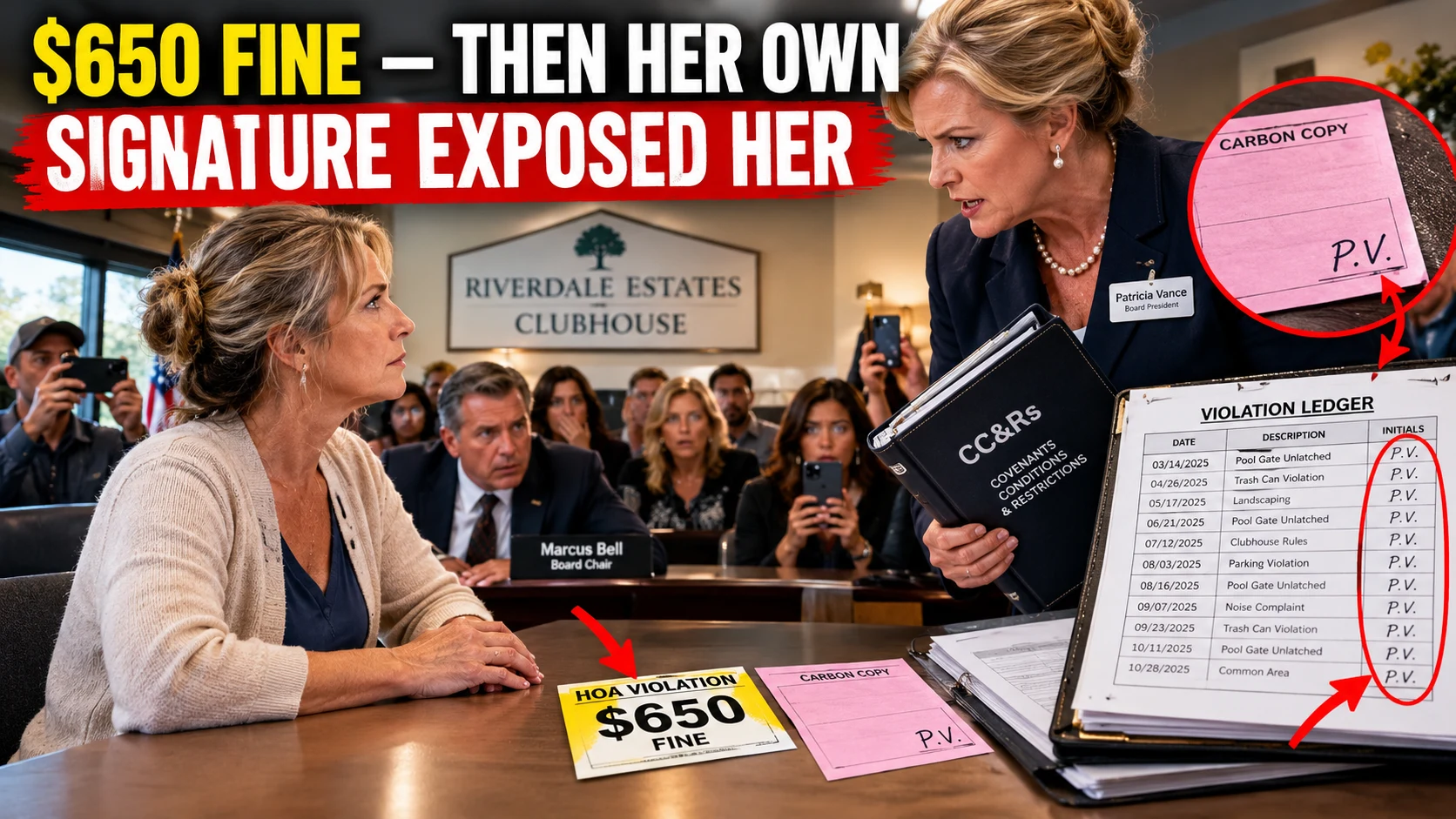
The HOA President Fined Me $650 for a Pool Gate I Never Touched — Then I Held Up the Pink Carbon Copy With Her Own Initials on It
"You left the pool gate unlatched again," Patricia Vance said, sliding the $650 violation sticker across the folding table, "and this time the board…
The Director Fired the Nursing Aide for Stealing—Then the Cabinet Fob Log Showed Whose Badge Opened It at 2:03 A.M.
The director's palm cracked down on the medication-room counter while the pill tray was still in my hands. "You took from the cart at…
She Shamed Me for a Junkyard Yard — My Doorbell Cam Caught Who Really Dumped It
"Your junkyard is why my property value dropped, Frank!" Brenda slammed the violation photo down on the table, and the whole clubhouse leaned in…