Chapter 1
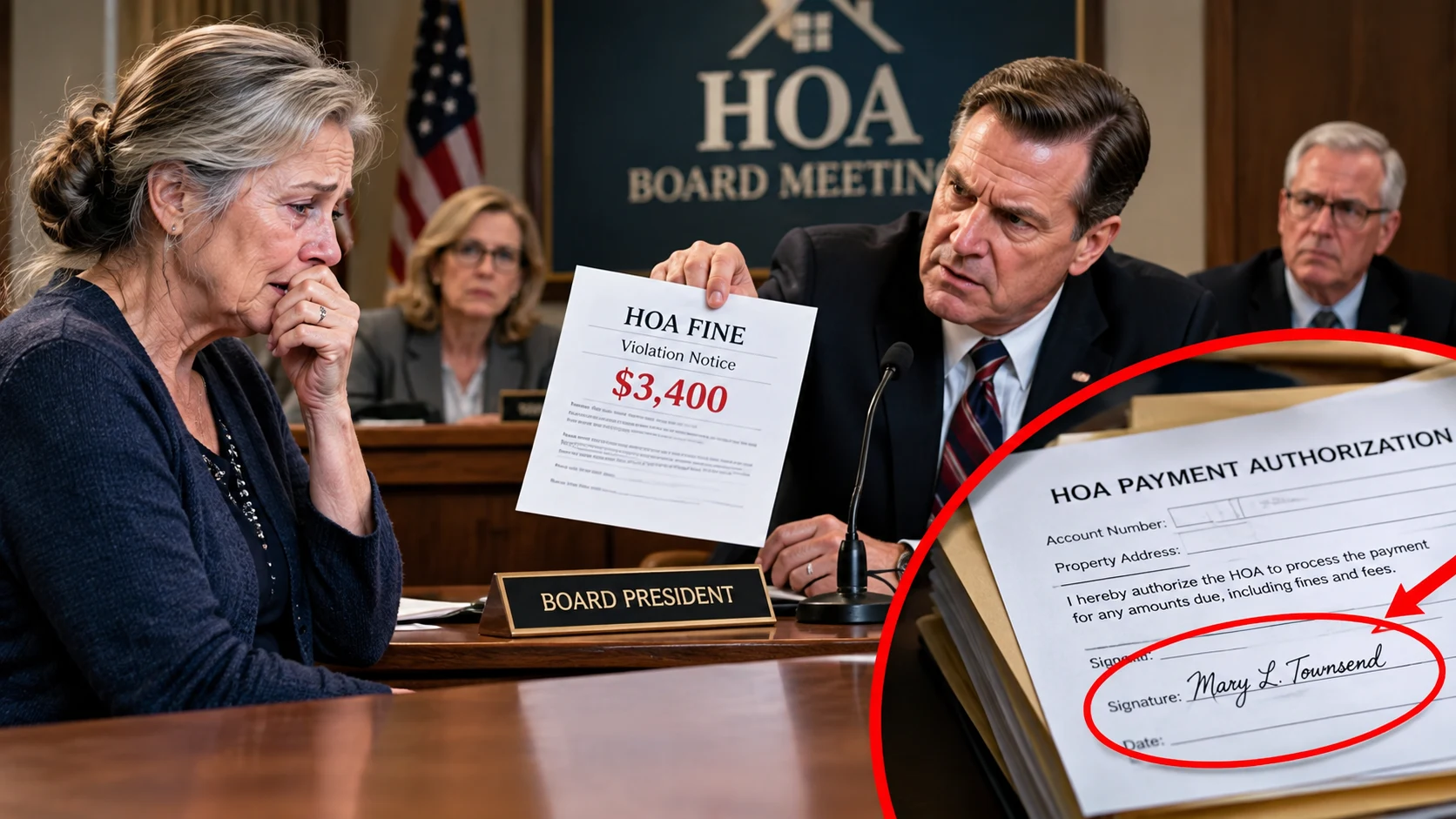
The HOA board president slammed her leather ledger on the folding table and pointed across the room. "1427 Sandpiper Court. You put up that pool deck without a permit — that's a $3,400 fine." Sixty neighbors in gray stackable chairs turned to look at Maggie…
The ledger hit the folding table before Pat Vance finished her sentence, and the sound was the only thing in the room that anyone would remember later.
"You put that pool deck up without a permit," she said. "That's a $3,400 fine."
The leather cover cracked against the dark wood edge and stayed there under her right palm, gold lettering catching the fluorescent light. Sixty gray stackable chairs had been arranged in two loose rows behind the long table, and every one of them had a person in it, and every person turned to look at the same address.
1427 Sandpiper Court.
Maggie Ellison stood on the other side of the table with a manila folder pressed against her ribs. She was fifty-eight, silver-gray hair clipped back with tortoiseshell, reading glasses hanging on a beaded chain across her light blue button-down. She did not move when the room turned. She had known the address was going to be hers since ten o'clock the night before, when the violation notice had appeared in her mailbox a second time — a photocopy of the April 3 original, this time with no return envelope and no explanation.
"You'll pay it," Pat said, "or the lien goes on your house."
Pat was fifty-four, tall, tan, blonde blown out and shoulder-length, white linen blazer over a navy blouse, silver necklace sitting perfectly on her collarbone. She had run the board for three years and she ran a meeting the way a real estate agent ran an open house — moving people through rooms, keeping them looking where she wanted them to look. She had a large gold watch on her left wrist that she checked twice during her own sentences, as though the room were a showing and she had another appointment at eleven.
The fine ledger sat open in front of her. Page seventeen. The Sandpiper line.
Maggie had seen the ledger before, from across the room in March, when Pat had read from it about the Hendersons' shed. She had not seen the page in her folder in front of anybody until now.
"You don't have to answer tonight," Pat said. "The board has the photographs. The architectural review packet is complete. We're just giving you the courtesy of an in-person hearing before we attach the lien."
A chair leg scraped somewhere in the third row. Someone near the coffee urn set a cup down too hard and the ceramic rang against the side table.
Maggie opened the folder.
She did it without any flourish, the way she used to open a lab manual in front of a class of eighth graders she was about to ask for a hypothesis. She lifted out a single page and laid it flat on the folding table, rotated it one hundred and eighty degrees, and pushed it across until it sat directly in front of the president.
Carbon paper was still attached at the top edge. The bottom right corner carried one set of initials in blue ink — two letters, P.V., wet, walking slightly uphill the way the pen had rolled.
"You signed the exception, Pat," Maggie said. "Your initials are right here."
The room made a sound that was not quite a noise. It was more like sixty people deciding at almost the same second not to say anything at all. The air conditioner clicked.
"Excuse me?" Pat said, and her smile stayed up for a beat longer than her voice did.
"March fourteenth," Maggie said. "Item six on the agenda. The architectural review committee approved a height exception for the pool deck at 1427 Sandpiper Court. You moved it, you seconded it, you signed the exception page. The clerk filed the original. This is the carbon."
"That's not—" Pat's eyes came down to the page. Her right hand stayed flat on the ledger. "—those aren't my—"
"They are," Maggie said. "You can look at the pen. It's the same pen you used on the March agenda sign-in sheet, because I sat three rows back and watched you do it."
Pat's face changed in stages, like a tan line moving under a different light. First the mouth, which had been shaped into the friendly sideways tilt she used on camera listings. Then the eyes, which dropped to the page and stayed down. Then the whole upper body, which rocked back half a step from the table edge without her seeming to know it had.
The man in the second row — Denny Booth, who had lived on Osprey Lane for eleven years — turned his head slowly toward the woman next to him and said, too loud, "Is that a carbon copy of the minutes?"
"It's a carbon," the woman said. "I can see the blue."
"Carbon copies go to the person who asks for them from the management company," Denny said, as if narrating a golf shot. "She'd have to have gone in and asked."
Across the table, Pat's voice came back a register lower. "This is a document I have no knowledge of."
"Then I'd like the board to look at it," Maggie said. "And I'd like Dave Pruitt to come up."
There was a pause, and then the silence arrived — and the thing people talked about afterward was how fast it came. A clubhouse that had been humming with two weeks of Facebook thread, with Nextdoor screenshots, with the violation sticker that had appeared on Maggie's garage door on a Tuesday morning while she was at the pool, went completely and instantaneously quiet. Not a slow hush. A hard stop, the way a classroom stopped when the intercom crackled and everyone knew the principal wasn't calling for the teacher.
Dave Pruitt stood up from the folding chair at the back-left corner of the room. He was sixty-one, stocky, gray mustache, navy community-logo polo, khakis, a lanyard with a badge clip. He had a tablet in his left hand and a black remote in his right, and he walked the long way around the rows — up the outside aisle, past the coffee urn, past the whiteboard where somebody had written the annual budget figures in green dry-erase marker.
He stopped beside the television on the rolling cart.
Pat turned her head. "Dave, sit down."
"Ms. Ellison asked me to come up," Dave said.
"I'm the president of this board and I'm telling you to sit down."
"Yes ma'am," Dave said, and did not move.
Somebody in the back row laughed — one short syllable, immediately swallowed. The room smelled like coffee and toner and warm plastic from the projector on the cart.
"I want the record to show that Ms. Ellison has produced a document of unknown origin," Pat said, turning back to the room. Her voice was steady now, in the register she used for closings. "The board will take it under advisement. This is a hearing, not a trial. The fine stands pending review. We have a full agenda—"
"Pat," Maggie said.
Pat stopped.
"You told this room in February that the second camera was offline for repairs," Maggie said. "Dave, please put the second camera on the screen."
Dave Pruitt did not move for one full breath. Then he pressed the button.
The television on the cart lit up.
It was a still image. The date stamp in the lower right corner read 04/03/2025 14:51. The image was a driveway — pale concrete, a mailbox at the curb, a hibiscus hedge along the property line. In the driveway, at the edge of the frame, a pool deck sat slightly too high against the fence line. The concrete apron on the underside was visible, bright and new, and the top rail measured against the fence at an angle that anybody in that room who had ever built anything could read in half a second.
The driveway belonged to 1439 Sandpiper Court.
Three doors down from Maggie.
The address on the mailbox was visible in the corner of the frame. The house behind it was the house everybody in that room had walked past on the way to the block party in September. The house with the black shutters and the white wicker on the porch.
Pat Vance's house.
Nobody gasped. That was the strange part. There was no group noise at all — just the small ambient buzz of the television coming off the rolling cart, and then a single chair creaking as Linda Salas leaned forward in the front row to get a better look.
"That's your driveway, Pat," Linda said.
"That is not my driveway."
"The mailbox has your numbers on it," Linda said. "I can read the four."
"It's a parallax—"
"The timestamps," Dave Pruitt said. He had not raised his voice. He had the remote in his hand and the tablet against his chest and he was looking at the television, not at the board. "April third, 2:51 p.m. Fence-line height on the north side of the deck at 1439 Sandpiper measures six inches over the CC&R limit on the tolerance sheet. The architectural review office has the measurement. I logged it myself."
The room turned from the television to Pat Vance. Sixty faces, and all of them wanting the same thing now, which was to see what a person looked like when the thing they had built a life around came off in one page.
Pat put her left hand on the ledger. Her right hand still had not moved off the carbon copy. Her face was doing something complicated — the mouth was still shaped for the listing, but the eyes had gone flat and the jaw was set too hard for the smile to hold.
"The camera system was offline," she said.
"It was offline for the community feed," Dave said. "It was recording to the local drive. That's how the system is built, ma'am. The board was told in February that the community feed was down for repairs."
"And the local drive?"
"I made a copy for the county assessor's office on Thursday," Dave said. "They requested the exception page on April seventeenth."
Pat Vance did not speak for four seconds. In the third row, someone started crying very quietly — Susan Whitfield, who had signed the architectural review packet on April 8 and had been telling people in the pool parking lot since then that Maggie Ellison had been getting away with things for years.
The board voted ninety-two seconds later, which was what the meeting minutes actually recorded, and nobody who was in that room ever agreed the meeting lasted that short. The motion was to vacate fine number 2025-0431, the Sandpiper Court pool deck penalty, in the amount of $3,400. It was moved by Linda Salas. It was seconded by Harold Chen, who had been on the board eleven years and had never seconded anything without a phone call first. It carried six to one.
The one was Pat Vance, and she voted against herself.
She stood at the head of the table with both hands flat on the ledger and said, "For the record, I am contesting the introduction of an unverified document and an unauthenticated image."
"You can contest it at the next meeting," Harold said. "The tally is six to one."
"I am the chair."
"You were the chair when you called the vote," Harold said. "You voted. It carried."
Pat Vance picked up the ledger — the leather volume, the gold lettering, page seventeen still open — and she stood there holding it for a moment with her weight shifted onto her back foot, and the room watched her decide something. What she decided was to close the ledger and sit down.
She sat down in the chair at the head of the table. The chair on the other side of the table, the seat where the homeowner or the accused was supposed to stand through the hearing and then leave, stayed empty.
Maggie Ellison sat back down in the first row, in the gray stackable chair she had been given when she walked in.
It was eleven minutes after ten.
Dave Pruitt turned the television off. The screen went dark and the little blue standby light came on in the corner, and the room slowly started to breathe again — someone stood up, someone else went for the coffee urn, and Susan Whitfield got up and walked straight out the side door without looking at anybody.
Maggie opened her folder again and slid the carbon copy back inside.
Under the page that carried Pat Vance's initials there was a second page. She did not pull it out. She turned the folder closed with the two pages inside it, and she sat with her hands folded on the cover, and she looked at the empty chair at the head of the table where the board president used to stand.
She had asked the clerk for the March minutes on April 4. The clerk had told her, over the counter at the management office, that the original was already filed with the property records and that the only copy she could give her was a carbon.
"They don't keep carbons," the clerk had said. "I keep them. Because I've watched this board change a page before."
Maggie had asked her why she was telling her that.
And the clerk had leaned over the counter and said something that Maggie had not repeated to anybody, not even Dave, not even that night, and would not repeat at any meeting until she knew who else needed to hear it.
The board meeting broke at 10:41 with no motion to adjourn. People just stood up and left. The budget whiteboard stayed on the wall with the annual numbers in green, and the coffee urn stayed on the side table with a quarter inch of coffee in it, and the pool outside the half-open blinds stayed flat and blue in the April sun.
Maggie walked out past the pool gate and stopped on the sidewalk.
Behind her, the clubhouse door opened again, and Pat Vance came out with the ledger under her arm, and she walked to her car without looking at anybody, and she drove out of the parking lot past the pool, past the clubhouse, past the cul-de-sac sign that said SANDPIPER COURT in small black letters on a white post.
Maggie watched the taillights until they turned onto the main road.
Then she took out her phone.
She had one voicemail she had not listened to yet, from a number with a 512 area code that had called twice that morning. The county assessor's office was in that area code. The voicemail had come in at 9:52, while the meeting was already in session.
She put the phone back in her pocket without pressing play.
Advertisement