Chapter 1
Story: She Slapped Her at the Estate Reception, Then a Photograph Fell From the Old Jacket
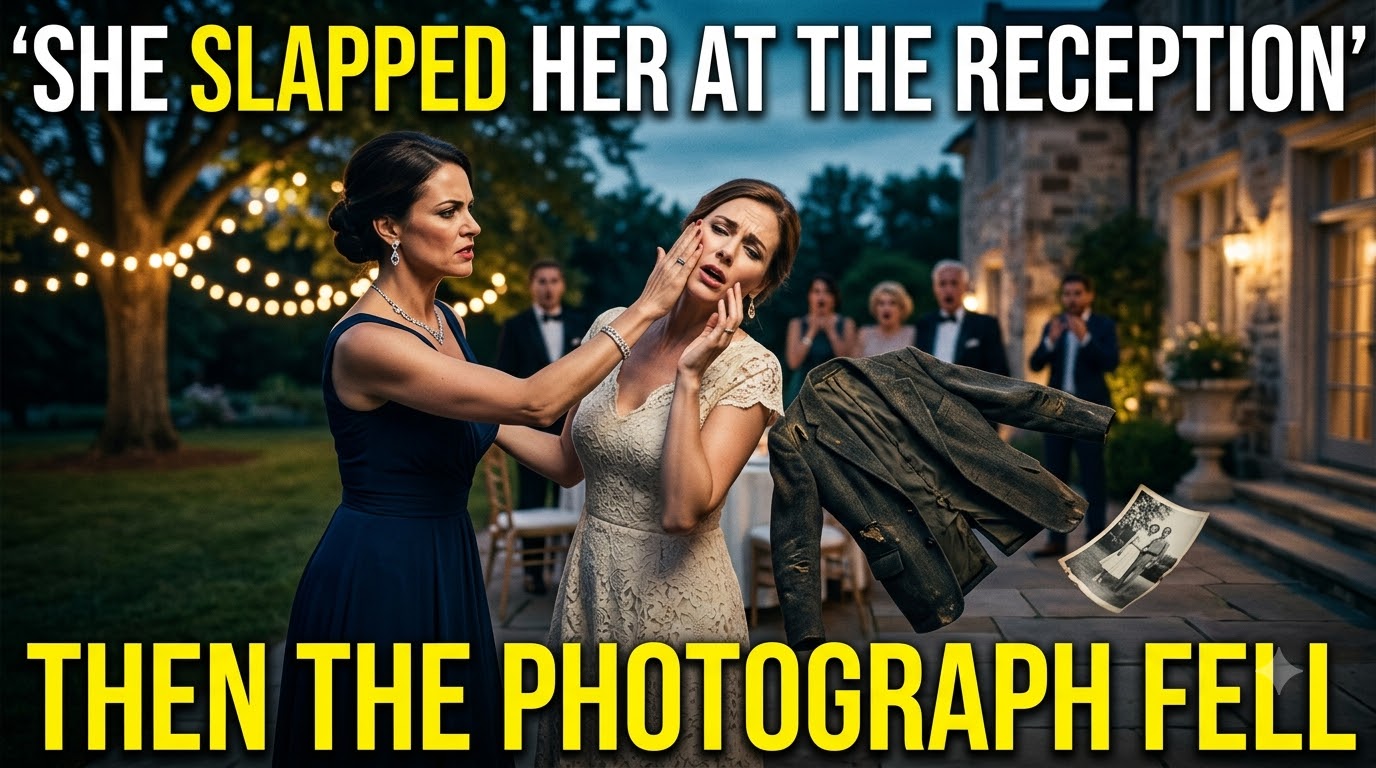
"You brought this shame here." Dorothy's palm cracked across Wren's cheek in front of every guest at the estate reception — and the room went quiet enough to hear the crystal glasses ring. Wren stands to lose the only thing she has left: her place…
The crack of Dorothy's palm against Wren's cheek stopped the reception hall mid-sentence.
Wren's head snapped to the right, the force of it rocking her on her heels. A sting bloomed across her jaw, hot and sharp, and she tasted the faint copper of her own lip where her teeth had caught it. The room around her — the warm chandelier light, the plum and cream walls, the gold trim catching every lamp — seemed to hold its breath. Crystal glasses stopped mid-lift. Conversations died in open mouths. The long carved reception table with its crystal punch bowl sat between her and the tall windows, and for one long second, nobody in the Halloway estate moved at all.
"Theo's name was on my tongue and you said not to speak it," Dorothy said, her voice cracking high and loud enough for the back of the room to hear. Her gold bangles rang as her hand dropped back to her side. "You brought this shame here. Into my home. Into your father's memory."
Wren lifted her chin slowly. Her hand stayed at her side, fingers loose, though her jaw throbbed where the rings had caught. She did not raise a hand to her face. She did not step back. Behind her, the guests who had been laughing at something near the punch bowl now stood frozen, none of them meeting her eyes, all of them watching.
"I didn't bring him," Wren said, low and level, the rasp in her voice barely carrying. "He's been here for an hour. You saw him arrive."
Dorothy's face colored. The platinum bob with its blue streak caught the light as she turned, presenting her profile to the room, one hand pressing to her chest in a gesture that wanted to look wounded. "An hour. An hour, and you think that makes it acceptable? That child — that —" She searched for the word, and the room leaned in to hear it. "That child has no place in this family. I've said it from the day your brother brought him home, and I will say it until someone in this house has the sense to agree with me."
A small sound came from the left, near the tall window.
Wren's eyes cut to it. Theo sat in the padded chair by the window, small for his four years, his red hoodie pooling around him like a tent, his blue shorts and white sneakers barely reaching the floor. His short black curls framed a face that was perfectly still, perfectly watchful. His hands gripped the armrests, knuckles pale, and he was looking at Wren with the kind of quiet attention that children learn when they've learned not to make noise.
He did not cry out. He did not say her name. But his mouth opened, just a fraction, and closed again.
Dorothy followed Wren's gaze and made a sound of disgust. "There. You see? He doesn't even speak. Does he speak, Wren? Does that child have a voice, or does he just sit there like a —"
"Don't," Wren said.
The word was quiet. It did not carry. But something in it made Dorothy stop, made the room draw in again, made the guests by the tall windows shift on their feet.
Wren turned to face her aunt fully. The red mark along her jaw was rising now, an angry stripe against her dark-brown skin, but her eyes were dry and her voice was steady. "He speaks when there's something to say. He's four. He's learning which words are safe."
Dorothy laughed, a short brittle sound. "Oh, the martyr. The quiet one. Standing there in that grey dress like a mourner at a wedding, acting as if this family hasn't carried you for years." She swept a hand toward the room, the bangles clattering. "You think they don't know? You think they didn't see you take and take and take, and then bring that — that —"
"Stop saying 'that.'" Wren's voice didn't rise, but it sharpened. "His name is Theo. He is your grandson. When you say 'that,' you sound like an animal."
The room went colder. Someone near the punch bowl set down their glass with a click that carried.
Dorothy's eyes narrowed. The performative warmth drained from her face, and for a moment, Wren saw something real underneath it — not anger, but fear. It was there and gone in a blink, replaced by a wide, tight smile directed at the guests.
"You hear that?" Dorothy said, pitching her voice to the room. "The disrespect. In her father's house, at her father's memorial reception, she calls me an animal." She laughed again, shaking her head. "I raised three children in this house. I hosted every Christmas, every birthday, every funeral. And she — she brings a stranger's child to her own father's remembrance and expects us to pretend."
"He's not a stranger's child," Wren said. "And this isn't Dad's memorial. It's a reception. There's a difference, and you know it."
But Dorothy was already moving, closing the distance between them, and the room drew back like a tide. Wren held her ground. She had held her ground through worse. She had held her ground through every Thanksgiving, every family vote, every whispered conversation that stopped when she entered a room.
Dorothy stopped an arm's length away, close enough for Wren to smell her perfume — something floral and expensive, worn like armor.
"Give me the jacket," Dorothy said.
Wren blinked. "What?"
"The jacket." Dorothy's eyes dropped to the garment draped over Wren's arm — an old tweed jacket, worn soft at the elbows, the color of autumn leaves. It had been their father's favorite. He had worn it every year on the first cold day, and it still smelled faintly of him, of cedar and pipe smoke and the long hallway of the estate. "It belongs to this house. It was his. You have no right to carry it out of here like a keepsake from a grave you never visited."
Wren's hand tightened on the jacket. "Dad gave it to me. The week before he died. He said —"
"I don't care what he said." Dorothy's hand shot out, but Wren stepped back, pulling the jacket with her, and Dorothy's fingers closed on empty air. The guests murmured. Near the punch bowl, a tall man in a navy suit turned away, suddenly interested in the tall windows. By the door, a woman in cream fumbled for her phone, then stopped herself.
"The recording," Wren said quietly. "Check the recording."
Dorothy's face went blank. "What recording?"
"The estate cameras. The ones you had installed after the last reception, when you said you wanted to catch whoever was stealing the silver." Wren's voice was careful, measured, each word placed like a stone. "The cameras cover every window in this hall. Every door. Every chair."
The room went very quiet.
Dorothy's lips parted, and for a moment, she had nothing to say. The bangles on her wrist caught the light as her hand twitched, and Wren saw it again — that flicker of something real behind the performance. Fear. It was there and gone, but Wren had seen it.
Theo made a small sound in the chair by the window. Not a word. Just a breath, a shift of weight. His white sneakers swung, stopped, swung again. His eyes never left Wren's face.
Dorothy turned to face the room, her smile back in place, her voice honeyed. "I think we've all had enough drama for one evening. The reception is over. Please —"
"Not over," Wren said.
The words stopped the room again. Dorothy turned back to her, the smile fraying at the edges.
"Not over," Wren repeated. "You slapped me in front of my family. You called my nephew — your grandson — 'that child' in front of every person in this room. And you did it in a hall with cameras on every wall. So either you planned this, which means you knew the cameras would catch it, or you lost control, which means you're not as careful as you think you are."
Dorothy's jaw tightened. "You think you're clever."
"I think I'm tired." Wren's voice cracked on the last word, and she hated that it did. She drew a breath, steadied herself, and looked at the room — at the faces that had watched her be slapped and done nothing. "I'm tired of being the one who keeps quiet. I'm tired of being the one who makes peace. And I'm tired of watching the people in this house pretend they don't know exactly what's happening."
She looked at Dorothy. "The cameras. Tomorrow. I'll have my lawyer pull the footage, and we'll see what you were doing in this hall before I arrived."
Dorothy said nothing. Her face had gone pale beneath the plum silk, and the gold earrings trembled slightly with a pulse at her jaw.
Wren turned and walked toward the door, the jacket still over her arm, Theo's eyes still on her back. Behind her, the room stayed frozen until she reached the threshold, and then the whispers started, a low tide of them, rising to fill the silence she left behind.
She didn't look back. She didn't need to. She had seen what she needed to see in Dorothy's face, and it wasn't anger.
It was fear.
And Wren had learned, in thirty-four years of being the quiet one in this family, that fear always left a trail.
Advertisement
You may also like

She Paid for Five Business-Class Seats to Maui. At the Gate, Her Ticket Was Already in Another Woman's Hand.
"Her seat is confirmed. You can head home." That was the sentence Margaret Ellsworth heard at Gate B12 in Chicago O'Hare, six months after…

A Year After the Divorce, He Mocked Her in the Maternity Wing — Then the Elevator Opened
"Best decision I ever made — leaving you," Derek called out across the maternity wing, loud enough for the whole corridor to hear. Mara…

He Threw Coins at Her Shoes in the Showroom She Secretly Owned
"Three million dollars for this car," Derek said, then reached into his blazer and threw crumpled bills and loose change across the marble floor…

On New Year's Eve She Served Dinner to One Person While Fourteen Guests Watched
"My family is starving! Table's not set!" Vanessa screamed across the kitchen, both palms slamming flat on the island — and Ruth kept eating,…

She Told the Soldier to Leave Her Own Lake House — Then the Humvee Rolled Up
"Pack up and leave, today." Carla jabbed her finger at the driveway glass like she was shooing a stray dog off her porch. Dana…

Five Years After the Divorce, He Walked Up to Her at the Wedding — Then a Little Girl Called Her Mom
"Leaving you was the best decision I ever made," Douglas said, and waited for Mara's face to break. Five years of rehearsal, and he…