Chapter 1
Story: She Paid the HOA Fine in May—Her President Signed It, Then Struck Her in July
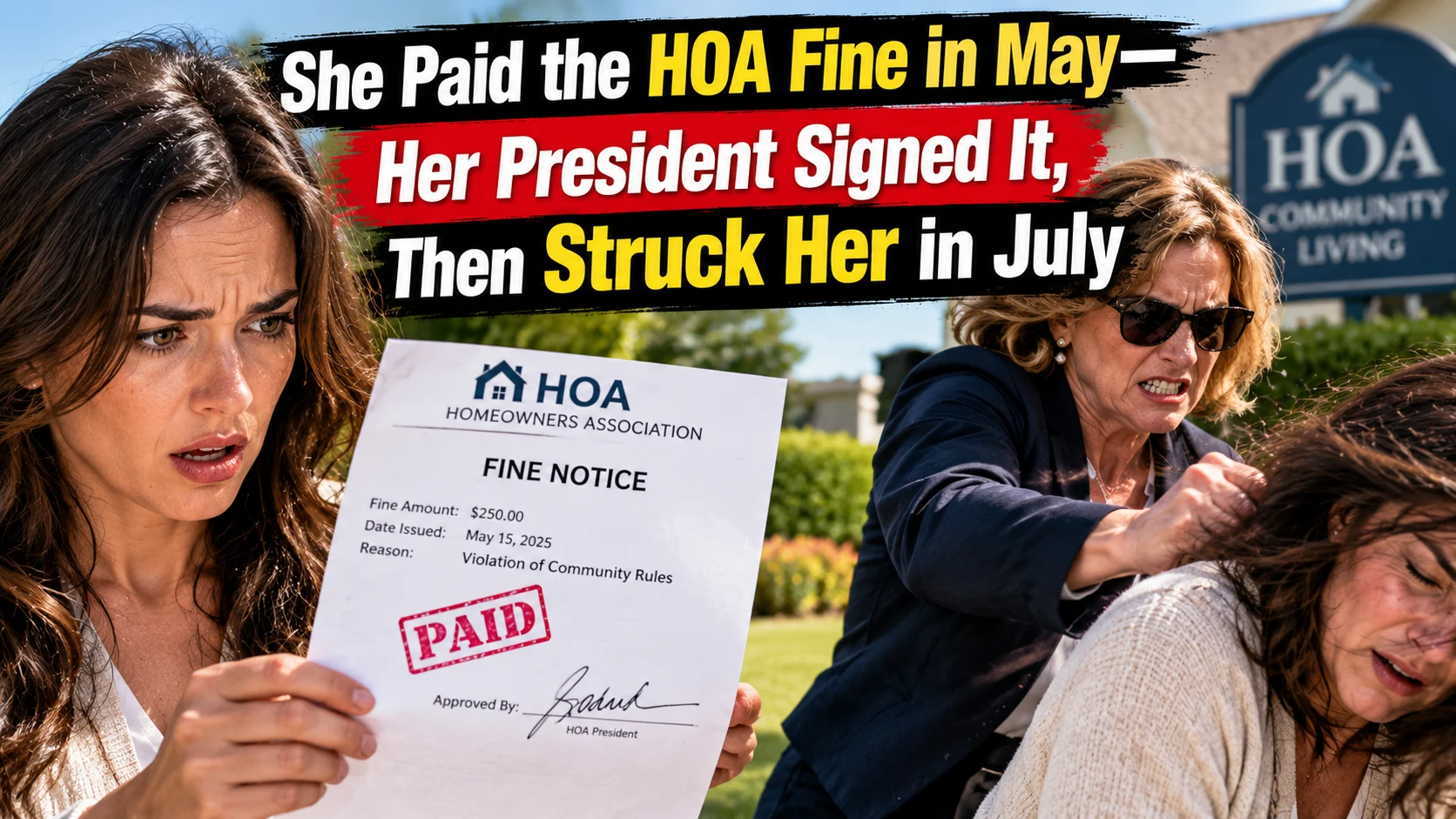
The three-ring binder caught her flush at the left temple, hard enough to snap her gray ponytail sideways before the room even heard the thud. The seated woman in the navy blouse and tan cardigan, frame-center at the long table (Diane Marsh), took the hit…
The thud arrived before the silence. That was the strange part—the way the room went quiet a half-second too fast, like the air itself had been slapped out of the building. Twelve people sat in the folding chairs behind Diane Marsh, their mouths already open, their eyes already wide, and not one of them had made a sound yet. The sound was still bouncing off the cheap paneling. The sound was still ringing inside her skull.
Diane felt the impact as a white flash behind her eyes. Her head snapped right, her gray ponytail whipping after the motion, and she was aware, in a faraway way, that her left arm had flown open like a broken wing. Her body folded toward the table edge, and it was only instinct that brought her forearm up in time to catch her forehead before it met the wood. She hung there, bent over her battered leather folder, her breath hitching in her chest.
A thin line of warmth traced down her cheek. She reached up without thinking, pressed her palm to her left temple, and felt the sticky slick of blood.
"You let the grass die because you wanted to sell cheap!"
Mark Barlow's voice boomed off the walls. He was still standing over her right shoulder, his heavy silver watch catching the fluorescent light, his right hand settling at his hip where the thick black three-ring binder had just completed its arc. The binder lay on the table beside her folder now. He had dropped it there like it was nothing. Like he had just swatted a fly.
Diane kept her palm pressed to her temple. She could feel her pulse hammering under her fingers. She could hear the pool filter humming through the open window, the distant chirp of crickets in the Texas dusk. And she could hear the silence—that awful, too-fast silence—as twelve neighbors sat frozen in their chairs, waiting to see what she would do.
What they expected was tears. What they expected was her to cry, to shout, to run out of the room with her hand over her face. That was what the board had always gotten from her before. Four years of hearings, four years of fines, four years of folding her hands in her lap and saying, "I understand, Mr. Barlow," while he talked down to her like she was a child.
She had practiced this moment, though. She had practiced it in her kitchen at 2 a.m. while her coffee went cold. She had practiced it in her car in the parking lot of the clubhouse, her hands gripping the steering wheel, the folder in her lap. She had rehearsed the words so many times that they had lost their fear.
Mark Barlow slapped a color photograph onto the long table. The print showed her lawn—or what used to be her lawn—brown and brittle, the grass lying flat like straw. The date stamp in the corner read July 14.
"That's four-thousand-eight-hundred dollars," Mark said, his finger jabbing at the photo, "or we file the lien tonight."
Diane looked at the photo. She looked at the date stamp. And she felt her hand, almost of its own accord, drop from her temple and reach into the interior pocket of her folder.
"Did you hear me?" Mark leaned closer, his cold blue eyes narrowing. "We all saw the lawn. You have no one to blame but yourself."
At the far left end of the table, the management-company clerk, Susan Gable, went pale. Diane saw it happen. Susan's pen, which had been clicking nervously a moment before, froze mid-click. Her eyes traveled from Mark's face to the violation photo, then down to Diane's folder, and her lips parted slightly.
Diane pulled the check from the folder.
It was a single white slip, folded twice, creased from months of being carried to every single hearing since May. She unfolded it slowly, deliberately, and held it up toward the window, where the orange Texas dusk light made the paper glow.
"I paid this fine in May," she said. Her voice was flat, steady, the voice of a woman who had stopped being afraid. "You signed it."
The silence that followed was different. It was not the stunned silence of the assault. It was the silence of a room that is suddenly, violently aware that the script has changed.
Mark's hand reached for the paper. For half a second, Diane thought he might actually grab it, might tear it in front of everyone. But then two men in the back row stood up. And Mark's hand stopped in mid-air.
"Let me see that," he said. His voice had changed. It was thinner now, higher. "That's—where did you get that?"
"From May," Diane said. "From when I paid you. From the day you signed it."
She held the check higher, angling it toward the window so the signature caught the light. She didn't need to say what the signature was. Everyone in the room knew Mark Barlow's signature. They had seen it on every piece of paper the board had ever produced. That bold, slanted scrawl was as familiar as his voice.
"I don't understand," someone in the back said. A woman's voice, uncertain. "What is she talking about?"
Mark's wife, seated at the far end of the board table, was already sliding her chair away from him. She did it slowly, almost imperceptibly, but Diane saw it. She saw the way Carol Barlow's eyes dropped to her purse, the way her fingers tightened around the clasp.
"It's a forgery," Mark said. His voice cracked on the word. "She—she must have had someone forge it. That's not my signature."
"Then why did the bank cash it?" Diane asked.
The room went still again. Susan Gable, the clerk, had risen from her seat. She was walking toward the corner of the room, toward the recycling bin, her sensible flats making soft sounds on the linoleum.
"I've seen that account number before," Susan said, her voice small but steady. "It's not the HOA account."
Mark turned to look at her. His face was going gray under the fluorescent light. "Susan—"
"Mark told me to lose the first appeal," Susan said. She had reached the recycling bin now. She bent down, her gray blazer straining at the shoulders, and pulled out a stack of papers. "He told me if I didn't, I'd be looking for a new job. I've been keeping copies of everything for a year."
Diane lowered the check. She placed it on the table in front of her, next to the folder, the signature still visible. She looked at Mark Barlow, the five-term president of the Willow Creek Homeowners Association, the self-styled mayor of the neighborhood, the man who had just hit her in the head with a binder full of rules.
"You have my payment," she said. "Now I want your resignation."
Mark opened his mouth to respond, but no sound came out. And then, behind her, Diane heard the scrape of a chair and the sound of footsteps on linoleum. She turned to see a man in a gray suit standing in the doorway at the back of the room, holding an envelope that seemed to have weight to it.
The lawyer.
Mark's lawyer.
He began to walk forward, his face unreadable, and Diane felt something cold settle in her stomach. She looked at the envelope, at how fat it was, at how certain the lawyer looked. And she realized, with a clarity that cut through everything else, that Mark Barlow had not come to this hearing planning to lose.
He had come planning to win.
The question was what was in that envelope. And whether the police would arrive in time.
Advertisement
You may also like

She Paid for Five Business-Class Seats to Maui. At the Gate, Her Ticket Was Already in Another Woman's Hand.
"Her seat is confirmed. You can head home." That was the sentence Margaret Ellsworth heard at Gate B12 in Chicago O'Hare, six months after…

A Year After the Divorce, He Mocked Her in the Maternity Wing — Then the Elevator Opened
"Best decision I ever made — leaving you," Derek called out across the maternity wing, loud enough for the whole corridor to hear. Mara…

He Threw Coins at Her Shoes in the Showroom She Secretly Owned
"Three million dollars for this car," Derek said, then reached into his blazer and threw crumpled bills and loose change across the marble floor…

On New Year's Eve She Served Dinner to One Person While Fourteen Guests Watched
"My family is starving! Table's not set!" Vanessa screamed across the kitchen, both palms slamming flat on the island — and Ruth kept eating,…

She Told the Soldier to Leave Her Own Lake House — Then the Humvee Rolled Up
"Pack up and leave, today." Carla jabbed her finger at the driveway glass like she was shooing a stray dog off her porch. Dana…

Five Years After the Divorce, He Walked Up to Her at the Wedding — Then a Little Girl Called Her Mom
"Leaving you was the best decision I ever made," Douglas said, and waited for Mara's face to break. Five years of rehearsal, and he…