Chapter 1
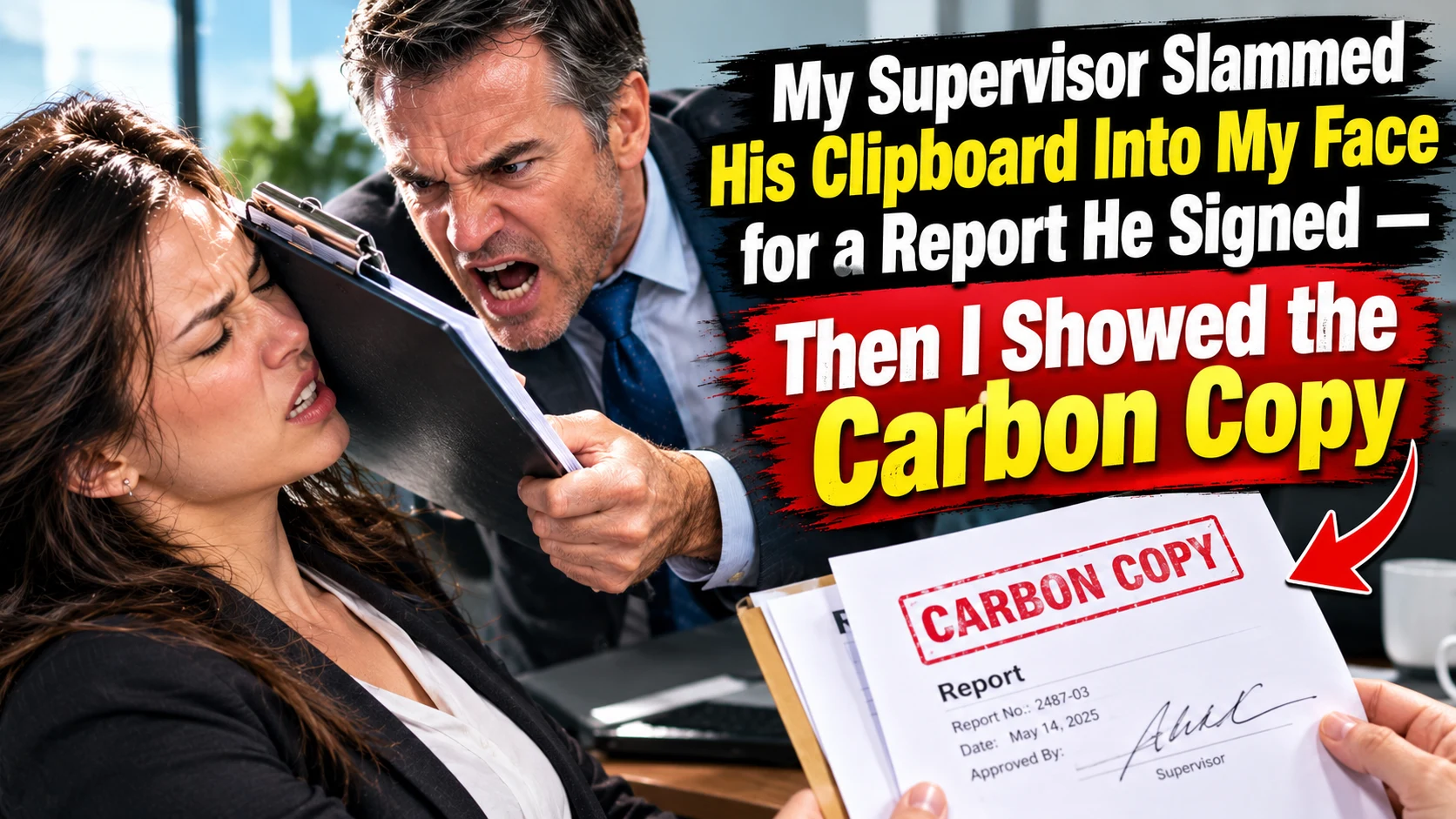
The break cage went dead silent the second Mark Teller's black clipboard cracked across my left cheek. I felt the impact in my teeth before I heard it echo off the wire walls. For three days I had carried the proof in my glove pocket,…
"You filed that false report to get me fired."
The words hit me a half-second before the clipboard did. Mark Teller's voice bounced off the wire mesh of the break cage, loud enough that heads turned all the way down the production line. I opened my mouth to answer, and then his right arm swung.
I saw the black clipboard leave his hand. I saw his knuckles whiten around the grip. I saw the flat edge of it coming toward my face, and I had just enough time to think — he's really doing this — before the plastic cracked across my left cheekbone.
My head snapped to the right. Pain exploded behind my eye, sharp and hot, and I heard the sound before I felt it — a dry, hollow crack that echoed off the concrete walls. That's the thing about being hit in the face. It's never the pain that comes first. It's the surprise. The part of your brain that thought, not him, not here, not in front of everyone. That part takes a second to catch up with the physics of what just happened.
I stood there, boots planted, and let the sting wash through me. Fourteen years on this floor, and nobody had ever raised a hand to me before. Fourteen years of clocking in early, staying late, covering shifts when people were sick, keeping my mouth shut when Mark took credit for my line's numbers. Fourteen years of being invisible enough to be safe. And now Mark Teller had hauled off and hit me in front of my entire shift.
My left hand moved automatically toward my pocket. It was instinct, the same instinct that had kept me awake every night since Tuesday — checking, patting, making sure the paper was still there. The carbon copy, folded once, sitting against my hip with my canvas work gloves. Three days now. Three days I'd been carrying it, waiting for the right moment. I hadn't known the right moment would feel like my teeth rattling in my head.
The machinery kept running behind us. The big press was still stamping, the conveyor belt still whirring. But in the break cage, the world had gone quiet. I could feel the eyes on me — twenty, thirty people, their faces pressed between the wire gaps, nobody moving, nobody saying a word.
"You hear me?" Mark stepped closer, jabbing the clipboard at my chest. His face was red, the way it got when he'd been yelling, and a thin line of spit collected in the corner of his mouth. "That report never existed. You filed it to settle a family grudge, and now you're wasting everyone's time."
The irony of him mentioning family had to be intentional. Mark had been my brother-in-law for over twenty years, ever since his brother Luis married my sister Rosa. We'd shared Thanksgivings, birthdays, funerals. He'd watched my kids grow up. And now here he was, standing two inches from my face, calling me a liar loud enough for the whole floor to hear.
"You know that's not true." I said it quietly, the way I always did. The way I'd said it a hundred times to him in private, in the parking lot after the ER visit, in the hallway when he'd tried to make me quit. "You know exactly who wrote that report."
Mark's eyes flickered, just for a second. Then he recovered, his voice rising. "Oh, look at that. The victim act. You think because you're Luis's wife's sister, you get special treatment?" He turned to the crowd, appealing to them. "'I've worked here fourteen years, I'd never falsify a safety document.' Tell them, Diane. Tell them how you were the only one in the office Tuesday afternoon."
That was the trap. He knew I'd been in the office. But he didn't know what I'd seen there. He didn't know I'd come in early to pick up the overtime slips for the third shift, and I'd stood in the doorway long enough to watch him rip a page from the shift log and shove it into his own desk drawer. He didn't know that fifteen minutes later, I'd seen him take that same page to the shredder bin and drop it in.
And he certainly didn't know that at 4:07 that afternoon, after he'd gone home for the day, I'd pulled the carbon copy out of the recycling bin myself.
I touched the paper through my jeans. The edges were soft from three days of wearing the same pants. I knew every word on it by heart. The date, the incident number, the near-miss description — "Line 4 conveyor jam, supervisor logged and rectified" — and the signature line at the bottom, scrawled in blue ink: MT.
And then the word everyone kept missing. Environmetal. Not environmental. Environmetal, with an extra M. A mistake Mark Teller had made on every piece of paperwork for twenty years. A mistake I'd watched him make a thousand times, laughing about it, saying spelling was for secretaries.
"I didn't file any report, Mark." I kept my voice steady. "You did."
The words landed wrong. I saw it on his face, the flicker of uncertainty. But the crowd didn't know what I knew. They just heard the quiet line worker talking back to the supervisor, and that was enough to make them shift their weight, to look at each other, to wonder if I'd finally lost it.
"You're done." Mark's voice dropped, threatening. "You understand me? You're done at this plant. HR will be here by the end of the day to process the termination. I've already written it — 'failure to maintain trust, willful falsification of safety documentation.'" He snapped his fingers. "Fourteen years, gone. All because you thought you could back-talk a supervisor."
I didn't answer. I was watching his hands. In the ten minutes he'd been yelling at me, he'd never once put the clipboard down. It was still in his fist, white-knuckle grip, raised slightly like he might swing it again. The violence wasn't over. It was just waiting.
Ellen cleared her throat from the table behind me. I hadn't even heard her move, but when I glanced back, she'd lowered her coffee cup and was watching us with those sharp, careful eyes. Fifty-five years old, twenty-two years on the floor, and I'd never once heard her raise her voice. We worked the same shifts, same line, same cage, and she'd never given me anything more than a nod at shift change.
But now she was looking at me, not Mark, and there was something in her expression I couldn't read. Almost like she was asking a question.
"You got something to say, Ellen?" Mark turned his attention to her, his voice dripping with contempt. "You want to weigh in on Diane's little story?"
Ellen picked up her coffee cup, took a slow sip, and said nothing. Mark let out a short, ugly laugh.
"That's what I thought." He turned back to me. "Now I'll tell you what I told you Tuesday. Walk away, Diane. Give me your badge, and we forget the whole thing. Keep the fourteen years on your record. Walk away clean."
"Clean?" I heard my voice crack. That woke me up. I'd been holding it together — the quiet, the steady hands, the years of practice at swallowing pride — but that word broke through. "You hit me, Mark. In front of everyone. And you want to talk about clean?"
Mark blinked. For the first time since he'd started, he didn't have a response ready. The crowd shifted again, and I could feel the mood change. People had been willing to believe me a problem employee. But now they'd seen him swing that clipboard, and that's a different kind of story. That's a story that makes people take out their phones.
"The report never existed." Mark said it like a prayer, like he could make it true by repeating it. "You're lying."
I took a breath. My fingers brushed the edge of the paper in my pocket. The carbon copy. The one he'd tried to shred. The one with his own initials on the signature line and the misspelled word that could only have come from his hand.
"Mark." I waited until his eyes locked on mine. "Do you remember what you wrote on line four of the incident form? The 'description of event' box?"
His face went blank.
"You wrote 'Line 4 conveyor jam, supervisor logged and rectified.'" I said it slowly, giving every word weight. "And you signed it MT. Right below the section header."
"That's not—"
"In one of your reports, you spelled 'environmental' wrong," I said, and I let the silence hang for just a beat. "You've always spelled it wrong. Every report for twenty years. Environmetal. With an extra M."
Mark's jaw worked. He looked from me to the crowd, then back. "You can't prove—" he started, and then the words died in his throat.
He'd remembered. I saw it in his eyes. He'd remembered what had gone into the shredder. He'd remembered what he thought was gone forever.
"Ellen," I said, not taking my eyes off Mark, "do you remember what happened at 2:14 last Tuesday?"
Behind me, I heard the soft clink of her coffee cup meeting the table. A long pause. Then her voice, flat and careful: "I remember. The conveyor jammed. Mark came back from the office, said it was handled."
"Did you see him log it?"
Another pause. Then: "I saw him carry a report."
Mark's face drained to a pale, gray white. His fist tightened on the clipboard, and for one terrible second I thought he was going to swing again. But he just stood there, breathing hard through his nose, the uncertainty rotting into something I'd never seen on him before.
Fear.
"I think we're done here." He announced, but the authority was gone from his voice. He was already scanning the room, looking for an exit, looking for a way to walk all of this back. "Back to work. Everyone back to work."
Nobody moved.
"I said—" Mark's voice cracked, and that was the moment. That was the second the spell broke, the second the shift stopped being his. He felt it. I watched him process it, watched him realize that a supervisor who swings a clipboard at a forty-eight-year-old woman doesn't get to just say "back to work" and have it happen.
"Mark." I said his name again, and he turned to look at me, and I reached into my pocket.
I felt his eyes widen as my fingers closed around the folded paper. I felt the weight of it as I pulled it out. And I felt the room lean in, the way a room does when it's watching the moment shift from one person to another.
"Before you say another word," I said, holding the carbon copy flat in the air, "I want you to remember what you put in the shredder."
I unfolded the page. The blue ink caught the fluorescent light, my initials nowhere on it, Mark's all over it. And I let the silence build, let the whole shift look at the proof in my hand, let the truth settle into the air between us.
"Because this is a carbon copy," I said. "And carbon copies don't lie."
Advertisement
You may also like

She Paid for Five Business-Class Seats to Maui. At the Gate, Her Ticket Was Already in Another Woman's Hand.
"Her seat is confirmed. You can head home." That was the sentence Margaret Ellsworth heard at Gate B12 in Chicago O'Hare, six months after…

A Year After the Divorce, He Mocked Her in the Maternity Wing — Then the Elevator Opened
"Best decision I ever made — leaving you," Derek called out across the maternity wing, loud enough for the whole corridor to hear. Mara…

He Threw Coins at Her Shoes in the Showroom She Secretly Owned
"Three million dollars for this car," Derek said, then reached into his blazer and threw crumpled bills and loose change across the marble floor…

On New Year's Eve She Served Dinner to One Person While Fourteen Guests Watched
"My family is starving! Table's not set!" Vanessa screamed across the kitchen, both palms slamming flat on the island — and Ruth kept eating,…

She Told the Soldier to Leave Her Own Lake House — Then the Humvee Rolled Up
"Pack up and leave, today." Carla jabbed her finger at the driveway glass like she was shooing a stray dog off her porch. Dana…

Five Years After the Divorce, He Walked Up to Her at the Wedding — Then a Little Girl Called Her Mom
"Leaving you was the best decision I ever made," Douglas said, and waited for Mara's face to break. Five years of rehearsal, and he…