Chapter 1
Story: My Sister Swatted My Baby at Christmas Dinner — Then My Husband Stood Up
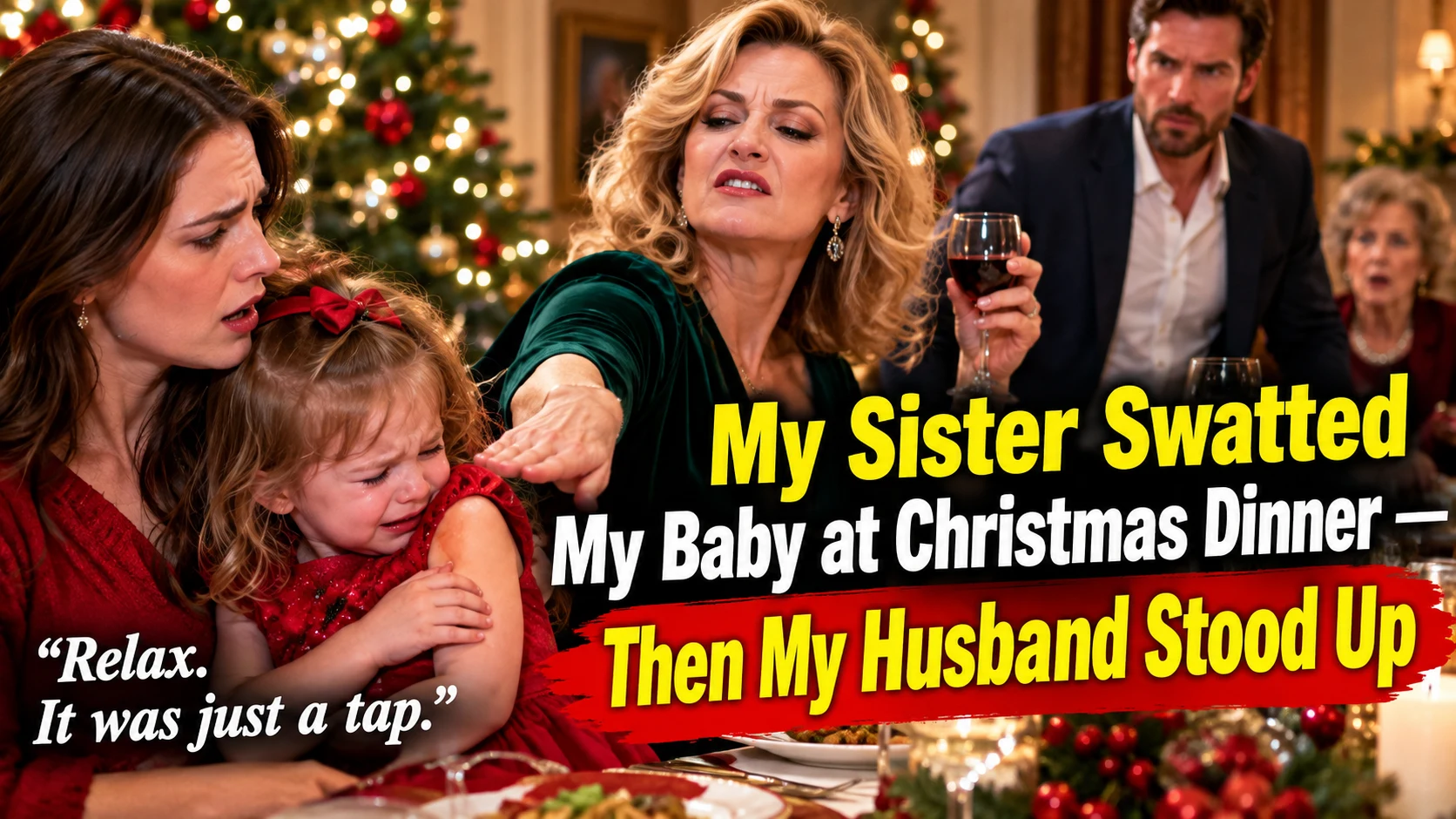
"Relax. It was just a tap." That is what my older sister said, wineglass already lifted, after her open hand came down on my daughter's arm at our mother's Christmas Eve table. Nora has spent thirty-four years being the sister who smiles through Petra's worst…
"—and she calls herself the famous one."
Petra's voice cut through the clatter of plates and the low murmur of the room, landing on the corner of the table where the wooden high chair sat like a tiny throne. My daughter, June, blinked up at the sound, her rose-pink sleep suit bunching around her wrists, her dark eyes wide and unimpressed.
I kept my hand on the tray of the high chair, thumb rubbing a smooth circle into the wood. "She's nine months old, Petra. She doesn't know what famous means."
"Oh, she knows." Petra's ash-blonde bob swung as she tilted her head, the dark roots catching the candlelight. She'd arrived late, as always, dropping a bottle of red wine on the counter with a thud that made our mother flinch, complaining about the driveway ice, the parking, the cold. Then she'd spotted June in the high chair and her whole face had rearranged into something that looked like a smile but wasn't. "She's the first grandchild. The legend. The one who made our mother actually leave the house to buy a wooden high chair." She gestured at the chair with her wineglass. "I never got that treatment."
Margaret, our mother, kept her eyes on the serving spoon in her hand, the silver trembling just slightly as she scooped mashed potatoes onto my plate. She was wearing the cream silk blouse she only brought out when she wanted the evening to feel like a postcard, the gold brooch pinned at her collar like a small shield.
"Petra," Margaret said, her voice soft and measured, the way she'd said it a thousand times. "Not tonight."
"Not tonight what? I'm complimenting her." Petra smoothed the burgundy wrap dress over her broad shoulders and settled into her chair, the gold bracelets on her left wrist catching the light. "She's gorgeous. Looks just like Eli, actually. Lucky for her."
Across the table, my husband Eli didn't react. He'd been quiet all evening, three days home from a deployment that had stretched out like a held breath, and I'd caught him more than once just watching June — watching her breathe, watching her reach for the candle flame, watching her chew on a buttered roll. He had his sleeves rolled to the forearm, the hunter-green button-down still crisp despite the long day, and his jacket hung on the back of his chair like a promise.
He reached over now and brushed his knuckles against June's cheek. She grabbed his finger and shoved it in her mouth, and something in his face softened.
"Eli, how's settling back in?" Petra asked, not really asking. She was already reaching for the basket of rolls. "I heard you guys had a rough first night. Baby's still not sleeping through?"
"She's fine," I said quickly, the words coming out before I could stop them. "She just—"
"I offered to help, you know," Petra said, dropping a roll onto her plate with unnecessary force. "Weeks ago. I said, Petra can come over, give Nora a break, settle the baby. You never took me up on it." She looked at Eli, then at me, and her lips curved into that not-smile again. "I'm great with babies. Everyone says so."
My hand froze on the high-chair tray. Across the table, I saw Margaret's hand freeze too — right over the serving spoon, the potatoes dripping slowly back into the bowl.
"Thanks, Petra," I said, keeping my voice even. "We've managed."
"Managed." Petra laughed, a short sharp sound. "That's one word for it. You look exhausted, Nora. Really. The circles under your eyes are—"
"Petra." Eli's voice was low and calm, the first time he'd spoken in almost an hour. "She's fine. We're fine."
The room went quiet. The fireplace crackled behind Margaret, the pine garland on the mantelpiece throwing long shadows across the cream tablecloth. I could feel the weight of the moment, the way everyone held their breath.
Petra recovered first. "Well, excuse me for caring." She lifted her wineglass and took a long sip, the gold bracelets sliding down her wrist. "Some of us actually think about family, not just ourselves."
The dinner continued after that, the way it always did — Margaret serving, Petra commenting, my father making a joke from the far end of the table that landed softly and dissolved. I pushed food around my plate, watching Eli watch June, watching June watch the candle flames dance.
The high chair sat at the corner of the table, right where the near-left edge met the wall. I was beside it, my chair angled toward June so I could reach her. Petra sat across from me, which meant she was also at an angle — close enough to the corner that her right arm, when she reached for the salt, crossed directly over the high-chair tray.
I noticed that. I was always noticing that.
June started fussing around the time Margaret brought out the turkey. Not crying, just that low whimper she made when she was getting tired, her little body squirming against the straps of the chair. I reached for her, unbuckling her and lifting her into my arms, settling her against my shoulder.
"There, there, baby girl," I murmured, turning my body away from the table slightly, shielding her from the light and the noise and the smell of sage and butter. "Mama's got you."
"See, this is what I mean," Petra said, gesturing with her fork. "You hover. You never let anyone help. You're going to raise a clingy kid, Nora. You know that, right?"
"Petra," Margaret said, her voice carrying a warning edge.
"I'm just saying what everyone's thinking." Petra leaned back in her chair, crossing her arms. "The baby cries for two seconds and Nora's already got her in a death grip. Let someone else hold her for once. Give your arms a break."
"Maybe later," I said, bouncing June gently. "She's tired."
"Tired, hungry, wet — it's always something with you." Petra shook her head, the ash-blonde bob swaying. "You know, when you were a baby, Mom handed you to anyone who asked. Had half the neighborhood holding you before you were six months old. That's how you raise a good kid — a kid who can handle life."
Margaret's hand was frozen over the serving spoon again. She wasn't looking at Petra. She was looking at me.
"I offered twice," Petra said, and her voice changed, got harder, more deliberate. "Twice tonight. And both times you've acted like I'm asking to hold a bomb. What are you so afraid of, Nora? Think I can't handle a baby?"
June whimpered against my shoulder. I shifted her weight, feeling the heat of her small body through the rose-pink sleeper. She was warm, a little damp against my neck, her breath coming in soft huffs.
"She's fine," I said again, the words automatic. "She just needs her mama."
"She needs a village." Petra pushed her plate back, the fork clattering against the china. "That's what family means, Nora. People who step in. People who help. You never let anyone help. You think you're the only one who can do it right."
I felt June's body tense against mine, the little warning shiver before a cry. She was tired. I'd been watching the clock, knew her schedule, knew it was past her bedtime and every minute we stayed at this table was a minute past her window.
"Petra, can we just—" I started.
"Relax, I'm not going to steal her." Petra laughed, but there was something sharp beneath it. "I'm just saying — you're making her worse. She was fine in the high chair until you picked her up. You carried her up and she started crying again. Don't you see the pattern?"
The words hit me somewhere between my ribs. It wasn't true — June had been fussing before I picked her up, that low whimper building toward something — but Petra said it with such certainty, such casual authority, that for a second I doubted myself.
Maybe I was making it worse. Maybe I was the problem.
June's whimper turned into a proper cry, thin and ragged, and I stood up, turning away from the table, bouncing her against my chest. "I'm going to take her to the other room for a minute—"
"Sit down, Nora." Petra's voice sharpened. "You're going to let that baby run the whole dinner? It's Christmas Eve. Mom spent three days on this meal. You're just going to take her away because she's being fussy?"
I looked at Margaret. She was staring at her plate, her jaw tight, the gold brooch rising and falling with her breath. She didn't say anything.
"It's just a cry, Nora," Petra said, and now she was standing too, pushing her chair back with a scrape. "Let me take her. I'll walk her around the dining room, let her look at the lights. She'll calm down in two minutes."
"No, I've got—"
"You always say that." Petra moved around the corner of the table, toward the high chair, toward me. "You always say you've got it. And then you hover and she cries and you hover more and it's a cycle, Nora. Let me help."
She reached for June.
I turned my body away, shielding June with my shoulder, and said, "Petra, no."
The word came out harder than I meant it to. The whole table went still.
Petra's face changed — a flicker of something I'd seen before, the mask of the not-smile slipping for a second. She didn't like being told no. She'd never liked being told no.
"Fine," she said, and her voice was flat, controlled, the effort of it visible in the tightness around her mouth. "Just trying to help. Forget it."
She stepped back to her chair, dropped into it, and reached for her wineglass. Her fingers wrapped around the stem, the gold bracelets sliding, and she lifted it to her lips.
June cried again, harder this time, her whole body convulsing against my shoulder. I bounced her, shushing, but she was past the point where bouncing would help. She needed quiet, she needed dark, she needed to sleep.
But before I could move toward the doorway, Petra set the glass down — no, she put it down with a deliberate soft click, and she said:
"You know, Nora, if you just let me hold her for two minutes, she'd calm down. I have this knack. Babies always settle for me."
She stood again.
"I'm serious. Let me just—"
She reached across the corner of the table.
In the background, the fireplace crackled. Someone coughed. Margaret's hand went flat on the tablecloth.
And Petra's open right palm came down on June's forearm — the little arm in the rose-pink sleeve — with a soft, sharp clap.
June went rigid. Her mouth opened. And then the scream came.
Advertisement
You may also like

She Paid for Five Business-Class Seats to Maui. At the Gate, Her Ticket Was Already in Another Woman's Hand.
"Her seat is confirmed. You can head home." That was the sentence Margaret Ellsworth heard at Gate B12 in Chicago O'Hare, six months after…

A Year After the Divorce, He Mocked Her in the Maternity Wing — Then the Elevator Opened
"Best decision I ever made — leaving you," Derek called out across the maternity wing, loud enough for the whole corridor to hear. Mara…

He Threw Coins at Her Shoes in the Showroom She Secretly Owned
"Three million dollars for this car," Derek said, then reached into his blazer and threw crumpled bills and loose change across the marble floor…

On New Year's Eve She Served Dinner to One Person While Fourteen Guests Watched
"My family is starving! Table's not set!" Vanessa screamed across the kitchen, both palms slamming flat on the island — and Ruth kept eating,…

She Told the Soldier to Leave Her Own Lake House — Then the Humvee Rolled Up
"Pack up and leave, today." Carla jabbed her finger at the driveway glass like she was shooing a stray dog off her porch. Dana…

Five Years After the Divorce, He Walked Up to Her at the Wedding — Then a Little Girl Called Her Mom
"Leaving you was the best decision I ever made," Douglas said, and waited for Mara's face to break. Five years of rehearsal, and he…