Chapter 1
Story: He Walked In Mid-Song and Found Someone Else's Name Card at His Son's Birthday Table
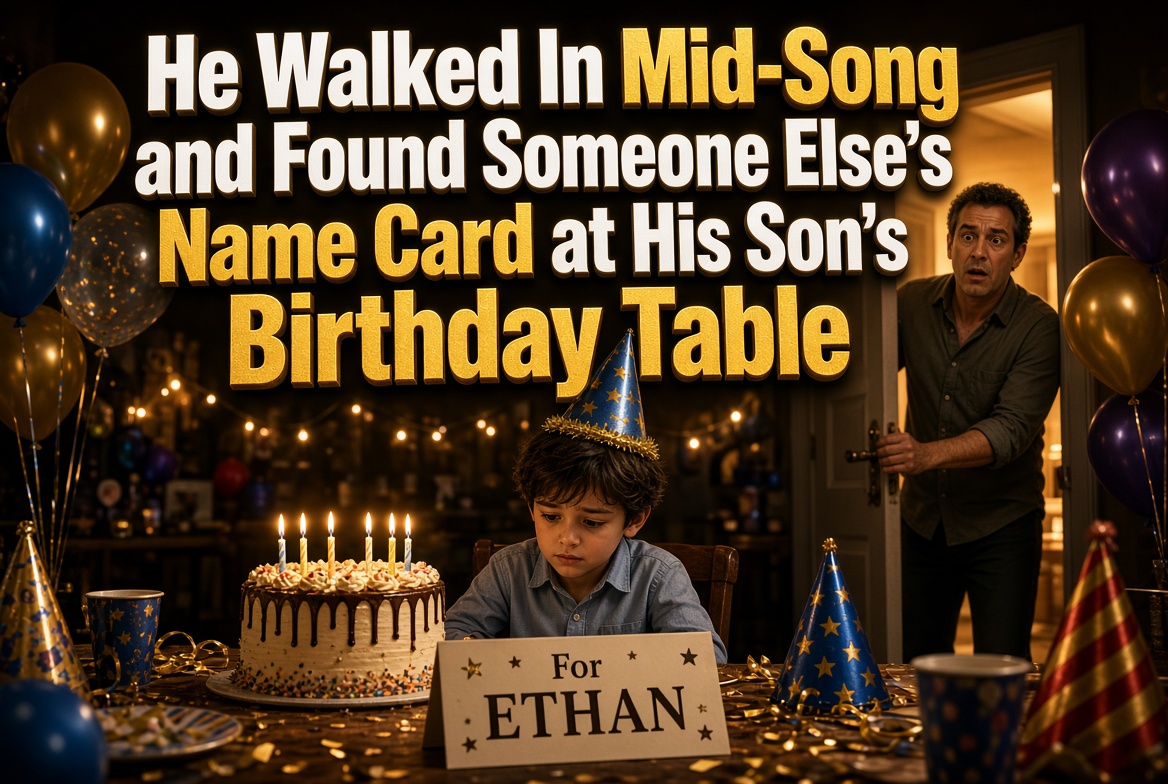
"Aunt Renee, why is my name not on my own son's cake?" Eight months overseas, and Aaron walked into the party already in progress — candles lit, plates down, and a folded name card sitting at the head of the table with somebody else's name…
The crack of the slap rolled through the dining room like a dropped tray, and for one full second the Happy Birthday song died on thirty tongues.
Aaron Mercer's head snapped to the side. The scar through his left eyebrow pulled tight as his jaw clenched, and the room swam back into focus in slices — the mustard-yellow of Mateo's hoodie across the table, the flicker of eleven candles he'd counted without meaning to, the folded white name card standing upright at the head seat like a headstone. He tasted copper on his lip.
Renee Kovacs stood over him with her hand still open, her pearl studs catching the hard afternoon light from the front window. "You don't belong at this table."
The words landed in the silence. Behind her, the guests pressed against the back wall — neighbors he half-recognized from driveways and school pickups, one woman holding a wrapped present with both hands, a man in a polo shirt already reaching for his phone. The punch bowl sat untouched. The sheet cake read HAPPY BIRTHDAY MATEO in red script, with a single name written beside it in frosting.
Not his name.
"Aunt Renee." Mateo's voice came small and clear from the far side of the table. He hadn't moved. His hands were closed on the armrests of the wheelchair, the green cushion flat beneath him. "He came back."
Renee didn't turn. Her eyes stayed locked on Aaron, bright and fast, the way they'd been when he'd called from the airport that morning and she'd said, *We're having a small thing, don't rush.* He'd taken the next flight anyway. He'd paid the rush fare himself. He'd stood in the terminal with his duffel and felt like he was breaking into a house he still held the keys to.
"Eight months," Renee said. Her voice was pitched for the room. "Eight months not a single call to the school, not one reply to a single email about your son's physical therapy. Eight months of me doing everything, and you walk in off a plane with your suitcase and expect a seat at the head of his table?" She swept an arm at the folded name card. "That's for someone who shows up. Someone who follows through."
Aaron raised his hand and touched his cheek. The mark was already warm. Behind him, someone whispered.
"That's for someone who shows up."
He let the silence hold for a moment. Then he said, quiet and low, "The cake says 'Dad.'"
The room went stiller. Renee's mouth came open, then shut. She turned to look at the cake, and Aaron watched her register it for the first time — the red script, the two words, the small plastic dinosaur figurine standing beside them that Mateo must have placed, or she had, or someone had. He didn't know. That was the point. He was eight months of unfamiliar with his own son's birthday and she was daring him to say otherwise in front of the neighborhood.
The candle flames bent in the draft from the open door. Mateo watched his father with wide dark eyes.
"Mom bought that cake," Mateo said. "She said 'Dad' because you said you'd try to come home before the candles."
Aaron's chest tightened. He hadn't said *try*. He'd said *I'll be there.* He'd booked the ticket five months out, then the job had held him two extra weeks, then the airline had cancelled, then Renee had stopped answering his messages about the party until this morning. He was there now. He was standing in the room, with the slap still stinging his cheek and all these people watching, and his son had just called him Dad in front of everyone.
Renee smoothed her wine-red blazer down. The gold chain bracelet shifted on her wrist, catching the light. "Michael felt he should be here for the boy's first real party in years," she said, and the name landed in the room like a dropped stone. "He's been taking Mateo to appointments for the past three months while you were off playing catch-up in another country. He's the one who helped me plan this. He's the one who's been here."
"Michael," Aaron repeated.
"You've never met him. He's been—" She stopped. She looked at the folded name card, then at the cake, then at the door that was still open behind Aaron. "He's running late. He'll be here any minute."
The front door hadn't been closed when Aaron walked in. He'd stepped into the hall with his duffel over his shoulder, seen the lights and the balloons and the crowd through the dining-room arch, and mistaken it for the life he'd left behind. He knew better now. He set his duffel down by the door frame, slow, and the weight of it hitting the floor sounded louder than the slap.
"Renee." His voice was still quiet. "Who signed the petition?"
The words came out of him before he'd fully decided to say them, and the room's temperature changed with the question. Renee's face did something complicated — the bright fast mask cracking at the edges. Her hand dropped to her side. The gold bracelet clicked against the cream fabric of her trousers.
"I don't know what you're talking about."
"You do." He said it flat. "The caseworker called me three days ago. Said a custody petition had been filed to move Mateo's legal guardianship from me to a guardian ad litem pending review. Said notification had been mailed to the address on file and returned, so they were trying a second route. They found me through work."
The guests were no longer pretending not to listen. The man with the phone had stopped reaching for it. The woman with the present had lowered her hands. Mateo sat very still in his wheelchair, his small face unreadable, watching the adults the way he must have watched a hundred of these conversations in eight months.
Renee said, "You're confused. You flew across the world and you're tired." But her voice had dropped, the way it never dropped, and she was looking past him now, toward the kitchen. Toward the counter.
Aaron followed her gaze. The kitchen was visible through the pass-through window, and on the counter, half-covered by a stack of paper plates, lay an open folder. Manilla. Plain. The kind a lawyer carries.
He walked toward it. The guests parted silently. Renee said his name once, sharp and wrong, and then she didn't say anything else.
The folder was open to a page near the back. The paper was thick, stamped in two places with a notary's seal, and typed across the top in small dark letters was a name he recognized from the caseworker's voice three days ago: *Petition for Modification of Custody — Ex Parte Review.* Below it, a printed paragraph stated that the undersigned sought to transfer legal custody of the minor child Mateo Mercer to a court-appointed guardian ad litem pending a full hearing, citing the biological parent's prolonged absence and inability to maintain visitation.
At the bottom of the page, in the margin beside the signature block, someone had written three initials in dark ink. He recognized the hand — he'd seen it on a hundred permission slips, on a thousand birthday cards addressed to his son.
*R.K.*
Renee Kovacs had signed her own petition to take his son away. And she'd dated it the day before his call from the airport, months before his plane ever touched down — stamped by the county clerk in the upper right corner, the date clear and official, proof the filing was real and recorded and part of a record that existed whether he'd known about it or not.
Then he noticed the second margin box — a different box, above the first. In the same dark ink, in the same hand, a second set of initials. But these weren't hers.
The room had gone completely silent. Somewhere at the table, a candle sputtered and went out.
Aaron turned, the petition held out in front of him, and fixed his eyes on the folded white name card standing at the head of his son's birthday table.
He said only one thing, quiet enough that only the nearest guests caught it.
"Michael didn't sign this." He turned the page so Renee could see it. "You did. But the second box — that's his. You had him initial it, too."
The front door opened behind him. A man's voice, light and unfamiliar, said, "Sorry I'm late, traffic was—"
And stopped.
Advertisement
You may also like

She Paid for Five Business-Class Seats to Maui. At the Gate, Her Ticket Was Already in Another Woman's Hand.
"Her seat is confirmed. You can head home." That was the sentence Margaret Ellsworth heard at Gate B12 in Chicago O'Hare, six months after…

A Year After the Divorce, He Mocked Her in the Maternity Wing — Then the Elevator Opened
"Best decision I ever made — leaving you," Derek called out across the maternity wing, loud enough for the whole corridor to hear. Mara…

He Threw Coins at Her Shoes in the Showroom She Secretly Owned
"Three million dollars for this car," Derek said, then reached into his blazer and threw crumpled bills and loose change across the marble floor…

On New Year's Eve She Served Dinner to One Person While Fourteen Guests Watched
"My family is starving! Table's not set!" Vanessa screamed across the kitchen, both palms slamming flat on the island — and Ruth kept eating,…

She Told the Soldier to Leave Her Own Lake House — Then the Humvee Rolled Up
"Pack up and leave, today." Carla jabbed her finger at the driveway glass like she was shooing a stray dog off her porch. Dana…

Five Years After the Divorce, He Walked Up to Her at the Wedding — Then a Little Girl Called Her Mom
"Leaving you was the best decision I ever made," Douglas said, and waited for Mara's face to break. Five years of rehearsal, and he…