Chapter 1
Story: He Tied a Freight Tag to His Own Son, Then a Stranger Held Up One Page
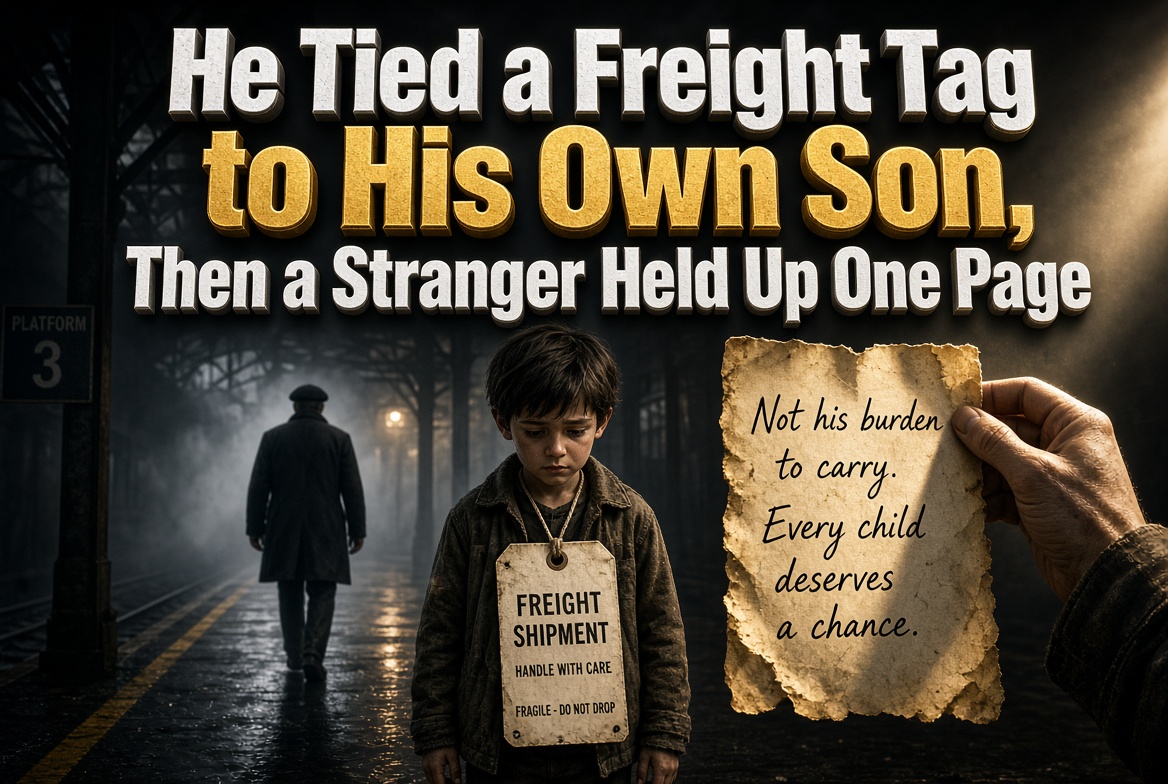
"Return to owner," the tag says — and the room just watches him buckle it on. Dane Corrigan has spent eleven months acting like a father at every barbecue in this garage. Tonight he lowers four-year-old Toby into the fiberglass display sidecar like a piece…
The tag rasped against the boy's wrist like a dry leaf, and the sound carried through the garage the way a dropped glass does — sharp enough to stop a room, too late to catch.
Dane Corrigan gripped his son under both arms and lowered him into the open fiberglass sidecar. The boy's back met the grey shell with a hollow thud, and his feet came up off the ground for a second before he settled into the curved bucket, knees tucked, hands already reaching for the rim. He was four years old, small enough that the sidecar built for exhibition equipment swallowed him whole, his head barely clearing the padded edge.
Dane looped the printed tag around the thin wrist.
FREIGHT — RETURN TO OWNER.
The paper had a hole punched in it and a short plastic cinch, the kind that went on luggage at an airport counter. Dane pulled it snug and let the tag fall against the boy's forearm, where it hung like a price sticker.
"Dad," the boy said. His voice was a thin whisper that cracked on the single syllable. "Dad, I can't get out."
Dane straightened, brushed his hands against his charcoal slacks, and turned his face away from the sidecar. He did it slowly, deliberately, the way a man turns from a table he's finished with. His gold chain caught the work-light and swung once against his black silk shirt.
The room let it happen.
Thirty people had been in this garage twenty minutes ago, and now maybe fourteen of them remained, scattered in small groups around the long table of picked-over food and the framed racing photos on the wood-panel wall. They'd come for the barbecue, stayed for the drinks, and now they stood with their bottles and paper plates and looked anywhere but at the fiberglass sidecar on the left side of the floor.
The sidecar was a collector's piece, part of a vintage motorcycle display that had never carried a passenger — built to hold a mannequin in racing leathers, not a four-year-old in a red-and-navy striped pajama top.
Toby's hands came up and pressed against his ears. His eyes squeezed shut, and one tear slid down his left cheek. His shoulders shook without a sound.
Nobody spoke.
A woman near the door — a neighbor whose name Dane always forgot — took half a step toward the sidecar and stopped when Dane's pale grey eyes found her. She looked down at her drink and moved back to the wall.
"Toby." The boy's name came from behind Dane, and Kendall Boyd stepped forward — mid-thirties, lean and wiry, sandy hair swept back, maroon hoodie under his black leather vest. He got two paces past the table before Dane's head turned.
Not fast. Not loud. Just a slow rotation of the shaved head, the hard jaw set, the grey eyes flat as a wall.
Kendall's mouth closed. His foot came down, and the step that should have become two became a shuffle that put him back behind Dane, where he always stood.
"Dad." The whisper again, thinner now, cracking harder. "Please."
Dane adjusted his gold chain and looked at the door of the house, where the warm amber light spilled out across the concrete threshold. The garage smelled of beer and grilled meat and the faint sharp tang of old motor oil. The work-lights hummed overhead, throwing black shadows across the polished floor.
"Little man's got the right seat for it," someone said from the back, and a few people laughed — quick, nervous laughs that died when Dane didn't join them.
Toby's arms were still pressed over his ears. His whole body had gone very still in the sidecar, small and folded, the freight tag lying against his blue sweatpants. One of his feet was bare; the other still had its sock. The bare foot was white-knuckled against the fiberglass.
The boy reached for his father's jacket.
Dane turned his face away.
The gesture was so complete, so practiced, that the room went quiet in a different way — the way a room goes quiet when everyone realizes they've been watching something they should have stopped.
Toby's hand hung in the air for a long second, then fell back to the edge of the sidecar.
"Family business," Dane said to no one in particular, his baritone cutting the air. "You all eat. This doesn't concern you."
It should have settled the room. It was the kind of voice Dane had built a decade of evenings on — the voice that ended arguments, closed deals, kept the crew in line. But the room didn't settle. The room held its breath, because the boy in the sidecar had stopped shaking, and his hands had dropped from his ears, and he was looking at his father with an expression no four-year-old should have: the blank, careful stillness of a child who has learned not to ask twice.
The tag lay against his wrist.
FREIGHT — RETURN TO OWNER.
He couldn't read it. But he knew what it meant when his father buckled a paper band around him and put him somewhere he couldn't climb out of.
The hollow thud of his back against the fiberglass was still echoing in the room when the open garage door filled with a silhouette.
Ronan Ashby came through the door at 9:47, looking for a friend's truck. He was late to a second-hand deal and the light was going, and he'd been told the truck would be parked in the third bay of the garage at the big house on Alder Lane. What he found instead was the last thing he'd expected on a Sunday night.
A small boy in a striped pajama top, folded into a display sidecar, a paper tag on his wrist.
The boy's face was turned toward the open door, and the overhead light caught it — the dark hair fallen across his forehead, the olive skin, the one tear still wet on his left cheek. His eyes met Ronan's.
Ronan stopped.
He stood in the mouth of the garage, close-cropped silver hair catching the amber spill from the house, his olive canvas jacket hanging loose over a plain grey tee, his scarred hands at his sides. He was late fifties, thick through the shoulders, and he'd seen enough in his life to know when a room was pretending.
This room was pretending hard.
The father in the black silk shirt turned to face him, and the hard grey eyes took in Ronan's work boots, his faded denim, the flat scarred nose that had been broken twice and never set properly.
"Door's open," Dane said. "Party's over. You're late."
Ronan didn't look at Dane.
He looked at the boy.
And the boy, still folded into the sidecar, freight tag on his wrist, looked back at him and said, in a voice so thin it almost didn't reach:
"Can you get me out?"
The room went quieter than it had been all night.
Ronan crossed the concrete. He didn't hurry, didn't run, didn't make a show of it. He walked like a man crossing the floor of his own garage, and when he reached the fiberglass sidecar, he went down on one knee so his eyes were level with the boy's.
Up close, he could see the whole picture: the red-and-navy pajama top with the collar crooked, the blue sweatpants with one sock missing, the printed tag cinched around the thin wrist, and underneath it the small pulse going fast.
Ronan reached into the sidecar with both hands.
"I've got you," he said, low and graveled. "Put your arms around my neck."
The boy did. Small arms, thin as twigs, hooked around his neck, and Ronan lifted — the boy weighed nothing, hardly more than a bundled jacket — and set him down on the concrete floor beside the sidecar.
The freight tag dangled from his wrist.
The room exhaled. It was one sound, fourteen people letting go at once.
Ronan stayed on one knee, his hands on the boy's shoulders, looking at the wet face two inches from his own.
"What's your name?"
"Toby."
"Toby. I'm Ronan. You're okay now."
"Am I?"
The question was so small, so serious, that Ronan felt something in his chest close like a fist.
"Yeah," he said. "You're okay now."
He stood, and Toby's hand came up and latched onto his — a small hand around two of his scarred fingers, squeezing hard.
Behind him, Dane's voice cut the air like a blade.
"Step off. Family business."
Advertisement
You may also like

She Paid for Five Business-Class Seats to Maui. At the Gate, Her Ticket Was Already in Another Woman's Hand.
"Her seat is confirmed. You can head home." That was the sentence Margaret Ellsworth heard at Gate B12 in Chicago O'Hare, six months after…

A Year After the Divorce, He Mocked Her in the Maternity Wing — Then the Elevator Opened
"Best decision I ever made — leaving you," Derek called out across the maternity wing, loud enough for the whole corridor to hear. Mara…

He Threw Coins at Her Shoes in the Showroom She Secretly Owned
"Three million dollars for this car," Derek said, then reached into his blazer and threw crumpled bills and loose change across the marble floor…

On New Year's Eve She Served Dinner to One Person While Fourteen Guests Watched
"My family is starving! Table's not set!" Vanessa screamed across the kitchen, both palms slamming flat on the island — and Ruth kept eating,…

She Told the Soldier to Leave Her Own Lake House — Then the Humvee Rolled Up
"Pack up and leave, today." Carla jabbed her finger at the driveway glass like she was shooing a stray dog off her porch. Dana…

Five Years After the Divorce, He Walked Up to Her at the Wedding — Then a Little Girl Called Her Mom
"Leaving you was the best decision I ever made," Douglas said, and waited for Mara's face to break. Five years of rehearsal, and he…