Chapter 1
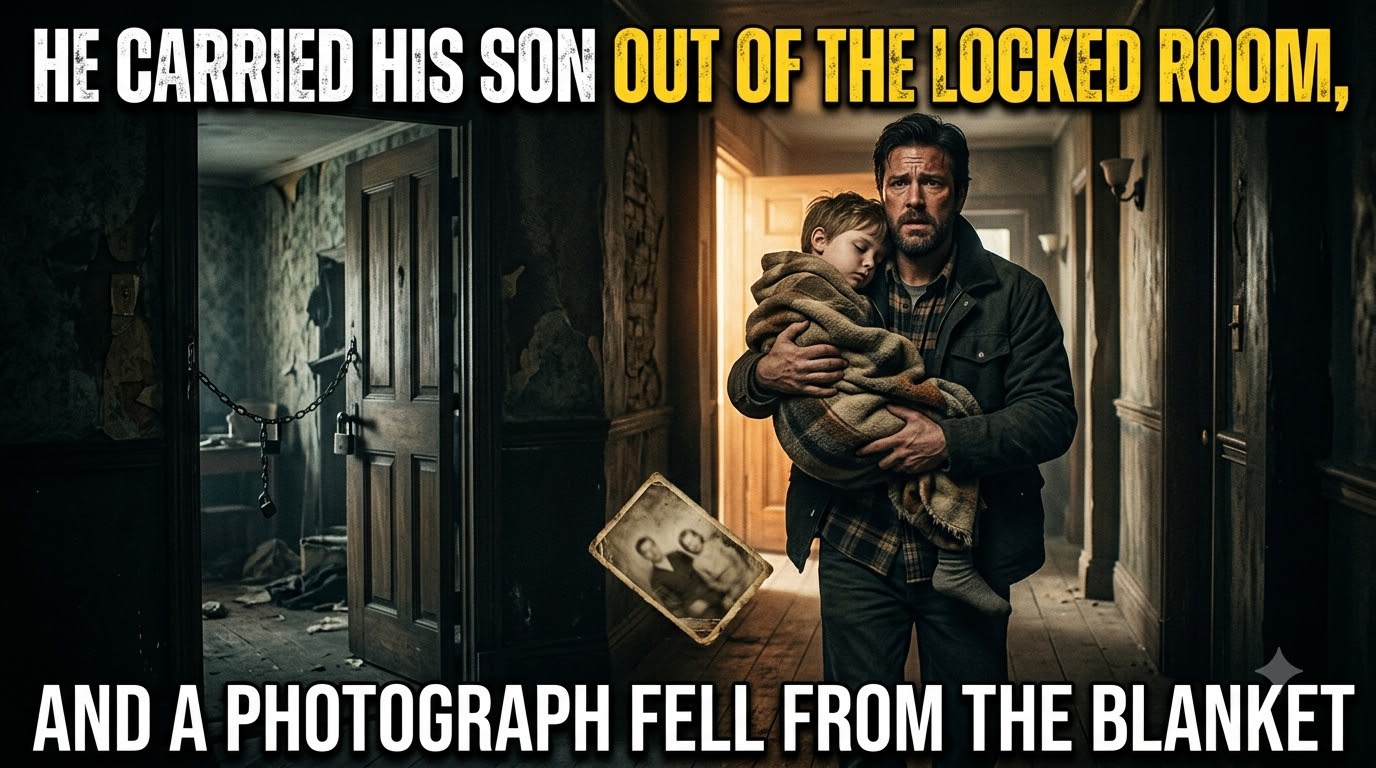
Story: He Carried His Son Out of the Locked Room, and a Photograph Fell From the Blanket
"Put him down. That blanket is mine," Mireille said in the courtyard, her coral lips barely moving. Ronan had carried Emory out of the locked storage room an hour earlier, and now the boy's small hands crammed the thin red blanket against his chest. The…
The cellar door was still open when Ronan Vale carried his son into the courtyard, and the hard midday sun hit the boy's face like a slap.
Emory blinked. His small hand came up to shield his eyes, then dropped back to the thing he was holding — a thin red blanket, worn to the softness of skin, crammed against his narrow chest like it was the only solid object in the world. Ronan felt the boy's ribs through the pale yellow t-shirt. He felt every one of them.
Seven years. Seven years of reports that went nowhere, of lawyers who wrote back in polite paragraphs that said nothing, of a missing-person file that grew cold and then froze solid. And now the boy was in his arms, light as a bundle of sticks, smelling of dust and old laundry and the dark of the locked storage room where someone had kept him.
"You're safe with me now," Ronan said, low, into the sandy curls.
Emory didn't answer. He pressed his face against Ronan's collar and held the blanket tighter.
They stood on the flagstone patio of the house on Meridian Lane, a house Ronan had been told Emory no longer lived in, a house his private investigator had found only because a neighbor posted a photograph of a child's birthday party on a public Facebook page. The party had been six years too late. The boy in the photograph had been seven years too big.
Mireille Corbin stood on the far side of the patio, silver chignon catching the light, cream cashmere cardigan buttoned over a lavender blouse, gold chain lying flat against her collarbone. She looked exactly as she had in the videotaped custody proceedings Ronan had watched in a hotel room with the curtains drawn. Gracious. Composed. A woman who had dedicated herself to a child who was not hers, who had fought for him, who had won.
"Put him down," she said. Her coral lips barely moved. "That blanket is mine."
Ronan looked at her over the boy's head. He had rehearsed this moment in a hundred motel rooms, lying awake in the dark with a ceiling fan clicking overhead. He had rehearsed the words, the posture, the evidence. He had never rehearsed the calm of it. The calm was a surprise. It sat in his chest like a stone that had been there so long he had stopped noticing its weight.
"He's not yours," Ronan said. "He never was."
Mireille's chin came up. In the sun her face was smooth and expensive, but something moved behind the eyes — a shutter closing, a calculation running. She had been the legal guardian for seven years. She had the paperwork. She had the dates. She had the court's blessing and the neighbors' sympathy and the small-town narrative of a lonely woman who took in a troubled child and raised him right.
"Seven years," she said, and the words were silk over steel. "Seven years of school mornings and doctor's appointments and birthday cakes. Where were you, Ronan? Where were you when he had a fever at two in the morning? When he couldn't sleep after a nightmare and I sat with him until dawn?"
Ronan's arms tightened. Emory's small hands balled in the fabric of his pale blue button-down. The boy didn't lift his head. He had not spoken a single word since Ronan found him in the locked storage room, huddled in the corner behind a stack of old paint cans and a rusted lawnmower, wrapped in the red blanket, his eyes huge and dry in the beam of Ronan's flashlight.
"I was looking," Ronan said. "I never stopped."
"Then you weren't looking hard enough." Mireille took a step forward. The pearls at her throat caught the sun. "You think I didn't see you in town? You think I didn't know what you were doing, driving past the school, sitting in your car at the end of the street? You think I didn't tell Emory to stay away from the windows when we saw your truck?"
The words landed like blows. Ronan absorbed them, because he had to. He had, in fact, driven past the school. He had, in fact, sat in his car at the end of the street, watching the front door of a house he was legally forbidden to approach. He had done it for years, two hours at a time, until the neighbors learned his face and started calling the police.
Emory's head lifted. The boy looked at Mireille with large dark eyes, then at Ronan, then back at Mireille. He didn't speak. He simply watched, the way a child watches older people argue over something he does not understand but knows is about him.
"The blanket," Mireille said, and her voice changed — sharper, colder, a seam showing. "Give me the blanket."
She moved.
It was not a lunge in the sense of an athletic person committing to a tackle. It was a woman of sixty-one who had spent her life learning to get what she wanted, moving forward suddenly and with intent, both open palms driving into Ronan's right shoulder. The impact shoved him back one step. Emory let out a small sound — not a cry, just an airless gasp — and the red blanket slipped.
Mireille reached for it.
Dorsey Eames caught her wrist mid-air.
The bodyguard had been standing behind the iron table at the edge of the patio, a man so still he seemed part of the furniture. He moved without violence, without theater — one step forward, his arm extending, his gloved hand closing around Mireille's bony wrist with the calm of a man who had done this before and would do it again. Her forward motion stopped as if she had run into a wall.
"Enough," Dorsey said. His voice was flat and deep.
Mireille's hand was still extended, fingers spread, reaching. Six inches beyond her knuckles, the blanket had fallen from Emory's grip and lay on the sun-warmed flagstones. And out of it, sliding free as it landed, a small rectangle of glossy paper.
A photograph.
It came to rest at Ronan's feet, face up. He looked down at it.
He saw himself.
Younger — twenty-something, hollow-eyed from a delivery room vigil, wearing a thin hospital bathrobe. He was sitting on the edge of a bed, and against his bare chest, wrapped in a white hospital blanket, was a newborn. His right hand cupped the back of the tiny head. His left hand lay flat under the small body, holding it safe. His face was turned down toward the infant, and even in the faded print Ronan could see the dumb, exhausted wonder of a man who has just become a father.
The room behind him was a delivery room. Pale green wall. A curtain rail.
And at the left edge of the frame, entering the photograph just barely — a woman's bare arm. A paper wristband circling it, matching the one visible on Ronan's own wrist. The arm came in at an angle, reaching toward the baby, and then it stopped.
Stopped because the photograph had been cut.
Snipped cleanly with scissors, straight down through the arm, removing the woman's shoulder, her neck, her face. Everything that would have identified her. Gone.
On the back of the photograph, in looping, familiar handwriting, a date.
Ronan's hand shook. He had not known his hand could still shake. The date — he knew it without counting, knew it the way a man knows the day his house burned down. The day Emory disappeared. The day Ronan had been told, by a social worker with a kind face and a terrible message, that his son had been taken from his ex-wife's care and placed with a guardian whose name he had never been given.
"What is this?" Ronan said. His voice came out rough.
Mireille was frozen, Dorsey's hand still closed around her wrist. Her face had gone pale under the carefully applied makeup. Her eyes were fixed on the photograph.
"Nothing," she said. "It means nothing."
Behind them, at the open cellar steps, Karel Dunst shifted his weight from one loafer to the other. The man with the shaved head and the rust-orange polo had been standing there since Ronan arrived, silent, sweating, watching. Now he took a half-step back, toward the darkness of the stairs.
Ronan looked at the date again. Then he looked up.
"Search the cellar," he said.
Dorsey released Mireille's wrist. She stumbled back, catching herself against the stone step of the cellar doorway, her purse swinging and bursting open, lipstick and keys and coins scattering across the flagstones. She didn't move to pick them up. She stood there, breathing hard, eyes on the photograph in Ronan's hand.
Dorsey walked past her, down the cellar steps, into the dark.
Advertisement
You may also like

She Paid for Five Business-Class Seats to Maui. At the Gate, Her Ticket Was Already in Another Woman's Hand.
"Her seat is confirmed. You can head home." That was the sentence Margaret Ellsworth heard at Gate B12 in Chicago O'Hare, six months after…

A Year After the Divorce, He Mocked Her in the Maternity Wing — Then the Elevator Opened
"Best decision I ever made — leaving you," Derek called out across the maternity wing, loud enough for the whole corridor to hear. Mara…

He Threw Coins at Her Shoes in the Showroom She Secretly Owned
"Three million dollars for this car," Derek said, then reached into his blazer and threw crumpled bills and loose change across the marble floor…

On New Year's Eve She Served Dinner to One Person While Fourteen Guests Watched
"My family is starving! Table's not set!" Vanessa screamed across the kitchen, both palms slamming flat on the island — and Ruth kept eating,…

She Told the Soldier to Leave Her Own Lake House — Then the Humvee Rolled Up
"Pack up and leave, today." Carla jabbed her finger at the driveway glass like she was shooing a stray dog off her porch. Dana…

Five Years After the Divorce, He Walked Up to Her at the Wedding — Then a Little Girl Called Her Mom
"Leaving you was the best decision I ever made," Douglas said, and waited for Mara's face to break. Five years of rehearsal, and he…