Chapter 1
Story: The Doctor Patted His Shoulder Like a Child, Then the Sealed Envelope Ended Twelve Years of Lies
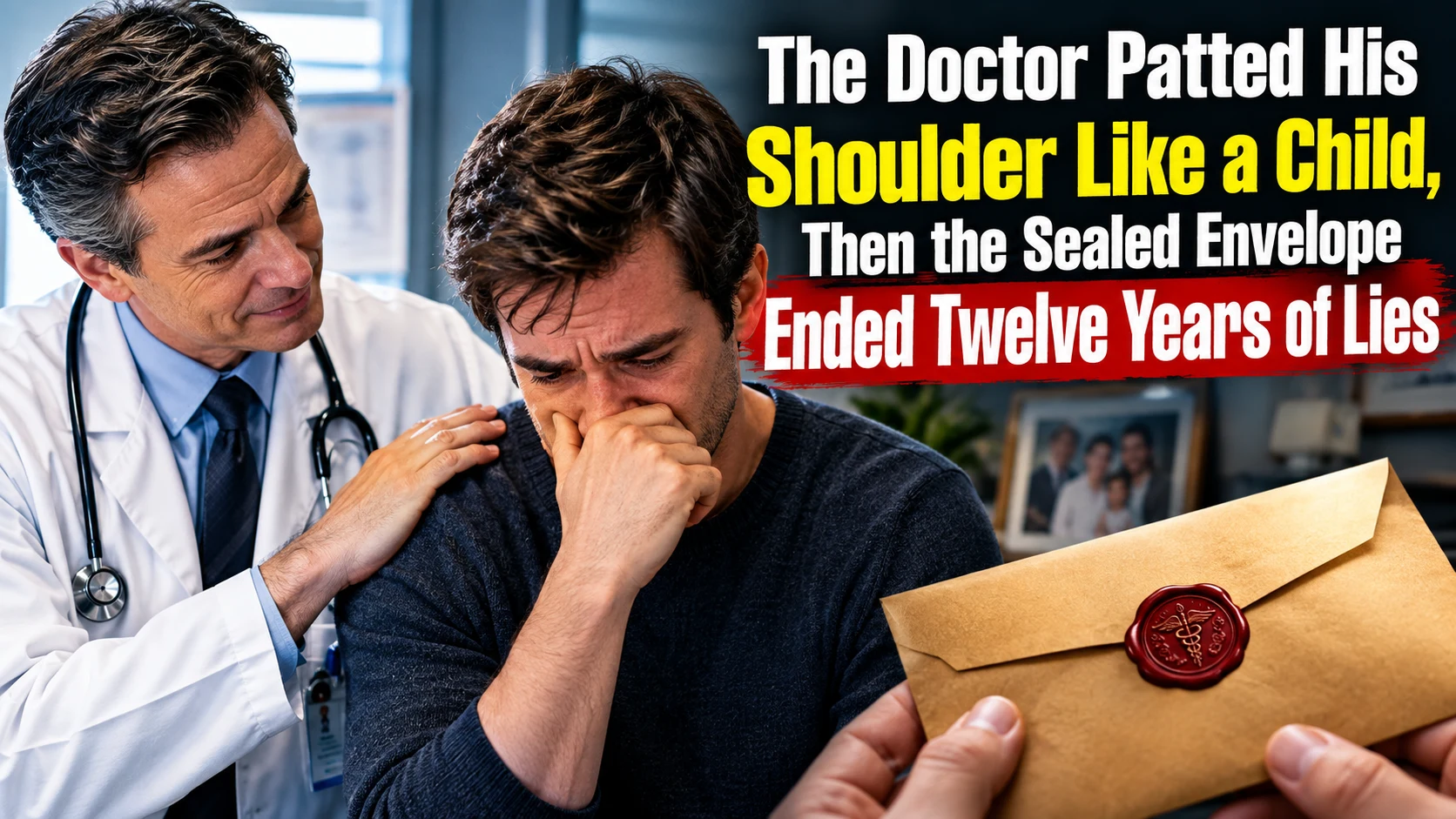
The pat landed on Enzo Marchetti's shoulder like he was a child. Dr. Harlow, the house physician who had "managed" his case for twelve years, didn't even glance at the wooden box on the walnut table. "Accept it, Marchetti," he said. "Twelve years." That's what…
"Accept it, Marchetti. Twelve years."
The words hung in the warm study air like smoke from a fire that had long gone out. Dr. Felix Harlow's open left palm came down on Enzo Marchetti's right shoulder in a flat, condescending pat—the kind of gesture you gave to a dog that had failed a trick. The leather folio in Harlow's other hand smelled of old paper and the arrogance of a man who had never once been wrong.
Enzo's torso dipped two centimeters. His head bowed fifteen degrees toward his chest. For one beat, his gray eyes squeezed shut, and his jaw tightened until the muscle stood out against the pale olive skin of his throat. Then his breath settled, slow and even, and when he raised his head, his face was as calm as the lake visible through the study window behind them.
The sun hung low over the water, casting a sheet of liquid gold across the late-afternoon surface. Beyond the glass, the gardener was rolling up a hose near the hedge—the same hedge with the gap that no one had been told to close. Enzo's gaze flicked to it, then back to the man standing over him.
Dr. Harlow lifted his hand off Enzo's shoulder, fingers spread dismissively, and took one small step back. He stood tall in his light gray suit, the gray-and-navy striped tie perfectly knotted, his pale blue eyes holding all the certainty of a man who had read every textbook and believed the world worked exactly as the textbooks said.
"You've had twelve years," Harlow continued, his voice clipped, clinical. "The specialists agreed. The tests agreed. Your own body agreed." He gestured vaguely at the wheelchair, as if the dark navy leather seat and chrome frame were a verdict rather than a vehicle. "A vascular event. Irreversible. The sooner you accept the permanence of your condition, the sooner you can—"
"Read that first."
Enzo's voice was low and calm, but it cut through Harlow's monologue like a blade through silk. His right hand left the armrest of the wheelchair—the signet ring catching the lamplight for a fraction of a second—and reached toward the walnut side table that sat between the two men.
The table was eighty-five centimeters high, polished to a deep maroon glow, and on it sat a closed wooden box. Simple. Unassuming. The kind of box you might keep cigars in, or letters, or the kind of things a man didn't want the world to see.
Enzo's fingers touched the lid. Opened it. Inside, on a bed of dark felt, lay a single sealed cream envelope.
Harlow frowned. His brow furrowed—the first crack in the mask of professional composure. He glanced at the envelope, then back at Enzo's face. "What is that?"
"Read it," Enzo said. His eyes never left Harlow's. "Read it first."
For a moment, Harlow didn't move. Then he laughed—a short, dry sound, the laugh of a man humoring an invalid. "Marchetti, I don't have time for—"
Enzo broke the seal with his right thumb. The wax crack was loud in the quiet room. He drew out a single typed page, raised it to chest height, and rotated the paper so the text faced the doctor.
Bold header: TOXICOLOGY — INDUCED NEUROTOXIN.
Red stamp, slightly smeared, unmistakable: NO VASCULAR EVENT.
The room went very quiet. The furnace hummed somewhere in the walls. A distant breeze brushed the window. Harlow's pale blue eyes dropped from Enzo's face to the page, and the color drained from his cheeks like water from a pierced cup.
His brow fell. His lips parted. The leather folio in his left hand slipped, and hit the floor with a soft thud that seemed to shake the whole study.
"It… was never… an accident."
The words came out cracked, barely a whisper. Harlow took one step backward, then another, and his legs folded. He sat—collapsed, really—into the wingback chair behind him, shoulders slumped, head bowed, both hands flat on his knees, staring at the floor as if the carpet held an answer he no longer wanted.
Enzo held the page steady at chest height. His face did not change. His eyes stayed fixed on the man who had just dismissed twelve years of his life with a pat on the shoulder.
Behind them, through the window, the lake kept its calm. The gardener finished with the hose and walked away. The hedge gap remained open, a dark slit in the green—a passage no one had bothered to close, because no one had ever thought to ask who might come through it.
Enzo's jaw tightened again, but not from anger. From something older. Something that had been sleeping in his chest for twelve years, wrapped in the same silence as his legs.
He lowered the page and placed it on the walnut table, next to the open wooden box. The torn envelope lay beside it like a shed skin.
"Felix," Enzo said, and the doctor flinched at the sound of his own first name. "Tell me everything you know about my blood work from the last twelve years."
Harlow opened his mouth. Closed it. For the first time in his career, the man had nothing to say.
Enzo waited. The silence stretched. Through the window, the sun continued its slow descent toward the lake, and in the deepening gold light, the shadow of the hedge gap grew longer, reaching across the manicured lawn like a finger pointing toward the house.
That was where she had come from. That gap. Two weeks ago. A small figure in an oversized mustard coat, slipping through the hedge like a secret that had decided it was tired of hiding.
Enzo had been sitting on the covered porch, watching nothing, when she appeared. She didn't see him at first. She was too busy looking at the baseball diamond—the one he'd built eleven years ago, back when he still believed he'd have a family to use it. The dirt was packed, the bases were still in place, and the chain-link fence had rusted in patches, but the little girl looked at it like it was made of gold.
She walked onto the diamond without asking permission. She stood at home plate, turned in a slow circle, then broke into a run toward first base. Halfway there, she started to dance—arms wide, feet kicking up small puffs of dust, a clumsy, joyful spin that ended when she tripped over her own feet and landed hard on the dirt.
She laughed before she hit the ground. Laughing while she fell. Enzo watched her pick herself up, brush the dirt off her coat, and try the spin again. She messed it up again. Laughed again.
Then she saw him.
She froze for a second, a small bird caught in the open. Her brown eyes went wide. She looked at the house, at the porch, at the man in the wheelchair, and then—instead of running—she walked toward him.
"You looked sad," she said, stopping at the edge of the porch.
Enzo said nothing.
"I'm Gia," she said. "My mom works here. She's Tessa."
The name landed somewhere in his chest. Tessa. His maid. The slim woman in the gray uniform dress who never met his eyes and never asked why the man she worked for couldn't walk. She'd been with him for years, quiet and efficient, and he'd never once asked about her daughter.
"Do you know why you look sad?" Gia asked.
"I'm not sad," Enzo said.
"Okay," she said, and turned, and did the spin again.
He watched her mess it up again, and something in his chest cracked open—a seam in the stone wall he'd built around himself. He signaled to the guard, a small flick of his fingers, a command to leave her alone. Let her dance. Let her fall. Let her laugh.
That was two weeks ago. Two weeks ago, before the envelope. Before the toxicology report with the red stamp. Before a child's hand on his knee changed everything.
Now, in the study, Dr. Harlow sat in the wingback chair with his head in his hands, and Enzo Marchetti—the silver-haired man in the maroon cardigan, the man who had once ruled a city, the man whose legs had been dead for twelve years and turned out to be sleeping instead—looked at the doctor and understood, finally, that the greatest lie of his life had not been told by his body.
It had been told to it.
"Felix," Enzo said again, softer this time. "Who else knew?"
Harlow raised his head. His pale blue eyes were red-rimmed, and for the first time, Enzo saw something in them he had never seen before: fear.
"Enzo," Harlow said, and his voice shook. "I didn't know. I swear. I didn't know."
Enzo nodded slowly. He believed the doctor. Harlow was arrogant, dismissive, cruel in the casual way of men who have never been challenged—but he wasn't a liar. He'd been fooled like everyone else.
Which meant someone else had done this. Someone with access. Someone with knowledge. Someone who had slipped a neurotoxin into the man who commanded a city, and then watched him fall, and then watched him stay down.
Gia's face appeared in Enzo's mind—round cheeks, gap-toothed smile, mustard coat too big for her. The first person in years who hadn't looked at the wheelchair first. The first person who'd touched his knee and felt something move.
"You said my legs are sleeping, not dead," he said to the memory of her. "How did you know, little one?"
Outside, the sun touched the lake, and the world went orange. And on the walnut table, the sealed envelope sat open, its contents spilled out like a secret finally tired of holding its breath.
The phone on Enzo's desk rang once, twice, three times.
He didn't answer it. He was watching the hedge gap through the window, waiting to see if a small figure in a mustard coat would slip through it again.
Someone had seen her that day. Someone had seen her hand on his knee.
And now that person knew the report had arrived.
The phone stopped ringing.
The room was quiet.
Enzo's right hand moved to the armrest of the wheelchair, and his signet ring caught the light. He began to plan.
Advertisement
All 10 chapters
You may also like

She Paid for Five Business-Class Seats to Maui. At the Gate, Her Ticket Was Already in Another Woman's Hand.
"Her seat is confirmed. You can head home." That was the sentence Margaret Ellsworth heard at Gate B12 in Chicago O'Hare, six months after…

A Year After the Divorce, He Mocked Her in the Maternity Wing — Then the Elevator Opened
"Best decision I ever made — leaving you," Derek called out across the maternity wing, loud enough for the whole corridor to hear. Mara…

He Threw Coins at Her Shoes in the Showroom She Secretly Owned
"Three million dollars for this car," Derek said, then reached into his blazer and threw crumpled bills and loose change across the marble floor…

On New Year's Eve She Served Dinner to One Person While Fourteen Guests Watched
"My family is starving! Table's not set!" Vanessa screamed across the kitchen, both palms slamming flat on the island — and Ruth kept eating,…

She Told the Soldier to Leave Her Own Lake House — Then the Humvee Rolled Up
"Pack up and leave, today." Carla jabbed her finger at the driveway glass like she was shooing a stray dog off her porch. Dana…

Five Years After the Divorce, He Walked Up to Her at the Wedding — Then a Little Girl Called Her Mom
"Leaving you was the best decision I ever made," Douglas said, and waited for Mara's face to break. Five years of rehearsal, and he…