Chapter 1
Story: The CEO Knelt for the Orphan Girl After His Step-Mother Slapped Her at His Gala
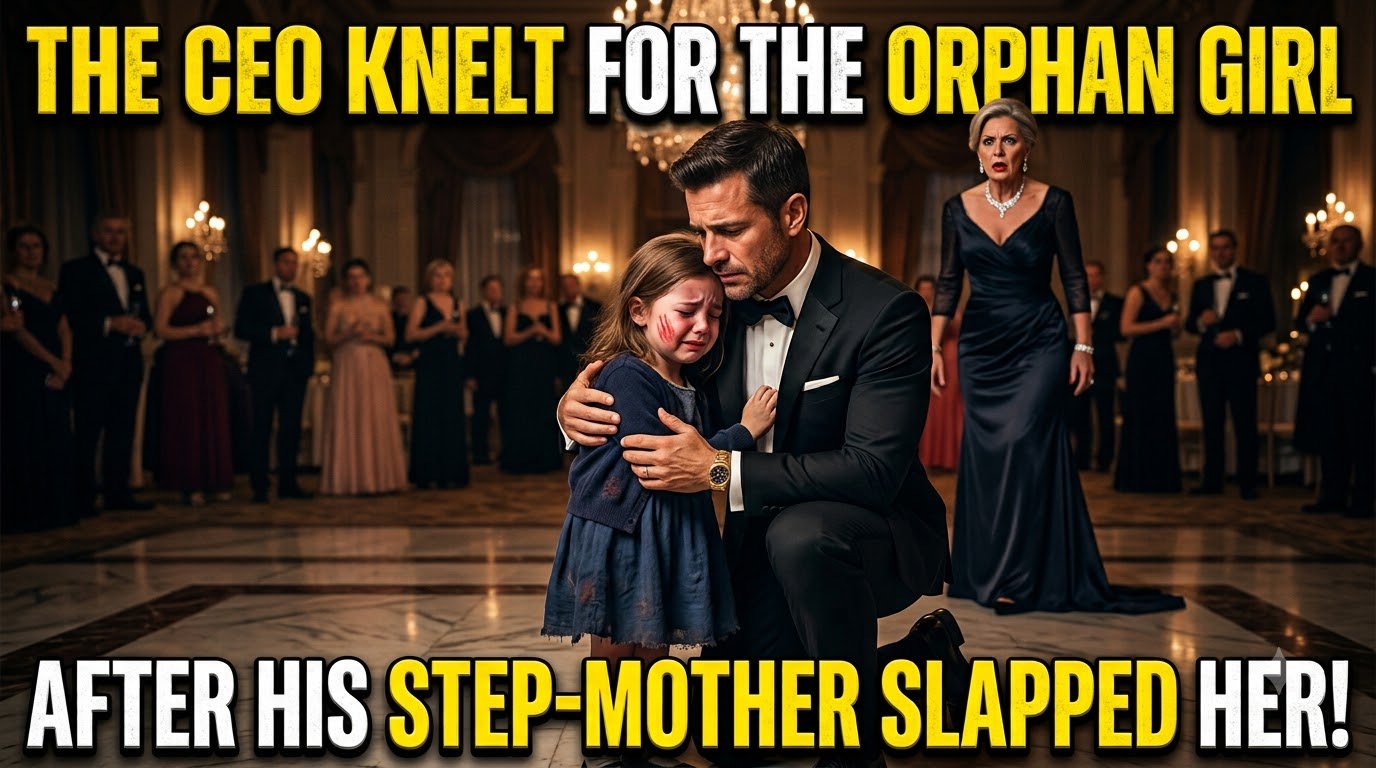
"That plate cost four thousand dollars," Nessa said, and her open palm was already moving. Sixteen-year-old Delia Marsh had carried napkins through that marble kitchen all evening, keeping her eyes down, keeping the borrowed navy dress out of the way. One small chip off the…
The napkin was still warm in Delia Marsh’s left hand when the slap landed.
She had carried forty of them from the pantry to the marble island in the last hour, each one folded flat and stacked on the caterer’s tray with the others. The kitchen of the Vale penthouse was full of people in black who laughed too loudly and held their champagne glasses high enough that the chandelier light caught the rims. Delia kept her eyes down. She had learned four years ago that looking at adults was how you got noticed, and being noticed was how you got sent away.
The plate sat on the counter beside her, one of the old ones from Thomas Vale’s mother, pale porcelain with a thin gold rim. She had seen Nessa’s hand brush it a moment earlier, nudging it toward the edge while she talked to the caterer about the salmon. Delia had moved it back. Then the plate had moved again, closer to the edge, and when Delia reached to steady it her elbow clipped Nessa’s bangle and the plate tipped.
It did not break. It only chipped — one small pale nick on the rim, small enough that a fingertip could cover it. The sound it made was tiny, a soft click against the marble. But the room went quiet anyway, because Nessa Vale had already turned, her gold hoop earrings swinging, her sharp blonde bob catching the light like a blade.
"That plate cost four thousand dollars."
The words were loud enough for the hallway.
Delia opened her mouth to say she was sorry. She had said she was sorry so many times in this house that the words lived on her tongue like a second skin. But the apology never came out, because her eyes caught Nessa’s hand moving, and her body remembered before her mind did.
The slap cracked across her cheek.
She staggered back into the marble island and felt the shock bounce through her shoulder blades. Her hand came up to her face and found the spot already burning, a light red mark rising under her palm. Her knees buckled, and a white linen napkin fell from her left hand and landed on the polished floor beside her shoe.
Delia did not cry out. She had learned four years ago, in the weeks after her mother’s funeral, that crying out made things worse. She pressed her lips together and waited for Nessa to hit her again.
Nessa lifted her arm.
Delia flinched — a small, quick movement, her shoulder coming up, her eyes closing. It was the flinch she had practiced on the night she arrived, the one that made her seem small and harmless and not worth hurting again. She heard her own breath shake once and felt the tears gather but refused to let them fall.
The second slap never came.
"What did you just do?"
The voice came from the kitchen doorway, low and slow and dry, like a stone dropped into still water. It was not loud. It did not need to be. Every head in the room turned, and Delia opened her eyes to see Ronan Vale standing where the hallway light bled through the door.
He was still in his dinner suit, the deep red tie loosened half an inch at the collar, his jacket off and hooked over one finger. His dark hair was grey at the temples and his jaw was set. He did not look angry and he did not look surprised. He looked like a man who had just seen the last piece of a puzzle click into place, and he was not happy about it.
Nessa lowered her arm. She performed a laugh, short and bright and hollow, the one she used with the investors.
"Ronan. She chipped Mother Vale’s plate. Four thousand dollars."
Ronan did not look at the plate. He looked at Delia’s cheek, where the red mark was still rising.
He crossed the kitchen slowly, walking past the guests who parted for him without speaking. He stopped at the island, looked down at the chipped plate beside Delia’s shoe, and then looked at Nessa.
"You said she’s not even ours."
The room leaned forward.
Nessa’s chin lifted. "She’s not. She's a ward — a charity case Thomas took in. Not family. Not our blood. She should be grateful she has a roof at all, not destroying heirlooms."
Ronan said nothing. He looked at the floor for a long moment, at the napkin still crumpled by Delia’s foot, at the small gold-rimmed plate with the chip in its edge. Then he looked at Delia.
"What’s your name?"
It was the first time anyone in that kitchen had asked her a question that did not sound like an order.
Delia swallowed. Her voice came out thin and scraped. "Delia. Delia Marsh."
"Say it louder."
She did, her voice shaking a little. "Delia Marsh."
Ronan nodded, and then he did the last thing any of those investors expected from a CEO in a three-thousand-dollar suit.
He knelt down on the marble.
The room inhaled — a collective gasp that was sharper than Nessa’s slap. Ronan Vale did not kneel for anyone. He negotiated with city councils and fired board members with a handshake and a low word. He stood six foot one in his stocking feet and weighed more than most of the room combined. And yet there he was, on one knee on the cold kitchen floor, so the orphan girl with the red mark on her cheek could look at him without lifting her head.
Delia flinched when his hand moved toward her.
Ronan stopped. His hand hung in the air, a question in it. He watched her shoulders come up, watched her eyes go wide, watched the way she braced for another blow. And something in his face changed — a shutter coming down, a mask of control that was suddenly very thin.
"Who taught you to do that?" he asked softly.
Delia could not answer. Her eyes were fixed on his hand, waiting.
Ronan let it fall. He did not touch her. He stayed on one knee, at her eye level, his voice so low that only she and the nearest guests could hear him.
"Look at me, Delia."
She did — a flicker, a glance, her brown eyes finding his and then dropping away.
"That’s enough," he said. "You don’t have to look any longer."
He stood. He walked to the pantry, pulled the door open, and reached into the bin behind the counter where the caterers stacked their trays. The guests watched in silence as he drew out a folded page, creased and torn at the edges, taped back together along the jagged lines where someone had shredded it and then been interrupted.
He smoothed it flat on the marble counter.
The page was a guardianship transfer. The top of it named Delia Marsh as the ward, printed in precise black type. The bottom of it carried a wet-ink signature in a smooth, confident hand — Nessa Vale’s signature, unmistakable, three lines above a gold notary stamp with a date on it.
The date was four years old.
Ronan looked at Nessa. His voice did not rise.
"You signed this, Nessa."
The silence in the kitchen was total. Even the caterers had stopped moving.
Nessa stared at the page. Her mouth opened, then closed. The gold bangle on her wrist slipped a little, catching the light, and Delia saw her fingers twist it the way she always did when something was wrong.
"That isn't—" Nessa started. "That's not what it looks like—"
"It is exactly what it looks like," Ronan said. "You signed for her. You took the money that came with her. And then you buried the paper so deep you convinced yourself she just appeared at the door."
The room was not gasping. It was doing something worse. It was going quiet, the way a board goes quiet right before it votes.
Ronan turned to the far corner, where Hale Whitmore sat in the leather wing chair with a folder on his knee. The family lawyer had not moved all evening. His thick glasses caught the chandelier light, and he looked at Ronan over the rims.
"Call the county attorney," Ronan said. "Have a car sent."
Hale Whitmore lifted his folder off his knee for the first time all evening.
And somewhere in that same envelope — the one Ronan had not yet pulled fully out of the bin — there was a second page, crumpled into the bottom, that neither of them had seen yet.
Advertisement
You may also like

She Paid for Five Business-Class Seats to Maui. At the Gate, Her Ticket Was Already in Another Woman's Hand.
"Her seat is confirmed. You can head home." That was the sentence Margaret Ellsworth heard at Gate B12 in Chicago O'Hare, six months after…

A Year After the Divorce, He Mocked Her in the Maternity Wing — Then the Elevator Opened
"Best decision I ever made — leaving you," Derek called out across the maternity wing, loud enough for the whole corridor to hear. Mara…

He Threw Coins at Her Shoes in the Showroom She Secretly Owned
"Three million dollars for this car," Derek said, then reached into his blazer and threw crumpled bills and loose change across the marble floor…

On New Year's Eve She Served Dinner to One Person While Fourteen Guests Watched
"My family is starving! Table's not set!" Vanessa screamed across the kitchen, both palms slamming flat on the island — and Ruth kept eating,…

She Told the Soldier to Leave Her Own Lake House — Then the Humvee Rolled Up
"Pack up and leave, today." Carla jabbed her finger at the driveway glass like she was shooing a stray dog off her porch. Dana…

Five Years After the Divorce, He Walked Up to Her at the Wedding — Then a Little Girl Called Her Mom
"Leaving you was the best decision I ever made," Douglas said, and waited for Mara's face to break. Five years of rehearsal, and he…