Chapter 1
Story: The Blue Ring at Table Seven
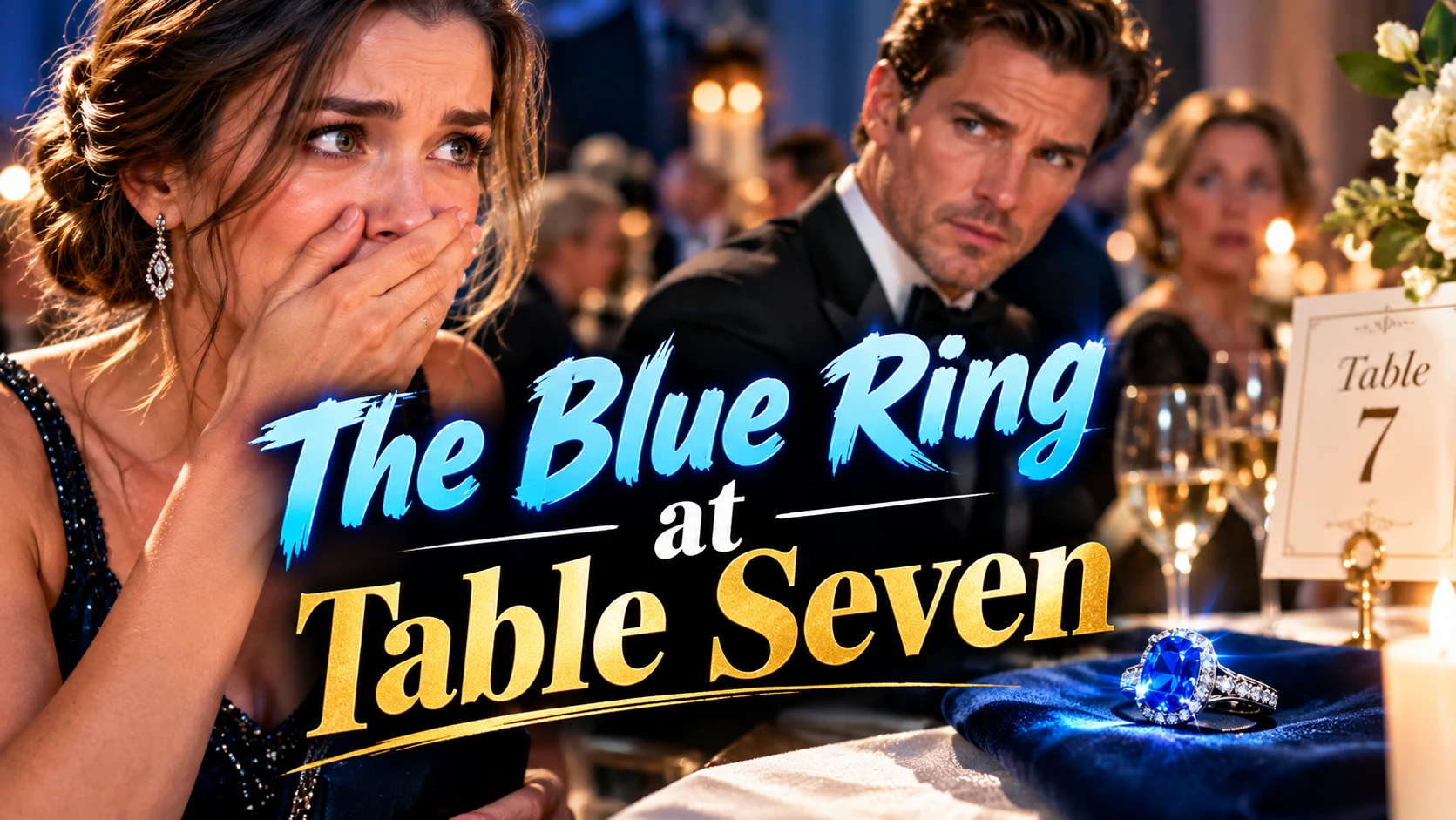
"Clear my father's name," Mara said, holding the ring he'd worn. She was mid-service when the hand closed around the water glass and the blue stone caught the lamp light an arm's length from her face. She froze, the glass tilting in her grip, water…
The water glass tilted in Mara Vance's grip, and for three full seconds she forgot how to pour.
The room kept moving around her — the low murmur of table four, the clink of a fork against china at table nine, the distant hiss of the service door swinging shut. Ten diners ate and talked within arm's reach, and not one of them looked up. The evening service at the Alden House Hotel had its own rhythm, and Mara had been part of that rhythm for four years, twenty-two nights a week, eight hundred and eleven shifts. She knew the exact weight of a full water glass, the precise angle at which the surface trembles before it spills. She had never once spilled.
Her hand did not move now. The glass stayed tilted, the water quivering against the rim, and her eyes locked on the blue stone that had just caught the lamp light an arm's length from her face.
The ring was gold, thick and worn at the edges, the way gold gets when it has been on the same hand for thirty years. The stone was a deep blue — not sapphire, something darker, almost slate, with a small chip at the lower left corner that caught the light differently than the rest. It was a specific chip. A particular chip. The kind of chip you notice in a photograph you have folded and unfolded a thousand times, in a uniform pocket, in the dark, in the staff bathroom at the end of a double shift, until the creases of the paper match the creases of your memory exactly.
Mara had that photograph in her pocket right now. She could feel it against her hip, folded into a square the size of her palm, the edges soft from years of handling. It had been her father's before it was hers. He had kept it in his wallet, and then he had kept it in a shoebox under his bed, and then he had died, and the shoebox had come to her, and she had carried the photograph ever since because it was the only picture she owned of both her parents together, standing in front of a building with doors that had closed on them.
The man at table seven lifted his hand to reach for the coffee cup, and the ring turned in the light.
"Miss."
Mara blinked. The man's voice was flat, patient, the voice of someone who has asked the same question many times and expects the same answer.
"Is there a problem with my table?"
"No," Mara said. Her voice came out steady. That was her gift, the thing the head waiter had noticed in her first week: Mara Vance did not shake. In a burning kitchen, in a sudden downpour of a hundred covers with two call-outs and a broken ticket printer, Mara Vance's hands stayed flat and her voice stayed level. "That ring. Where did you get it?"
The man across the table was not someone she knew by name, but she knew what he was. She had seen him twice before, always in the navy three-piece suit, always at this table, always with the same silver tie pin shaped like a small key. The other servers called him "the owner" without knowing which owner. The Alden House had been run by the same family for three generations, and the family had a habit of showing up unannounced to watch the room like a clock they had built.
"Miss," the man said again, and now there was a warning in it, the polite edge of a man who is not used to being questioned by staff. "Why do you want to know about my ring?"
Mara set the glass down on the white cloth. Her hand did not tremble. The water settled, and she watched the man's face, and she heard herself say the words she had practiced in the mirror a hundred times but had never once said out loud to another living person:
"My father wore that ring."
The man's hand stopped mid-air over the coffee cup.
The room kept eating. Table four laughed at something. Table nine asked for more bread. The busboy cleared a plate on the other side of the room, and the service door hissed again, and none of it touched the small square of silence that had opened at table seven.
"Your father," the man repeated. He said it like he was tasting the word for a lie. "What was your father's name?"
Mara reached into her uniform pocket. She did it slowly, the way you handle something fragile, and she unfolded the photograph and laid it flat on the white cloth, beside his coffee cup, next to the ring that was still on his hand.
The photograph was black-and-white, faded at the edges, creased down the middle from a lifetime of folding. Two people stood outside a building with wide front doors and a marquee that read THE ALDEN HOUSE in letters that were still legible if you knew where to look. The man was mid-thirties, lean, dark curly hair, fair skin, a simple grey work shirt. The woman beside him was a few years younger, soft brown hair to her shoulders, olive skin, a faded pale-blue waitress uniform. The man's hand rested on the woman's shoulder, and on that hand, clearly visible even in the faded print, was a gold ring with a dark blue stone.
"Owen Hale," Mara said. "That's my father."
The man across the table did not move.
He looked at the photograph. He looked at her face. He looked back at the photograph, and Mara watched him check her eyes against the eyes in the picture, the same way she had checked her own face in the mirror her whole life, looking for a father she had never met.
The man's hand came off the coffee cup. It hovered over the photograph, not touching it, and Mara saw his fingers tremble — the first crack in the steel of him.
"Where did you get this?" he asked, and his voice had changed. It was thinner now, younger, the voice of a man who has just been handed a key to a door he thought was bricked over.
"That's my father," Mara said again. "That's my mother. Her name was Cora. She was a waitress here."
The man's jaw moved. He looked up at her, and for the first time, he really looked — not at her uniform, not at her name pin, but at her face, feature by feature, as if he were reading a document he had been told didn't exist.
"My father didn't leave," Mara said.
The words came out flat, the way she had practiced. She had learned, in four years of serving tables, that if you let your voice move, it moves in a direction you can't control in front of a full dining room. So she kept it still.
"He was told to leave. He fell in love with a woman this family decided wasn't good enough for him, and the day he refused to end it, they stopped being a family to him."
The man stared at her.
"When my mother sent the ring back," Mara said, "she wrote one letter with it. The last thing she ever sent back to this building."
The man was quiet for a long moment. His hand was still hovering over the photograph. His face had gone pale under the deep tan, the way a man's face goes pale when the floor drops out from under him.
"I never received a letter," he said.
Mara heard it. She heard the sentence land, and she watched the man hear it too, because even as he said it, she could see him replaying it, hearing his own words the way she had heard hers a hundred times in the mirror.
"What I received was a package. My father put it in my hands and told me it was over."
The man's eyes went to the ring on his hand. He looked at it as if he had never seen it before.
"Sir," Mara said, slower now. "How many things do you think she mailed?"
The man's jaw tightened. He pulled cash from his wallet — a folded bill, more than the meal cost — and set it beside the cup. He stood up, and he walked out of the dining room, and he left the photograph on the table.
Mara picked it up. She refolded it carefully, the same creases, the same square, and put it back in her pocket beside her order pad. She finished her section, because that was the job. She refilled water at table four, cleared table nine, carried the tray to the service station, and did not look at the empty chair at table seven.
But she felt the photograph against her hip, and she knew, with a certainty she had carried her whole life, that something in that building had just cracked open.
She just didn't know what was going to crawl out.
Advertisement
You may also like

She Paid for Five Business-Class Seats to Maui. At the Gate, Her Ticket Was Already in Another Woman's Hand.
"Her seat is confirmed. You can head home." That was the sentence Margaret Ellsworth heard at Gate B12 in Chicago O'Hare, six months after…

A Year After the Divorce, He Mocked Her in the Maternity Wing — Then the Elevator Opened
"Best decision I ever made — leaving you," Derek called out across the maternity wing, loud enough for the whole corridor to hear. Mara…

He Threw Coins at Her Shoes in the Showroom She Secretly Owned
"Three million dollars for this car," Derek said, then reached into his blazer and threw crumpled bills and loose change across the marble floor…

On New Year's Eve She Served Dinner to One Person While Fourteen Guests Watched
"My family is starving! Table's not set!" Vanessa screamed across the kitchen, both palms slamming flat on the island — and Ruth kept eating,…

She Told the Soldier to Leave Her Own Lake House — Then the Humvee Rolled Up
"Pack up and leave, today." Carla jabbed her finger at the driveway glass like she was shooing a stray dog off her porch. Dana…

Five Years After the Divorce, He Walked Up to Her at the Wedding — Then a Little Girl Called Her Mom
"Leaving you was the best decision I ever made," Douglas said, and waited for Mara's face to break. Five years of rehearsal, and he…