Chapter 1
Story: At the Records Counter She Called Me a Kidnapper, Then the Clerk Set Down a Dusty Tape
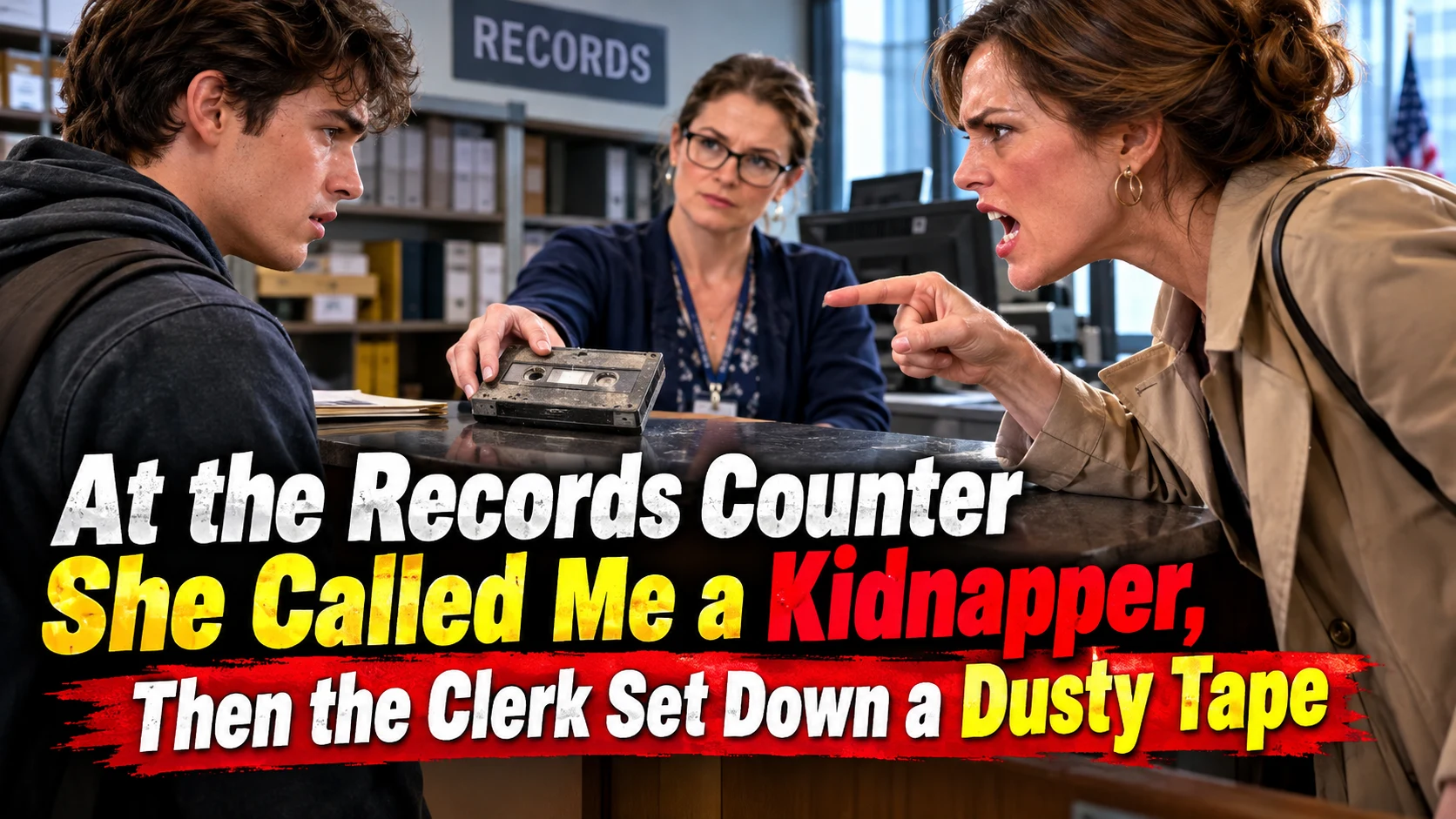
"You lost her yourself," Ruth said, right there at the county counter, loud enough for the whole room. Elijah has spent six years defending the one person who never left his side at a single hearing. Now the clerk sets a dusty tape on the…
The slap cracked through the county property-records room like a gunshot.
Elijah Mercer's head snapped left, his silver watch tapping the grey laminate counter as his palm shot out to steady himself. The thin red mark on his cheekbone bloomed hot, and he could feel every pair of eyes in the room — the clerk behind the counter, the two researchers at the far table, the security guard by the door — all of them frozen, all of them watching.
Ruth Pendleton lowered her hand slowly, deliberately, smoothing the sleeve of her white silk blouse as if the slap had cost her something. Her silver-blonde bob caught the hard midday sun slanting through the tall windows, and her pearl studs glinted as she tilted her head.
"You lost her yourself," she said, her voice honeyed and slow, carrying to every corner of the room. "Six years, Elijah. Six years of hearings, and you never once asked yourself why a stranger would break into a lake cottage to take a child who meant nothing to him."
Elijah's jaw tightened. He could feel the sting in his cheekbone, the heat spreading down his neck. Behind him, he heard the soft creak of the wheelchair, and he didn't have to turn to know Avery was there, her small hands gripping the collar of her cream cardigan, her short twists held back with the green band she'd worn every single day since she was nine years old.
"Ruth." His voice came out level, quieter than he intended. "Not here."
"Where, then?" She stepped closer, her slate trousers whispering against the worn linoleum. "You've had six years to ask the right questions. Six years of me driving you to every hearing, holding your hand in every parking lot, telling you we'd find her. And now you want to dig through county records like some amateur detective, dragging Avery to a dusty room full of deed books."
Isaac Mercer stood at the far end of the counter, stocky and silent, his shaved head bowed over a thick leather-bound volume. His round glasses had slipped down his nose, and he hadn't looked up once since Ruth's palm had connected with Elijah's face. The padded envelope under his left arm crinkled as he shifted his weight.
"Isaac." Ruth's voice cut across the room. "Tell your brother this is a waste of everyone's time."
Isaac's jaw worked. He turned a page in the deed book, his brown canvas jacket straining at the shoulders, and said nothing.
Elijah watched his brother for a long moment. Isaac had been quiet his whole life, the kind of quiet that made people forget he was in the room. But he'd also been the one who'd called Elijah at 2 a.m. the night Avery vanished, his voice shaking as he said, "Something's wrong at the cottage. Get here now." He'd been the one standing in the driveway when Elijah arrived, the one who pointed toward the open door and whispered, "She's gone."
And he'd been the one, three weeks ago, who'd left a single sheet of paper on Elijah's kitchen table. A copy of a deed, old and yellowed, with a name Elijah had never seen before.
The name of his own bloodline.
"Your family," Isaac had said that night, standing in Elijah's doorway with rain dripping off his jacket. "Before your father changed his name. The cottage belonged to them first."
"When?" Elijah had asked.
"A long time ago." Isaac had looked down at his sneakers. "Before you were born. Before me. But someone kept the paperwork."
"Who?"
Isaac hadn't answered. He'd just pressed the paper into Elijah's hand and said, "The county clerk has something for you. A tape. From the cottage."
Now, standing in the records room with Ruth's slap still burning on his cheek, Elijah understood why Isaac had been so careful. Why he'd waited until Ruth was out of town. Why he'd driven Elijah here himself, past the diner and the hardware store and the lake road, and parked at the county building without saying a word.
The clerk behind the counter — a thin woman with short nails and a plain steel band on her ring finger — had been watching the whole scene with the careful neutrality of someone who'd seen worse in this building. She cleared her throat.
"Mr. Mercer?"
Elijah turned toward her, and for the first time he noticed the dusty VHS tape on the counter between them. It was unmarked, the plastic yellowed with age, a faded paper label stuck to the top with aged tape.
"I pulled it from the archive," the clerk said, her voice low. "It was filed under the old property owner, the one on the deed your brother brought you. The label says it came from the lake cottage's security camera, mounted high in the corner of the main room. Someone checked it out to the archive twenty years ago and never returned it."
Ruth stepped forward, her eyes narrowing. "That's not possible. That cottage belonged to my husband's family. There was no security system."
The clerk looked at her, then at Elijah. "The label is marked 'do not copy' in handwriting that doesn't match any of our staff."
Elijah reached for the tape, his fingers brushing the dusty plastic. The handwriting on the label was sharp, angular, unmistakable.
He knew that handwriting better than he knew his own.
It was Ruth's.
The room went very quiet. Elijah heard the distant tick of a wall clock, the muffled traffic through the tall windows, the soft hiss of the heating vent. Behind him, Avery shifted in her wheelchair, the fabric of her denim dress whispering against the armrest.
"Play it," Elijah said.
Ruth's laugh was sharp, brittle. "Elijah, this is absurd. That handwriting isn't mine — I've never touched that tape in my life."
"Play it," Elijah repeated, his eyes still on the dusty plastic.
The clerk glanced between them, then reached for the tape. From somewhere behind the counter, she produced a small television on a wheeled cart, the kind of ancient machine that had been obsolete for a decade. She slid the tape into the slot and pressed play.
Static hissed across the screen. Then the image steadied: a sunlit cottage room, familiar hardwood floors, a low wooden table by the window, the same cream-colored walls Elijah remembered from a hundred summer visits. The camera was mounted high in the corner, looking down at a scene that made his stomach drop.
A small figure in a cream cardigan stood beside the low table, her back to the camera.
Avery.
Beside her, two men. One was tall, broad-shouldered, his face turned toward the small figure, his hands gripping her shoulders from behind. The second man stood at the tall man's left, one hand flat on the table edge.
The tape wobbled, the date stamp in the corner — a date Elijah had memorized, replayed, dreamed about for six years.
The night Avery vanished.
But there was no stranger breaking in. No masked intruder through a window. No struggle in the dark. Instead, the tall man pressed Avery down toward the table, her small hands splayed on the wood, her mouth open in a scream that the silent tape couldn't carry.
And the tall man's face — the camera angle was perfect, the light from the window falling across him — was not a stranger's.
Elijah's own face stared back at him from the screen.
He'd been there that night. He'd been there, and he'd stood in the doorway of the cottage, his one hand on the door frame, watching.
Advertisement
You may also like

She Paid for Five Business-Class Seats to Maui. At the Gate, Her Ticket Was Already in Another Woman's Hand.
"Her seat is confirmed. You can head home." That was the sentence Margaret Ellsworth heard at Gate B12 in Chicago O'Hare, six months after…

A Year After the Divorce, He Mocked Her in the Maternity Wing — Then the Elevator Opened
"Best decision I ever made — leaving you," Derek called out across the maternity wing, loud enough for the whole corridor to hear. Mara…

He Threw Coins at Her Shoes in the Showroom She Secretly Owned
"Three million dollars for this car," Derek said, then reached into his blazer and threw crumpled bills and loose change across the marble floor…

On New Year's Eve She Served Dinner to One Person While Fourteen Guests Watched
"My family is starving! Table's not set!" Vanessa screamed across the kitchen, both palms slamming flat on the island — and Ruth kept eating,…

She Told the Soldier to Leave Her Own Lake House — Then the Humvee Rolled Up
"Pack up and leave, today." Carla jabbed her finger at the driveway glass like she was shooing a stray dog off her porch. Dana…

Five Years After the Divorce, He Walked Up to Her at the Wedding — Then a Little Girl Called Her Mom
"Leaving you was the best decision I ever made," Douglas said, and waited for Mara's face to break. Five years of rehearsal, and he…