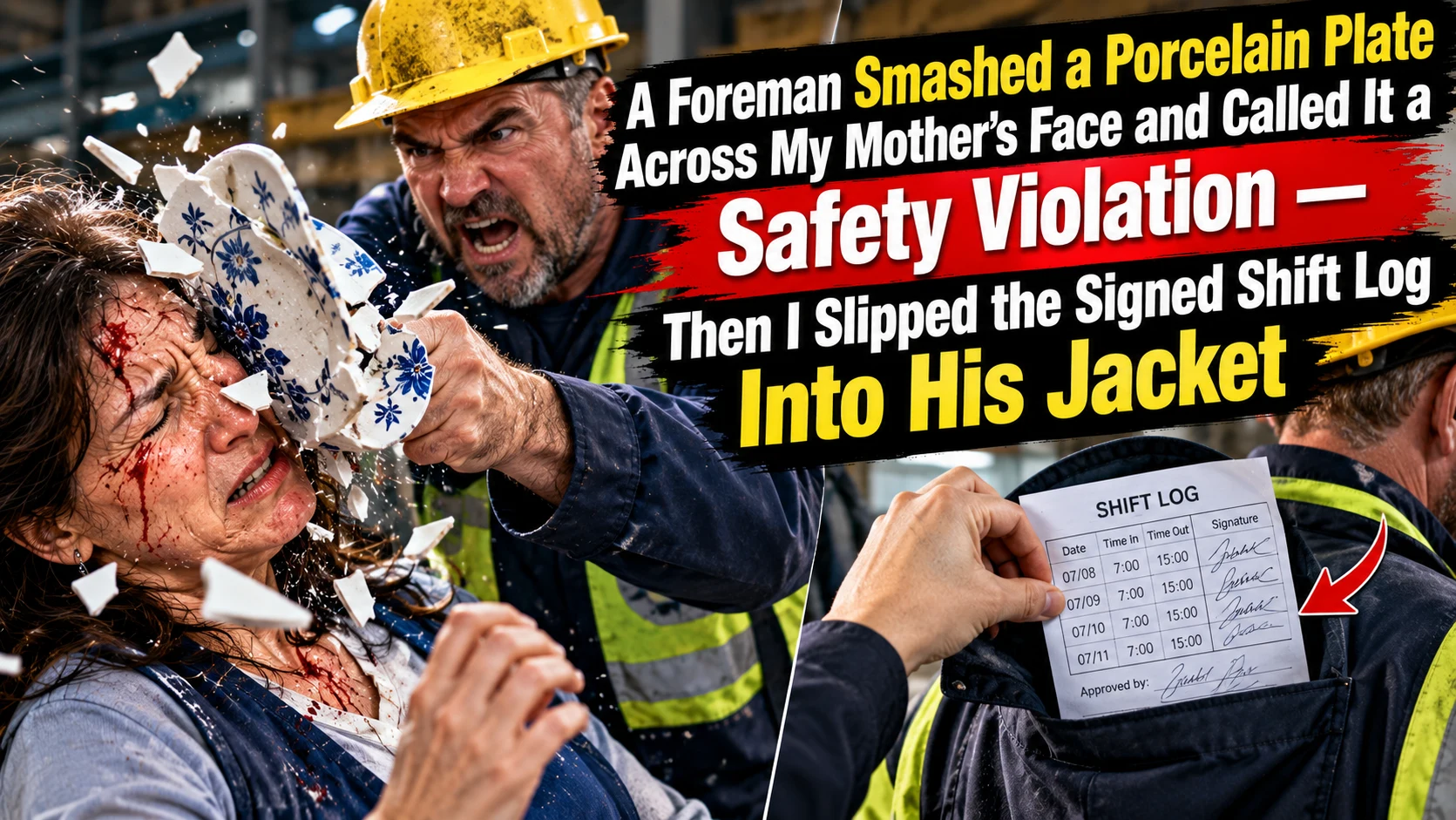
A Foreman Smashed a Porcelain Plate Across My Mother's Face and Called It a Safety Violation — Then I Slipped the Signed Shift Log Into His Jacket
Chapter 1
The plate hit my mother's face before she could finish the sentence.
The sound was not a crack. It was a wet, hollow slam, the kind of noise a body makes when it is caught by surprise, and then the porcelain broke apart and the coffee went everywhere. The cup had been half full, still warm, and the brown liquid sprayed across the front of her faded blue uniform, darkening the worn apron, dripping off the edge of the metal break table onto the concrete floor. Shards of white plate scattered across the Formica surface, one spinning off the edge and landing at my boots.
A chair screeched back somewhere behind me. Somewhere else, a woman gasped. But most of the cafeteria went quiet in that first second, the way a room goes quiet when something violent happens and no one is sure yet whether to look or to run.
My mother did not scream. That was the thing that got me. She was fifty-eight years old, she had worked this line for twenty years, and when a man smashed a plate across her face in front of thirty of her coworkers, she did not scream. She made a small sound, a grunt of shock and pain, and her hands came up to her face, and her chair tipped backward, and she caught herself on the edge of the table with her elbow, folding forward, her grey-streaked bun coming loose, reading glasses knocked sideways on the cord around her neck.
She did not scream.
Frank Hale stood over her, his empty right hand still hanging in the air where the plate had been, his knuckles white, his gold watch catching the sickly fluorescent light. His face was red. His chest was heaving. He had watched his own hand do this, and he had not stopped it, and now he was going to make sure everyone in this room understood why it had happened.
"You cost us the Johnson order, Elaine!"
His voice filled the cafeteria. He pointed at her, one thick finger stabbing the air between them, his green foreman's shirt stretched tight across his barrel chest.
"You cost us the Johnson order, and you stand there lying to my face about it!"
My mother made a noise. It came out through her hands, muffled and small.
"I didn't touch the line stop."
He was already talking over her, stepping closer, his shadow falling across her folded shoulders.
"That's your job on the line, old woman. You hear me? That's your job! I've been watching you slow down for a year. I've been writing you up for a year. And now you cost me the biggest order this plant has seen in a decade, and you want to stand there and tell me you didn't touch the line stop?"
She tried to push herself up from the table. Her hand was shaking. There was a red bloom already forming on her left cheek, dark against the pale skin, and a thin line of blood was starting to trickle from the corner of her lip where the edge of the plate had caught her.
"I didn't touch it, Frank. I was checking the time clock. I have a witness."
"A witness?" Hale laughed. It was a hard, ugly sound, and he looked around the room, inviting them to share the joke. "A witness. You hear that, folks? The old lady wants a witness. Who saw her at the clock? Who's going to stand up and admit they were watching the line instead of doing their job?"
Nobody moved. The twenty or thirty people at the nearby tables were frozen, coffee cups held halfway to their mouths, sandwiches forgotten. A man named Pete, who had worked the riveting station for fifteen years, was staring at his own lap. A woman named Rosa, who my mother had known since she was a girl, was looking at the vending machines on the far wall as if they were the most interesting thing in the world.
Nobody said a word.
"That's what I thought," Hale said. He turned back to my mother, and his voice dropped to something almost quiet, almost friendly, which was worse. "Now you listen to me, Elaine. You cost me that order. You cost this plant that order. I'm going to walk over to the manager's office right now and tell him what you did. And when I come back, your locker will be empty, and you will be gone."
My mother's hand went to her cheek again. She was trying to be brave. I could see her jaw working, the way it did when she was trying not to cry, the way it had done when my father died and when the mortgage company called and when the transmission went out on her car and she had to walk two miles to the bus stop for a week. She had never once asked me for help. She had never once complained. She had worked the line for twenty years, and she had never once been written up for anything, and now a man was going to stand over her and call her a liar and a thief of time, and the room was going to let him.
I was standing two steps behind Hale's right shoulder. He had forgotten I was there. Everyone had forgotten I was there. I was twenty-eight years old, I was a junior line worker on the assembly floor, and for the last year I had learned how to be invisible. I had learned how to keep my mouth shut when Hale berated me for being too slow, too young, too green. I had learned how to nod and say "yes, sir" and go back to my station because the alternative was losing my job, and my mother's job, and that was not a risk I could take.
But I was not following the script today.
Because yesterday, I had found something in Hale's office.
It had been an accident. I had been sent up to the glass office on the mezzanine to retrieve a shipping manifest, and Hale had stepped out to the restroom, and the folder on his desk had been lying open, and I had seen the shift log. It was dated that morning. It had his initials on the bottom, block letters, FH, pressed hard into the paper in blue pen. And it had authorized a line stop at 6:42 AM.
My mother clocked in at 6:41.
I had photocopied it. I had folded the copy into my jacket pocket. And I had stood there in Hale's office, my heart hammering, and I had told myself that I was going to do something with it, that I was not going to let him get away with what he had been doing for the last year.
But I had not expected him to break a plate across her face.
He was still talking. He was telling the room about the Johnson order, about how much money they had lost, about how the line had been down for eleven minutes because someone had hit the emergency stop, about how that someone was my mother. He was building the story with the confidence of a man who has practiced it, who has told it to himself in the mirror, who has convinced himself that it is true.
I moved.
It was a small movement, nothing that anyone would notice. I took one step forward, closing the distance between me and Hale's back. My right hand left my side and drifted toward the green jacket hanging off the back of the chair beside him. He never wore the jacket inside the cafeteria; he always draped it over the chair, kept his smokes in the inside pocket, his clipboard under the arm.
The folded shift log was in my hand. I had pulled it out of my own jacket while everyone was looking at my mother.
I slid it into his pocket.
It made no sound. The paper folded into itself, settling against the pack of cigarettes, disappearing into the green fabric.
Hale turned around, and I was back in my place, my hands at my sides, my face empty.
"You," he said, pointing at me. "Webb. You're her son. You going to stand up for her?"
The room held its breath. Pete looked up from his lap. Rosa turned away from the vending machines. Every eye in the cafeteria swung toward me.
My mother looked at me. Her face was bloodied, her cheek already swelling, and there was something in her eyes that I had never seen before. It was not hope. It was fear. Fear that I would make it worse, fear that I would lose my job, fear that I would do what she had never done and make a scene.
I looked at Hale. He was grinning. He had won, and he knew it. A junior line worker was no match for a foreman. I could shout, I could object, I could tell them all what I had seen, and it would be my word against his, and the plant manager would believe him, because the plant manager always believed him.
"Answer me, boy," Hale said. "You going to stand up for her?"
I looked at my mother. I looked at the blood on her cheek.
"No, sir," I said. "I'm sure my mother made a mistake."
The room exhaled. Hale clapped his hands together, one sharp crack that echoed off the concrete floor.
"See? Even her own son knows it. Now get her out of here, Webb. Get her down to HR, pick up a check, and get her off the floor before I change my mind about calling security."
I walked around the table and put my hand on my mother's arm. She was trembling. She looked up at me, and I could see the shame in her eyes, the confusion, the hurt — the way I had just watched her be humiliated and done nothing, said nothing, agreed with the man who had hit her.
"Honey," she whispered.
"Come on," I said. "Let's go."
I helped her to her feet. Her chair was still tipped over on the concrete. Her lunch was scattered across the table, the coffee spilled, the sandwich untouched. I didn't stop to pick anything up. I kept my arm around her and walked her toward the door.
Hale was already on his way out the other side, heading toward the plant manager's office, patting his chest.
Patting his pocket.
The pocket where I had just put the shift log.
I watched him go. I watched the green jacket disappear through the door, and I felt my own heart pounding in my chest, faster now, the way it had not pounded when he had broken the plate, the way it had not pounded when he had called her old woman.
Because now I knew what was going to happen next.
And I was not sure which one of us was going to survive it.
Advertisement
You may also like

She Paid for Five Business-Class Seats to Maui. At the Gate, Her Ticket Was Already in Another Woman's Hand.
"Her seat is confirmed. You can head home." That was the sentence Margaret Ellsworth heard at Gate B12 in Chicago O'Hare, six months after…

A Year After the Divorce, He Mocked Her in the Maternity Wing — Then the Elevator Opened
"Best decision I ever made — leaving you," Derek called out across the maternity wing, loud enough for the whole corridor to hear. Mara…

He Threw Coins at Her Shoes in the Showroom She Secretly Owned
"Three million dollars for this car," Derek said, then reached into his blazer and threw crumpled bills and loose change across the marble floor…

On New Year's Eve She Served Dinner to One Person While Fourteen Guests Watched
"My family is starving! Table's not set!" Vanessa screamed across the kitchen, both palms slamming flat on the island — and Ruth kept eating,…

She Told the Soldier to Leave Her Own Lake House — Then the Humvee Rolled Up
"Pack up and leave, today." Carla jabbed her finger at the driveway glass like she was shooing a stray dog off her porch. Dana…

Five Years After the Divorce, He Walked Up to Her at the Wedding — Then a Little Girl Called Her Mom
"Leaving you was the best decision I ever made," Douglas said, and waited for Mara's face to break. Five years of rehearsal, and he…