The Director Fired the Nursing Aide for Stealing—Then the Cabinet Fob Log Showed Whose Badge Opened It at 2:03 A.M.
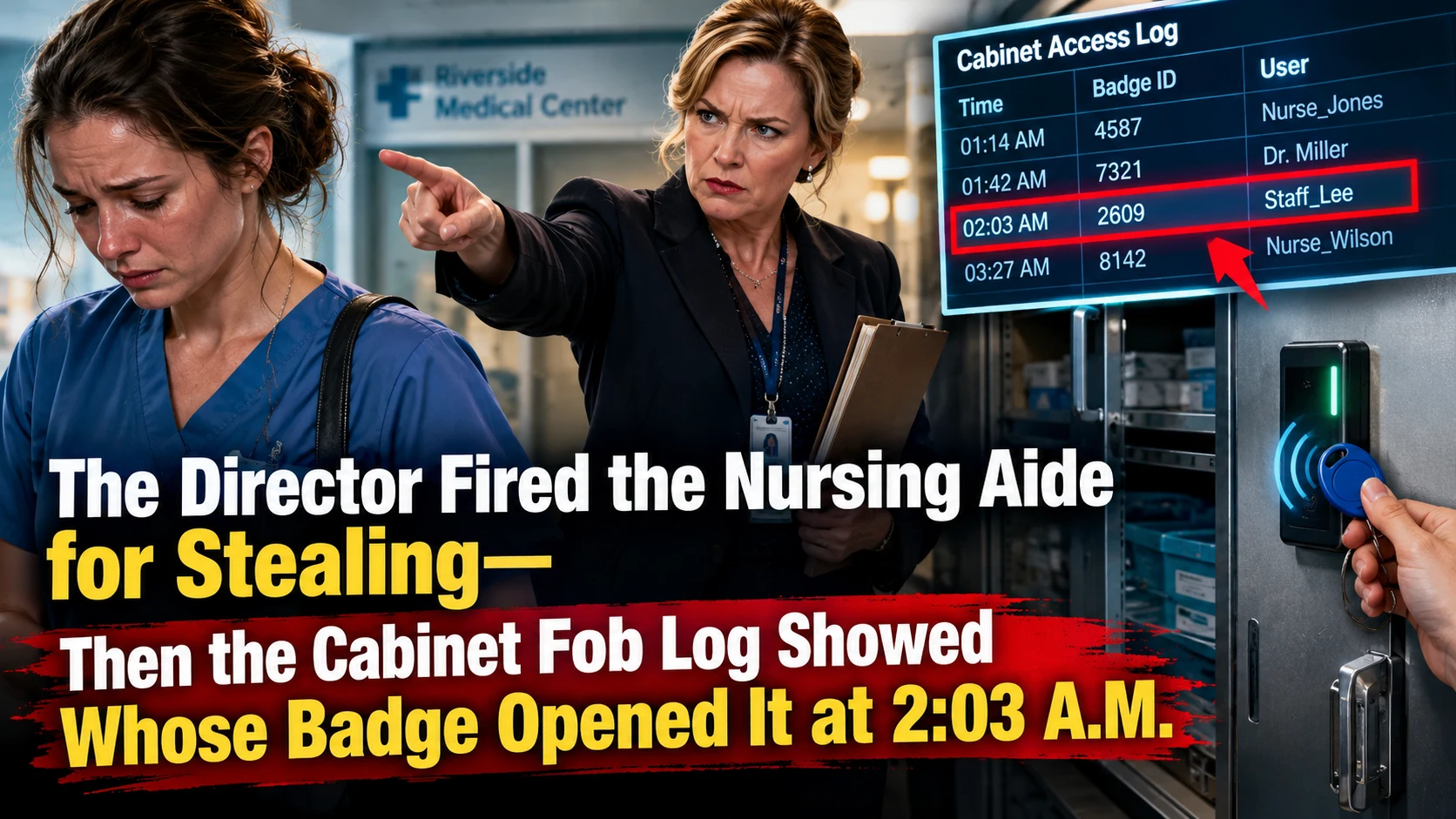
Chapter 1 : Director Yvonne Pryor's right palm came down flat on the stainless medication-room counter and the sound went through the whole dining hall like a dropped bedpan.
"You took from the cart at two a.m., Maren."
Maren Delacroix's hands were full. Both of them, wrapped around the stainless pill tray, four paper cups nested in the wells, the twelve-o'clock and six-o'clock doses for table three still not delivered. Her shoulder blades were six inches from the med cart. She had been walking the tray out the service door when Yvonne stepped in front of her, and the room on the other side of that wedged-open door had gone quiet in the particular way a room goes quiet when every single person in it has stopped chewing at the same time.
Maren did not move her hands. That was the first thing. She had learned that in year two on this floor, when a resident with advanced dementia grabbed her wrist mid-transfer: you do not pull, you do not flinch, you wait for the grip to release. Her wrists stayed level. The tray stayed level. One cup slid a half-inch in its well and stopped.
Behind her, past the open door, she could see the dining hall in pieces: the tall gray windows with the late-afternoon light coming through them flat and November-colored; the blue glow of the television nobody watched, mounted high on the far wall with the volume at twelve; the good tablecloths the activities director put out on Mondays because Monday was family day; and the families. Fourteen, maybe fifteen of them, most still in their coats because it was two-fifteen and visiting hours had only been open fifteen minutes. Some of them were halfway out of their chairs. Miss Owens at table three had her hand up like a schoolgirl, because Miss Owens always had her hand up at two-fifteen, because Miss Owens knew her own pill schedule better than the MAR did.
"Say it again," Yvonne said. "Say it in front of the families."
"I wasn't on that shift," Maren said.
Her voice came out level. It always did. She had a flat voice, she knew it; it was the thing about her that people read wrong at first, the thing that made residents nervous for a week until they figured out that the flatness was the whole job. You do not want a nurse aide whose voice cracks when your mother's sheet is wet. You want someone whose hands work while her voice holds.
"Your badge. Right now," Yvonne said.
Yvonne Pryor was fifty-four years old and she had been director of nursing at Cedar Hollow for twelve years. She was wearing the cream cardigan — the good one, the one she wore for state visits — over the gray blouse, charcoal slacks, the thin gold chain, the pearl studs. Her badge reel was clipped to the cardigan pocket with her own fob attached, and the whole reel bounced a little as she leaned forward onto the counter. Her eyes were red-rimmed. This was the thing that made it feel real to the room: the director looked like she had been crying in her office for an hour before she came out, and everyone in that dining hall had spent their adult lives reading crying women as truth-tellers.
Maren's badge was clipped to her left breast pocket, and behind it was a laminated photograph of her two children, cut down to fit inside the plastic sleeve, the boy squinting into the sun and the girl laughing with one eye closed. Six years on this floor. Four of them on nights, two of them split because her husband Darius had blown two discs in his back working warehouse and the afternoon shift paid the ninety cents more an hour that the nighttime childcare cost.
"I was home Wednesday," Maren said.
"You were on the schedule."
"The schedule's wrong."
"Your initials are on the count sheet."
The pill tray was getting heavy. It always did after about ninety seconds of standing still; the tray was designed for a moving hand. Maren's forearms started to burn and she did not shift her grip, because shifting her grip in front of fifteen families looked like a confession.
"Doses are missing out of that cabinet," Yvonne said. "Two of them. From the eleven o'clock count. It came up short this morning and I've been in my office since seven trying to figure out how to tell a family their mother's medication went somewhere else." Her hand stayed flat on the counter. "I kept hoping you'd come to me."
"Yvonne."
"I kept hoping you'd come to me," she said again, louder, and turned her head just enough that the dining hall could hear her clearly, "and instead I had to find out from a count sheet with your initials on it."
The room heard her. Maren could feel the sound move through the doorway like water finding a seam. Somebody's coat rustled. A chair leg scraped. Down at table eight, a woman in a red quilted jacket — Maren knew her, she was the daughter of Mr. Felton in room 214, she came every Monday at two-oh-five and always brought the same chocolate bars for the staff because she thought the staff liked them — the woman in the red jacket was already typing on her phone. Not calling anyone. Typing. In a group chat, probably, the one the families had, the one Maren knew existed and had never read and did not want to read.
"Then who signed the count sheet?" Maren said.
Yvonne's mouth opened.
She did not get a word out.
"I'll need the survey binder first," a voice said from behind the door.
Ada Loomis came through the service door at three-ten in the afternoon, ten minutes before her window closed and two hours after she had parked her state car in the lot by the dumpster and sat there with the engine off for eleven minutes, reading the facility's last two years of complaints, which were in a file the state kept because Cedar Hollow had been flagged once before, four years ago, for a medication discrepancy that had been resolved by staff education and never mentioned again. Ada was forty-eight years old, wore a dark green blazer over a white blouse, gray slacks, plain lanyard with a state ID, reading glasses on a chain around her neck that she had not put on her face once since she arrived. She was carrying a thick black tabbed binder against her chest with both forearms, the way you carry something you are not sure is welcome.
Yvonne did not turn around for a full second and a half. Maren counted it, because Maren was counting everything now, counting the way she counted pulse and respiration, counting to keep her hands busy because her hands were already busy and if they weren't she would have said something she could not take back.
"Ada," Yvonne said. "I didn't know you were scheduled."
"We're not scheduled," Ada said. "That's the point of me." She came around the counter and stopped a meter from the two women and set the binder down on the corner of the counter, flipped the cover, and started turning tabs without rushing. "You have a pending complaint filed by a family member at two-forty-one this afternoon, alleging diversion of a controlled substance by an unlicensed staff member. When a complaint comes in during an open survey window, I have to be on site within ninety minutes. I was already in the county."
"Which family member," Yvonne said.
"The one in the red jacket," Ada said, and did not look up. "She called the state complaint line from the parking lot. The intake person flagged it as low-confidence and I flagged it right back as high-interest, because your facility has a prior." She found the tab. "I'm not here about the complaint. I'm here because of the prior, and because the medication log for this facility shows a fob override at two-oh-three a.m. last Wednesday that doesn't match any staff member's normal shift."
The room had become a different room. Maren did not know how to describe it then and would never quite describe it right afterward, when she tried — the room still had all the same people in it, still had Miss Owens with her hand up at table three, still had the blue television muttering, still had the gray light coming flat through the tall windows and the chocolate bars sitting unopened on the activities desk in a paper sack with a smiley face drawn on the front in ballpoint pen. But it stopped being a dining hall. It became a room where people were waiting to hear the next sentence.
"The override log," Ada said, and turned the binder around so it faced the doorway, and pointed at one line, and read it out loud in a voice you would use to read a bus schedule.
"Cabinet B-seven opened at zero-two-oh-three on Wednesday November the twentieth. Badge eight-four-one-seven. Total open duration, fifty-one seconds. Doses removed, two."
Yvonne's hand was still flat on the stainless counter. Maren watched the fingers. The fingertips went white at the tips and then pink again, a slow flush coming up under the nail beds like the tide coming into a sandbar.
"Eight-four-one-seven," Ada said, "is your badge, Director Pryor."
The dining hall made no sound at all.
"Read it again," somebody said from the doorway, and it was not Maren. It was the woman in the red jacket, her phone gone, both hands flat on the table like she was braced for a bus that was going to hit the table.
Ada turned her head toward her and said, "I'd rather not read a badge number out loud three times. Twice is once too many." She looked at Yvonne. "The fob override log is generated by the cabinet, not by us. It logs who opened the door, not who was standing in front of it. But you know that. You had the logs pulled for staff training in January." She tapped the page once. "It also logs when a cabinet override is used to adjust a count."
"Because we had a broken cabinet door in the fall," Yvonne said. "We had maintenance in and out of that room for three weeks. Anybody could have—"
"Badge eight-four-one-seven is not a maintenance badge," Ada said. "It's a director badge. The maintenance crew signs in with a paper log at the front desk. I have it in the back of this binder. The last maintenance visit to that room was November the fourteenth."
Two more pieces of paper sat on the counter. Maren had not seen them come out of the binder. One was a photocopy of the count sheet for Thursday morning — the one with the rewritten initials, M.R. in a careful ballpoint that was not Maren's writing, which Maren knew for a fact because Maren signed her initials in one motion, the two letters connected, and these two letters stood apart like strangers at a bus stop. The other was a still frame printed from the med-room camera, the one mounted above the cabinet door, and the timestamps on the bottom of the still read 02:03:11 and the woman in the frame was wearing a cardigan the color of cream and the frame cut off at the shoulder because the camera's field was tight, but the sleeve was there and the sleeve was not navy.
"I have a question," Ada said. "Which is the only question I care about this afternoon. Director Pryor, who has access to the count sheet rewrite permissions on the MAR module?"
"Anyone with director-level access."
"You are the only person at this facility with director-level access."
"The regional office has it."
"The regional office has read-only access as of January, when the new system came online. I have that in a memo I could read to you." Ada put her glasses on and looked over them at Yvonne. "I'm not going to read the memo. I'm going to ask you one more time. Do you want to answer my question here, or in your office, on the record, with a witness present."
And here is the thing that Maren would turn over in her hands for weeks afterward, the thing she would eventually come to think of as the proof of the whole day: Yvonne Pryor, who had stood in that same dining hall on the day the facility won its four-star quality award and given a speech about how the families of Cedar Hollow were the beating heart of the place, did not answer the question. She did not cry. She did not run. She took her hand off the counter and looked down at it, both palms, like she was checking them for something, and then she picked up the count sheet photocopy and turned it over and put it down again and did not turn it back.
She said, "Maren, I need you to step off the floor."
And Miss Owens at table three, who was ninety-three years old and could not reliably name the current president, said in a voice that carried because her hearing aid was turned up too loud, "For what? She hasn't brought me my pills yet."
That got a sound out of the room that Maren could not name, and would not try to name, at 3:14 on a Monday afternoon in November, standing with both hands around a stainless tray that had stopped being a tray and had become the only thing in the room she could hold onto.
The sound was not laughter, exactly. It was the sound a room makes when it decides, all at once and without a vote, that it has been listening to the wrong story.
Ada turned one more tab in the binder and said, without any particular emphasis, as though she were noting the weather, "I'll also need the current shift schedule. The paper copy, not the one in the module."
Yvonne said, "Why."
"Because you called a family meeting about a Wednesday-night diversion and the schedule in your system shows the accused aide clocked in Wednesday night," Ada said. "I want to compare it against the version that was active before Thursday morning. There's a print history on the copier. The copier keeps sixty days." She closed the binder and held it against her chest the way she had carried it in. "We can do this here. Or you can call the regional office and tell them why the state is asking for your copier log."
The room got very still again, but it was a different still. It was the still of people doing arithmetic in their heads — the woman in the red jacket, who had called the state from a parking lot and would now have to explain to her own family why she had gotten a director walked off a floor; the aide at table six who was on the schedule for Thursday and had watched Yvonne hand out the count sheets that morning; the granddaughter in the doorway with her coat half off who had a copy of last month's call-light report in her bag and had never known who to give it to.
Maren set the pill tray down on the counter. It took both hands and she did it slowly, because the doses for table three were still in it and Miss Owens was still waiting, and some things did not stop being true just because the floor had tilted.
She slid the tray across the stainless toward the med cart, toward the locked cabinet with the keypad she had never had a code for, and she said to Ada, in the level voice that had made residents nervous for one week apiece until they learned better: "Can I finish her pills first?"
Ada said, "Yes."
And Yvonne Pryor, who had been speaking for the room since two-fifteen that afternoon, did not say anything at all.
Advertisement
You may also like

My Uncle Slapped Me at the Country Club and Called Me a Thief — But I Was Already Holding the Chit He Signed
My uncle's palm cracked across my cheek at the country-club lunch table and he shouted that I had stolen a member number that never…

The HOA President Swiped My Pool Badge and Called Me a Squatter — Then I Held Up the Deed He Notarized Himself
Dale Brandt ripped my pool badge out of my hand in front of forty neighbors and told me squatters don't get to swim. My…

The Vice Principal Tore Up My Transfer Slip at the Pep Rally — Then the Attendance Clerk Walked In With His Own Initials
Coleman Pruitt tore my transfer slip in half at the pep rally, held the pieces above my head, and told eleven hundred people I…
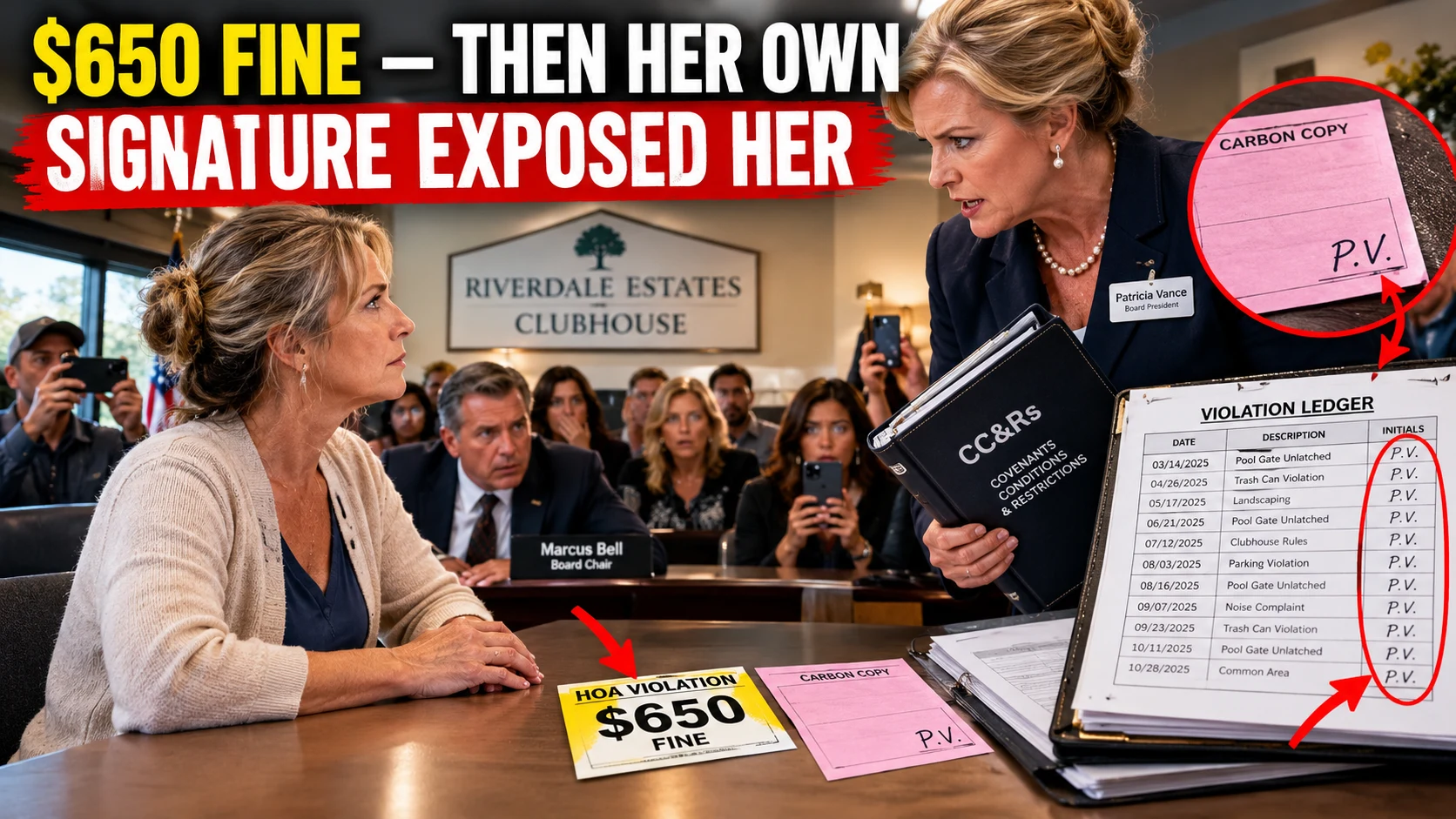
The HOA President Fined Me $650 for a Pool Gate I Never Touched — Then I Held Up the Pink Carbon Copy With Her Own Initials on It
"You left the pool gate unlatched again," Patricia Vance said, sliding the $650 violation sticker across the folding table, "and this time the board…
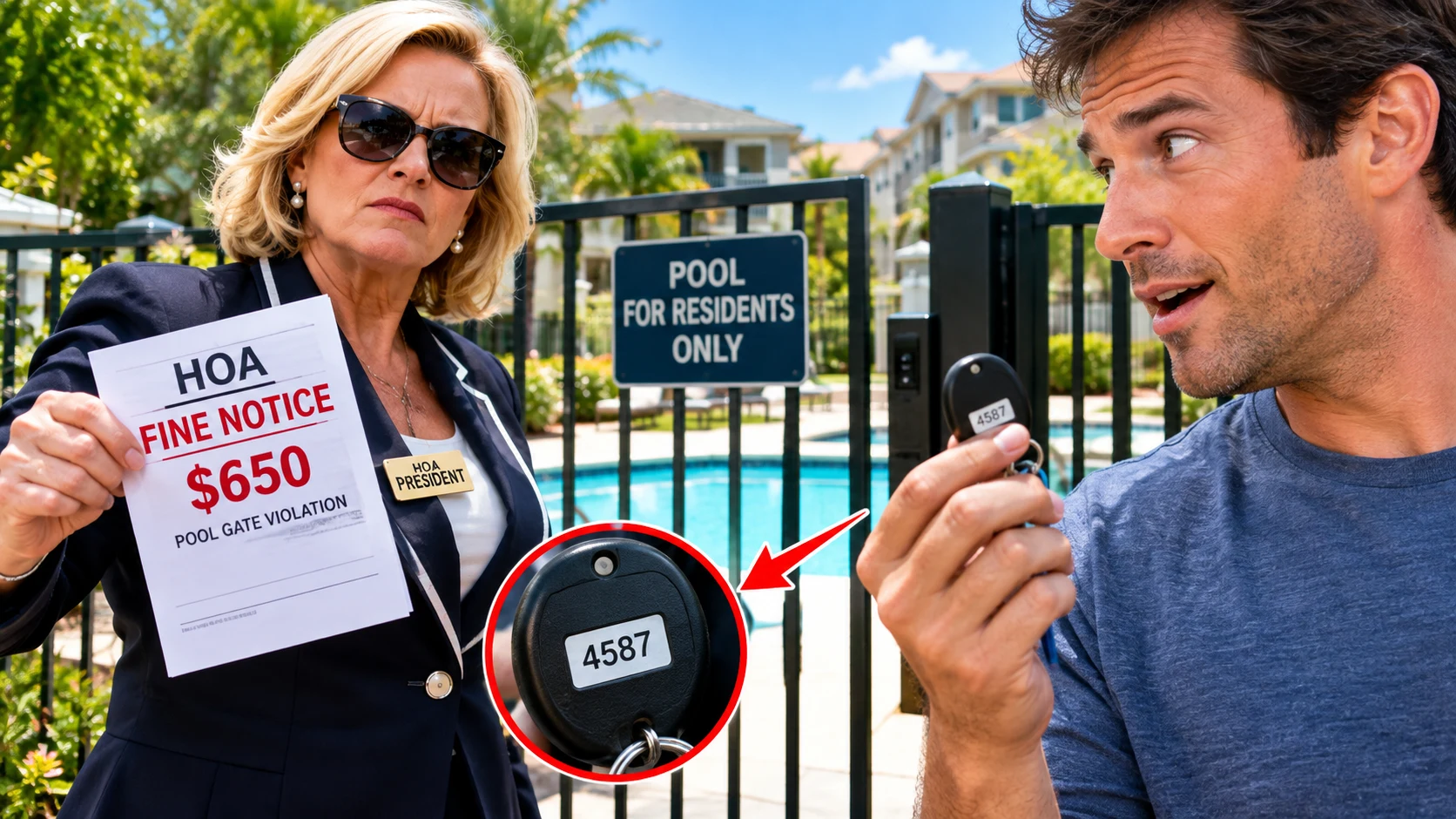
The HOA President Fined Me $650 for a Pool Gate — Then the Log Showed Her Own Fob at 2 A.M.
The violation sticker landed on the folding table in front of me dated April 12 — the night I was three states away at…

She Shamed Me for a Junkyard Yard — My Doorbell Cam Caught Who Really Dumped It
"Your junkyard is why my property value dropped, Frank!" Brenda slammed the violation photo down on the table, and the whole clubhouse leaned in…